

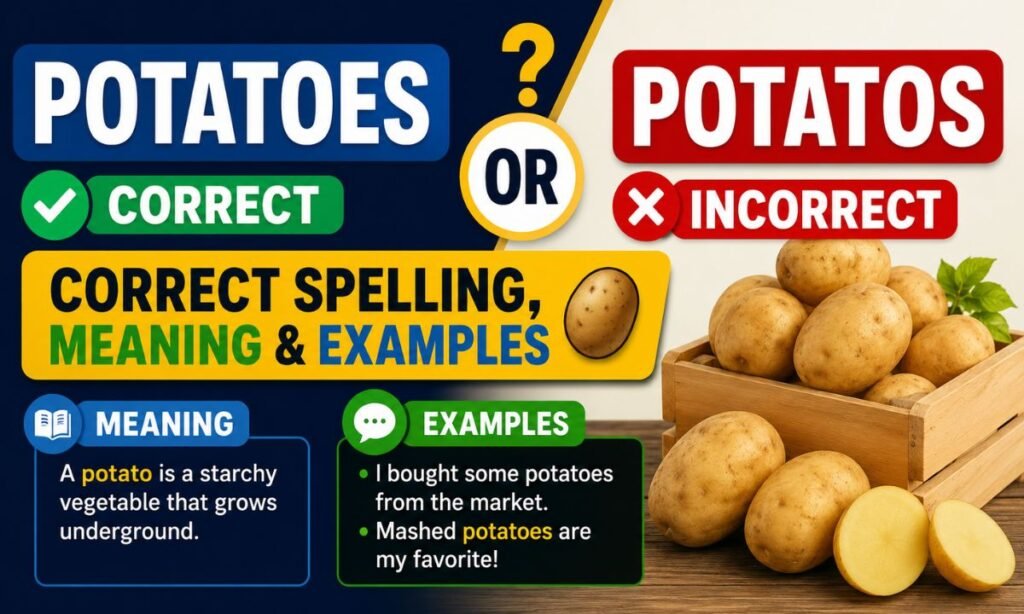
Quick Answer: Potatoes or Potatos?
Potatoes is the correct spelling. Potatos is a misspelling and should never be used in any type of writing — formal, casual, academic, or professional. The rule is simple: when a noun ends in “-o” and is preceded by a consonant, English typically adds “-es” to form the plural. Since “potato” ends in “t-o,” it becomes “potatoes,” not “potatos.”
Understanding the Basics: Potatoes or Potatos
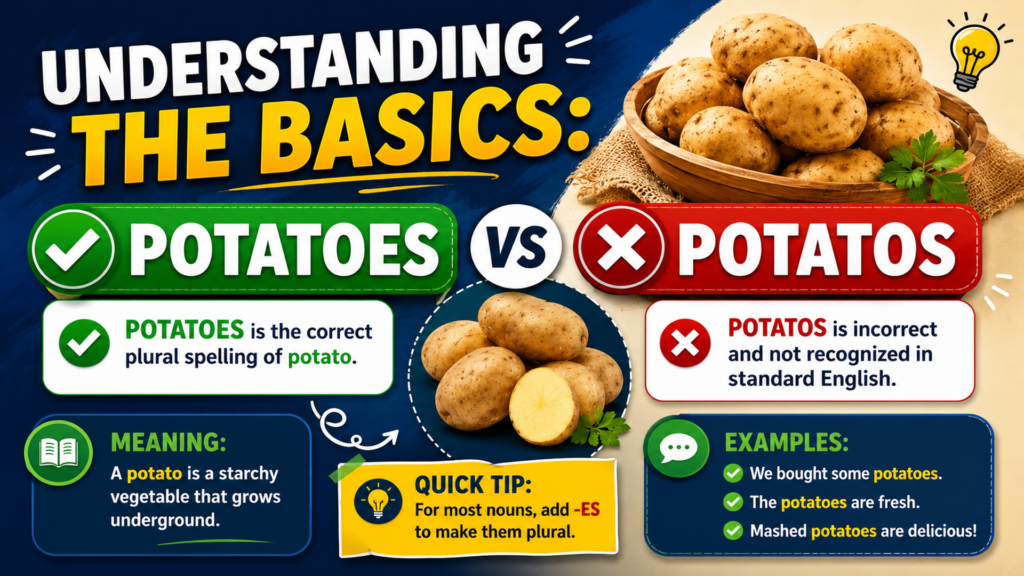
The confusion between these two spellings is one of the most common pluralization mix-ups in English. It usually happens because the singular word “potato” has no “e” in it, so writers assume the plural drops it too. But English pluralization doesn’t always follow the most obvious path, and “potato” is one of the words that requires the extra “e” before the “s.”
Comparison Table
| Spelling | Correct? | Notes |
|---|---|---|
| Potatoes | ✅ Correct | Standard plural of “potato” in all English dialects |
| Potatos | ❌ Incorrect | Common misspelling; never accepted in standard writing |
| Potato’s | ❌ Incorrect (unless possessive) | Apostrophe is only for possession, not plurals |
Uses: Correct Meanings &
What Does “Potato” Mean?
A potato is an edible tuber that grows underground and is a staple food in cuisines around the world. It’s used in countless dishes — from fries and mashed potatoes to soups and stews. The plural form, “potatoes,” simply refers to more than one of these tubers.
Examples
- I bought five potatoes at the farmer’s market.
- Roasted potatoes make a great side dish.
- The chef diced the potatoes before frying them.
Sentence Breakdown
In each sentence above, “potatoes” functions as a plural noun — the object or subject referring to multiple potato tubers. Notice the pattern: singular “potato” always gains an “e” before the “s” when it becomes plural.
Test Tip 💡
If you’re ever unsure while writing an exam, email, or essay, remember this trick: potatoes has an “e,” and potatoes are edible — pairing “e” with “edible” can help the spelling stick in your memory.
Why “Potatos” Is Incorrect
“Potatos” breaks the standard English rule for nouns ending in “-o” after a consonant. It’s a visual and phonetic mix-up — when spoken aloud, “potatoes” and “potatos” sound nearly identical, which is likely why the incorrect version keeps appearing in casual writing, texts, and even some restaurant menus.
Case Study Section
Workplace Email Example 📧
Correct: “Hi team, please confirm the delivery of the potatoes for Friday’s catering event.”
Incorrect
“Hi team, please confirm the delivery of the potatos for Friday’s catering event.”
Even a single misspelled word like this can make a professional email look careless, especially in industries like food service, hospitality, or publishing where attention to detail matters.
Grammar Rules Explanation
General Rule
English nouns ending in “-o” form their plurals in one of two ways:
- Consonant + “-o” → add “-es”: potato → potatoes, tomato → tomatoes, hero → heroes, echo → echoes
- Vowel + “-o” → add “-s”: radio → radios, video → videos, studio → studios
Since “potato” ends with a consonant (“t”) before the final “o,” it falls into the first category and takes “-es.”
Common Mistakes
- Dropping the “e”: writing “potatos” instead of “potatoes”
- Adding an apostrophe: writing “potato’s” when referring to more than one potato
- Confusing pronunciation with spelling, since both versions sound alike when spoken quickly
Similar Grammar Confusions
| Singular | Correct Plural | Incorrect Plural |
|---|---|---|
| Tomato | Tomatoes | Tomatos |
| Hero | Heroes | Heros |
| Echo | Echoes | Echos |
| Photo | Photos | Photoes |
| Piano | Pianos | Pianoes |
Notice that some “-o” words (like photo and piano) only add “-s,” not “-es.” This is one of the trickier exceptions in English and a major reason so many people second-guess themselves with “potato.”
Usage in Different Contexts
Everyday Conversation 🗣️
In casual speech, no one really notices the spelling — but if you’re texting a recipe or grocery list, using “potatoes” keeps your writing clear and consistent.
Professional Writing 💼
In reports, emails, or menus, correct spelling reflects professionalism. A misspelled “potatos” on a printed menu or press release can come across as sloppy.
Creative Writing ✍️
Fiction writers and poets should still use “potatoes” unless intentionally stylizing dialogue or an informal character’s voice — even then, it should be a deliberate choice, not an accidental error.
Social Media and Texting 📱
While informal platforms are more forgiving, using “potatoes” correctly still helps your captions, reviews, and posts look polished and easy to trust.
Why It Matters
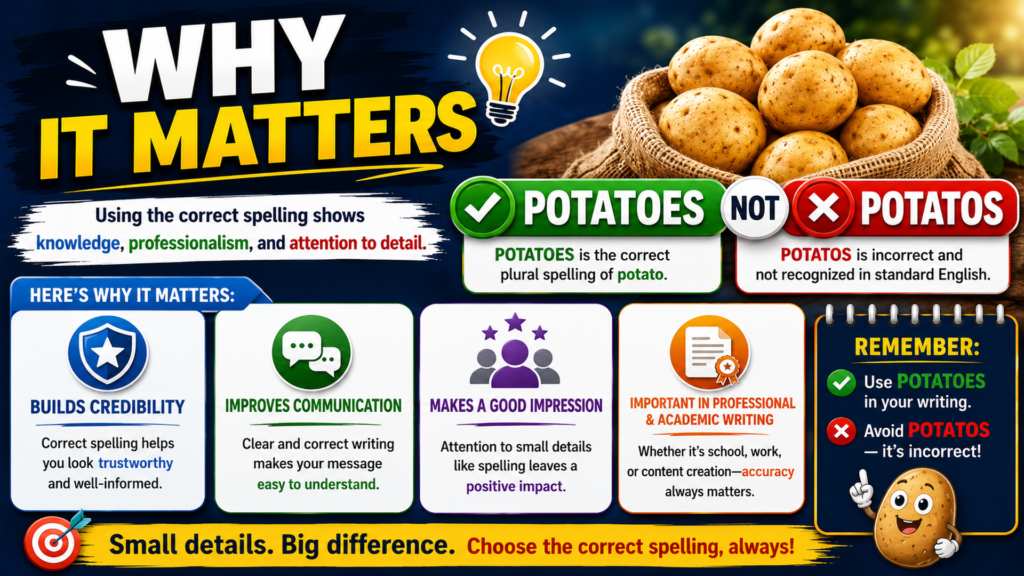
1. Better Clarity
Correct spelling avoids any ambiguity about what you mean, keeping your writing easy to read and understand.
2. Professionalism
Whether it’s a business email, resume, or blog post, accurate spelling signals attention to detail and credibility.
3. Digital Writing Accuracy
Search engines, spell-checkers, and readers all favor correctly spelled content, which also helps your writing rank better and appear more trustworthy online.
Special Exception
There isn’t a regional or dialect-based exception here — “potatoes” is correct in both American and British English. Unlike some words that differ across dialects (like “color” vs. “colour”), the plural of “potato” stays the same everywhere.
Quick Recap Checklist ✅
- Use potatoes, never potatos
- Remember the rule: consonant + “-o” → add “-es”
- Don’t confuse plural “potatoes” with possessive “potato’s”
- Applies the same way in American and British English
- Similar words: tomatoes, heroes, echoes
Practice Examples
Example 1
Incorrect: We planted potatos in the backyard garden. Correct: We planted potatoes in the backyard garden.
Example 2
Incorrect: The recipe calls for three large potatos. Correct: The recipe calls for three large potatoes.
Example 3
Incorrect: She peeled the potatos before boiling them. Correct: She peeled the potatoes before boiling them.
Frequently Asked Questions: Potatoes or Potatos
Is “potatos” ever correct?
No. “Potatos” is always a misspelling in standard English, regardless of context or region.
Why does “potato” take “-es” instead of just “-s”?
Because it ends in a consonant followed by “-o,” which is the pattern that typically requires “-es” in English plurals.
Is “potatoes” the same in British and American English?
Yes, the spelling “potatoes” is identical and correct in both British and American English.
What’s the plural of “tomato”?
“Tomatoes,” following the same consonant + “-o” rule as potato.
How can I remember the correct spelling?
Think of the phrase “potatoes are edible” — the shared “e” helps lock in the correct spelling.
Conclusion
The spelling debate between “potatoes” and “potatos” has a clear, unchanging answer: potatoes is correct, and potatos is a common but incorrect misspelling. The rule comes down to a simple pattern in English pluralization — nouns ending in a consonant plus “-o” usually take “-es.” Once you connect “potato” to similar words like “tomato” and “hero,” the correct spelling becomes second nature. Whether you’re writing a grocery list, a professional email, or a recipe blog, sticking with “potatoes” keeps your writing accurate, polished, and easy to trust.
