

If you’ve ever paused mid-sentence wondering whether to type “I’ll pick up the kids” or “I’ll pickup the kids,” you’re not alone. This is one of the most common word-form mix-ups in English, and it trips up native speakers just as often as learners.
The confusion makes sense. “Pick up,” “pickup,” and even “pick-up” all look related, sound identical, and often show up in the same sentence. But each one plays a different grammatical role, and using the wrong one can make an email, resume, or text message look careless.
This guide breaks down the correct spelling, meaning, and usage of “pick up” vs. “pickup” with clear rules, real examples, and quick memory tricks so you never second-guess yourself again.
Quick Answer: Pick Up or Pickup?
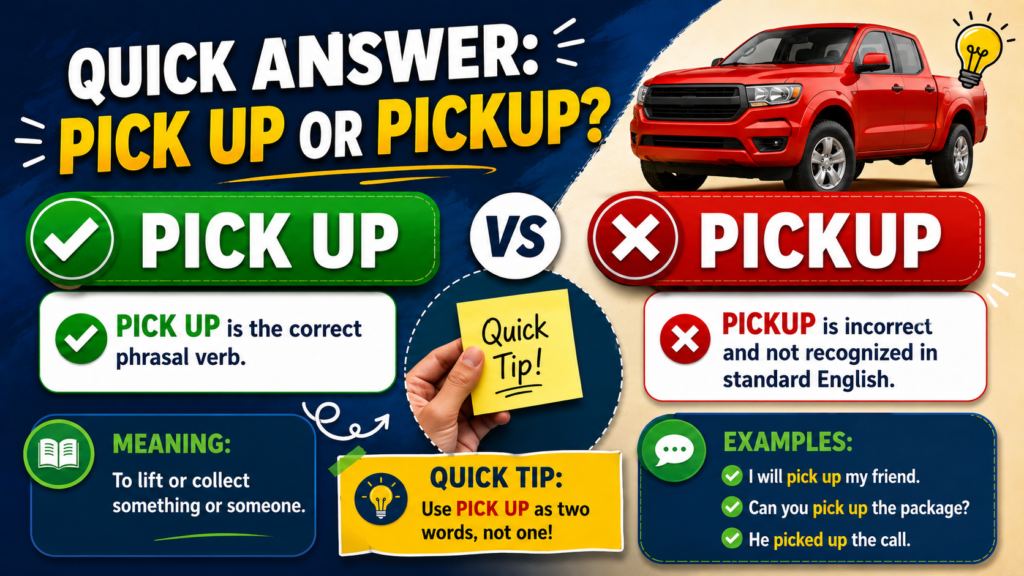
“Pick up” (two words) is a verb — it describes an action, like collecting, lifting, or grabbing something. “Pickup” (one word) is a noun or adjective — it names a thing, event, or type, like a pickup truck or a same-day pickup.
Simple test: if the word is doing something in the sentence, use two words. If it’s naming something, use one word.
Understanding the Basics: Pick Up or Pickup
English is full of word pairs that split into a verb form and a noun form depending on spacing — “log in” vs. “login,” “set up” vs. “setup,” “sign up” vs. “signup.” “Pick up” and “pickup” follow the exact same pattern.
The spacing isn’t random. It reflects a real grammatical shift: the two-word version acts, while the one-word version labels.
The Golden Rule
| Form | Part of Speech | What It Does | Example |
|---|---|---|---|
| Pick up | Verb (phrasal verb) | Describes an action | “Can you pick up the mail?” |
| Pickup | Noun | Names a person, place, thing, or event | “The mail pickup is at noon.” |
| Pickup | Adjective | Describes another noun | “He drives a pickup truck.” |
If you remember nothing else from this article, remember this: verb = two words, noun/adjective = one word.
Correct Meanings and Uses
Using “Pick Up” as a Verb
As a verb, “pick up” means to lift, collect, gather, retrieve, or acquire something — and sometimes to improve or resume.
Examples:
- Please pick up your toys before dinner.
- I need to pick up groceries on my way home.
- Sales tend to pick up during the holiday season.
- She picked up French quickly while living in Paris.
Sentence Breakdown: In “I need to pick up groceries,” pick up functions as the main verb, and groceries is the object being acted upon. Notice the space between the two words — this is what marks it as an action, not a thing.
Test Tip: Try swapping in “collect,” “grab,” or “retrieve.” If the sentence still makes sense, you need the two-word verb form: “I need to grab groceries” ✅.
Using “Pickup” as a Noun
As a noun, “pickup” refers to a type of vehicle, an act of collecting something, an increase or improvement, or an informal, unplanned gathering.
Examples:
- The delivery driver arrived early for the pickup.
- We bought a used pickup last spring.
- There’s been a noticeable pickup in customer orders.
- The kids joined a pickup soccer game after school.
Sentence Breakdown: In “The delivery driver arrived early for the pickup,” pickup is the object of the preposition “for” — it’s naming an event, not performing an action. That’s your signal to keep it as one word.
Test Tip: Try swapping in “collection,” “truck,” or “gathering.” If that fits, use the single-word noun: “We bought a used truck” ✅.
Using “Pickup” as an Adjective
As an adjective, “pickup” describes another noun, most often in fixed, familiar phrases.
Examples:
- She has a great pickup line.
- The store offers curbside pickup service.
- He’s known for his pickup basketball skills.
- The venue hosts pickup jam sessions on Fridays.
Sentence Breakdown: In “curbside pickup service,” pickup modifies “service,” telling you what kind of service it is. This adjective use almost always sits directly before the noun it describes.
Test Tip: If the word answers “what kind?” and sits right before a noun, it’s the one-word adjective form.
Case Study Section
Workplace Email Example
❌ Incorrect: “Please confirm the pick up time for tomorrow’s shipment, and let me know if the driver can pickup the pallets earlier.”
✅ Correct: “Please confirm the pickup time for tomorrow’s shipment, and let me know if the driver can pick up the pallets earlier.”
✅ Correct (alternative phrasing): “Please confirm when the shipment will be picked up, and share the scheduled pickup window.”
Notice how the first sentence needs the noun form (“pickup time”), while the second needs the verb form (“pick up the pallets”).
Real-Life Conversation
Anna: “What time should I pick you up from the airport?” Ben: “My flight lands at 6, but the pickup zone is on the second floor now.”
This exchange naturally uses both forms in the space of two sentences — a good reminder that context, not habit, should decide which one you type.
Grammar Rules Explanation
Rule 1: Use “Pick Up” for Actions
Whenever the word is functioning as a verb — something someone does — keep it as two separate words: pick up, picks up, picking up, picked up.
Rule 2: Use “Pickup” for Things or Events
Whenever the word is naming a person, object, event, or category — or describing one — merge it into a single word: pickup, pickups.
Common Mistakes
| Mistake | Why It’s Wrong | Correction |
|---|---|---|
| “I will pickup the package.” | “Pickup” is used as a verb | “I will pick up the package.” |
| “The truck pick up is broken.” | “Pick up” is used as a noun | “The pickup is broken.” |
| “He drives a pick up truck.” | Compound adjective needs one word | “He drives a pickup truck.” |
| “Can you pick-up my sister?” | Verb form doesn’t take a hyphen | “Can you pick up my sister?” |
Why These Mistakes Happen
Fast Typing When typing quickly, especially on mobile, it’s easy to merge or split words without thinking about their grammatical role.
Autocorrect Autocorrect tools sometimes “fix” spacing incorrectly, especially in casual texting apps that don’t check part of speech.
Lack of Grammar Knowledge Many English speakers were never taught the noun-verb split rule explicitly, so the error gets repeated by habit rather than intent.
Similar Grammar Confusions
This verb-vs-noun spacing pattern shows up across dozens of common English word pairs.
| Two-Word Verb | One-Word Noun/Adjective |
|---|---|
| log in | login |
| set up | setup |
| sign up | signup |
| check in | check-in |
| follow up | follow-up |
| work out | workout |
| break down | breakdown |
Once you understand the logic behind “pick up” vs. “pickup,” these related pairs become much easier to remember.
Usage in Different Contexts
Everyday Conversation
In speech, the distinction barely matters since both forms sound the same. It only becomes visible — and important — once you write it down.
Professional Writing
Business emails, reports, and resumes are judged on precision. Mixing up “pick up” and “pickup” can look like a careless error to a hiring manager or client.
Creative Writing ✍️
Fiction and dialogue often lean on the verb form to show action and movement, while the noun form appears in scene-setting or description.
Social Media and Texting
Casual platforms are more forgiving, but getting it right still signals attention to detail — something that stands out in captions, bios, and marketing copy.
Why It Matters
Clarity in Communication
The wrong form can genuinely confuse a reader for a split second, which slows down comprehension.
Example: “I’ll pickup you” reads awkwardly because “pickup” can’t take a direct object the way a verb can — the sentence needs “pick you up.”
Professionalism
Consistent, correct usage builds trust in written communication, especially in customer-facing messages, job applications, and official documents.
Better Digital Communication
Search engines, spell-checkers, and readers alike reward text that follows standard grammar conventions — it simply reads as more polished.
A useful way to think about it: word spacing isn’t decoration, it’s information — it tells the reader whether something is happening or something exists.
Special Exception
Pickup Truck
“Pickup truck” is always written as one word plus “truck,” never “pick up truck” or “pick-up truck,” even though it functions like a two-word adjective phrase. This is simply how the compound noun has standardized in modern English.
Other Fixed Expressions
These noun/adjective forms are always one word, regardless of context:
- Pickup line
- Pickup game
- Pickup artist
- Pickup basketball
- School pickup
- Curbside pickup
Quick Recap Checklist
- ✅ Use pick up (two words) when it’s a verb showing action.
- ✅ Use pickup (one word) when it’s a noun or adjective naming a thing.
- ✅ The hyphenated form “pick-up” is largely outdated — modern style guides favor “pickup” for the noun/adjective.
- ✅ “Pickup truck” is always one word before “truck.”
- ✅ When in doubt, try replacing the phrase with “collect” (verb) or “truck/event” (noun).
Which Form Should You Use?
Ask yourself one question: Is the word doing something, or is it naming something?
- Doing something → pick up (verb)
- Naming something → pickup (noun or adjective)
Practice Examples
Example 1: “Can you _____ the kids from school?” → pick up (verb — an action)
Example 2: “The _____ line for the concert wraps around the block.” → pickup (noun — naming the line)
Example 3: “I need to _____ my dry cleaning before 5 PM.” → pick up (verb — an action)
Frequently asked questions
Is “pickup” one word or two words?
It depends on usage: one word (“pickup”) when it’s a noun or adjective, two words (“pick up”) when it’s a verb.
Is “pick-up” with a hyphen still correct?
The hyphenated form is considered older style; most modern dictionaries and style guides now prefer “pickup” for the noun/adjective form.
What is the plural of “pickup”?
The plural is “pickups,” as in “The lot had three pickups parked outside.”
Is “pickup” a formal word?
Yes, it’s standard English and appears in formal writing, though “collection” or “retrieval” may sound more formal in business contexts.
How do you use “pick up” in a sentence?
Use it as a verb followed by an object, such as “Please pick up your badge at the front desk.”
Is “pickup truck” one word or two?
“Pickup” is always one word when paired with “truck” — “pickup truck,” never “pick up truck.”
Can “pickup” ever be used as a verb?
No — standard English always uses the two-word “pick up” for the verb form, even though “pickup” is common as a noun and adjective.
Conclusion
The difference between “pick up” and “pickup” comes down to one simple grammar rule: two words for actions, one word for things. Once that rule clicks, you’ll never have to pause mid-sentence again. Whether you’re writing a quick text, a business email, or a blog post, getting this small detail right adds up to clearer, more professional communication.
