

If you’ve ever paused mid-sentence wondering whether to write “shiny” or “shiney,” you’re not alone. This is one of the most common spelling mix-ups in everyday English, and it trips up native speakers just as often as English learners. The good news? The rule behind it is simple once you see it clearly.
This guide breaks down the correct spelling, explains the grammar rule that causes the confusion, and gives you practical tricks so you never second-guess yourself again.
Quick Answer: Shiny or Shiney
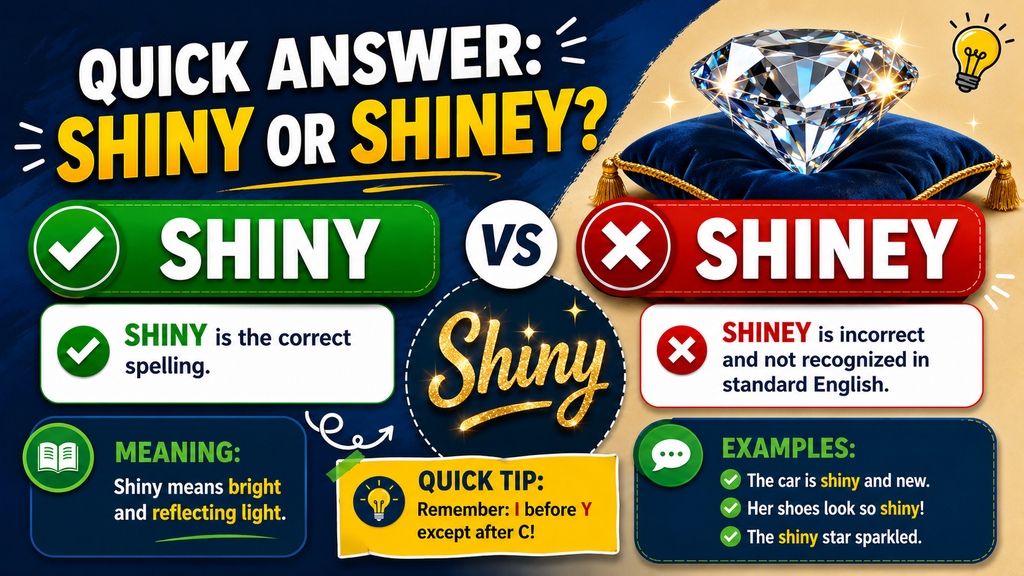
“Shiny” is the correct spelling. It’s the standard adjective form found in every major dictionary, including Merriam-Webster, Oxford, and Cambridge.
“Shiney” is a common misspelling. It shows up often in casual writing, texting, and social media, but it isn’t recognized as standard English outside of a few proper-name exceptions covered later in this guide.
Understanding the Basics: Shiny or Shiney
The confusion comes down to one small habit: when English speakers add “-y” to the end of a word, they sometimes forget to drop a silent letter that came before it.
“Shiny” is built from the base word shine plus the suffix -y. When you add “-y” to “shine,” the silent “e” at the end gets dropped, giving you “shiny,” not “shiney.” This is a predictable spelling pattern, not a random exception, which is exactly why it’s worth learning once and remembering for good.
Comparison Table
| Feature | Shiny ✅ | Shiney ❌ |
|---|---|---|
| Standard spelling | Yes | No |
| Listed in major dictionaries | Yes (Merriam-Webster, Oxford, Cambridge) | No |
| Part of speech | Adjective | Not a recognized adjective |
| Comparative form | Shinier | N/A |
| Superlative form | Shiniest | N/A |
| Common in formal writing | Yes | No |
| Common in casual texting/typos | Sometimes seen, but incorrect | Frequently misspelled version |
| Acceptable as a proper noun | N/A | Yes (names, nicknames, brands) |
Correct Meanings and Uses
What Does “Shiny” Mean? ✨
“Shiny” is an adjective that describes something bright, glossy, or reflective — anything that catches and reflects light. It can describe physical objects, like polished metal or clean hair, or be used figuratively to describe something impressive or brand new.
Examples
- The freshly waxed car looked shiny under the streetlights.
- She wore a shiny silver necklace to the party.
- He couldn’t stop staring at the shiny new smartphone.
- The floor was so shiny you could see your reflection in it.
Sentence Breakdown
Take the sentence: “The trophy was shiny and new.”
- “Trophy” is the noun being described.
- “Shiny” is the adjective modifying it.
- The sentence works because “shiny” follows standard adjective placement rules, sitting right before the noun or after a linking verb like “was.”
Test Tip ✔️
If you’re unsure while writing, say the word out loud and picture the base word “shine.” If your sentence would still make sense with “shine” or “shining” swapped in conceptually (e.g., “a shining object”), you’re dealing with the correct root — just remember to drop the “e” and add “y.”
Is “Shiney” Ever Correct?
As a standalone adjective, no — “shiney” is not correct in standard English. It won’t appear in dictionaries, style guides, or professional writing as a substitute for “shiny.”
The one exception is when “Shiney” functions as a proper noun, such as a personal name or a stylized brand name. In that narrow context, it’s spelled with the “e” simply because that’s how the name is registered — not because it follows a grammar rule.
Examples
- Correct as a name: “Shiney Ahuja is an actor known for his film work.” (proper noun, not an adjective)
- Incorrect as an adjective: ~~”The kitchen counter looked shiney.”~~ → Should be “shiny.”
Test Tip ✔️
Ask yourself: am I describing an object, surface, or quality? If yes, use “shiny.” Are you referring to someone’s name or a registered brand? Then “Shiney” may be correct, but only in that specific case.
Why People Confuse Shiny and Shiney
This mix-up happens for a few understandable reasons:
- Phonetic instinct – English speakers often spell words the way they sound, and “shine” plus “-y” feels like it should keep the “e.”
- Pattern confusion with other words – Words like “homey” or “limey” keep the “e,” which makes people assume “shine” should follow suit.
- Visual memory of the base word – Since “shine” is spelled with an “e,” some writers unconsciously carry that letter into the derived form.
- Regional or informal spelling habits – Casual writing online has normalized the misspelling to the point where it looks familiar, even though it isn’t standard.
Case Study: Workplace Email Example 📧
Small spelling choices can shape how professional a message feels. Here’s a side-by-side look at the same email line written two ways.
Version 1
“The updated packaging looks shiney and modern — great work, team.”
Version 2
“The updated packaging looks shiny and modern — great work, team.”
Lesson Learned
Version 2 is grammatically correct and reads as polished and professional. Version 1 contains a spelling error that, while minor, can make an email feel less carefully written — especially in client-facing or formal communication. In professional settings, small errors like this can quietly undercut credibility, even when the message itself is clear.
Grammar Rules Explanation
Rule: Drop the Silent “E”
English has a well-established spelling rule: when adding a suffix that starts with a vowel (like “-y,” “-ing,” or “-ed”) to a word ending in a silent “e,” you generally drop the “e” before attaching the suffix.
This rule applies far beyond “shiny.” Consider these parallel examples:
| Base Word | + Suffix | Correct Spelling |
|---|---|---|
| shine | + y | shiny |
| spice | + y | spicy |
| grime | + y | grimy |
| bake | + ing | baking |
| hope | + ing | hoping |
Once you notice the pattern, it becomes much easier to apply it automatically.
Pronunciation
“Shiny” is pronounced SHY-nee (/ˈʃaɪni/). Interestingly, “shiney” — even though it’s a misspelling — is pronounced exactly the same way, which is part of why the error is so easy to make and so easy to miss during proofreading.
Common Mistakes
Fast Typing
When typing quickly, it’s easy to add an extra letter out of habit, especially on mobile keyboards where autocomplete suggestions can reinforce errors instead of catching them.
Autocorrect Issues 📱
Not all autocorrect tools flag “shiney” as wrong, particularly since it resembles a valid proper noun. This means the error can slip through even careful proofreading.
Lack of Knowledge 📚
Many writers simply haven’t been taught the silent-e spelling rule explicitly, so the mistake isn’t carelessness — it’s a genuine gap in spelling instruction.
Similar Grammar Confusions
“Shiny vs shiney” isn’t an isolated case. Several other English words follow the same drop-the-silent-e pattern and get misspelled for identical reasons:
- Icy, not “icey” (from “ice”)
- Spicy, not “spicey” (from “spice”)
- Bony, not “boney” (from “bone”)
- Stony, not “stoney” (except as a proper noun or informal slang usage)
Learning the rule once helps you avoid all of these at the same time.
Usage in Different Contexts
Everyday Conversation 😊
In spoken English, pronunciation hides the spelling issue completely, so this mistake almost never comes up in conversation — it’s purely a writing concern.
Professional Writing
Reports, emails, and marketing copy should always use “shiny.” Spelling accuracy contributes to how trustworthy and polished a piece of writing feels to readers.
Creative Writing 📕
Fiction and poetry sometimes bend spelling for stylistic effect, but “shiny” remains the standard choice unless a character’s dialogue is intentionally written in nonstandard dialect.
Social Media and Texting 📱
This is where “shiney” appears most often. Because captions and comments are informal and rarely proofread, the misspelling spreads easily — but it’s still worth correcting in anything meant to look professional.
Why It Matters
Clarity in Communication
Correct spelling helps readers process your message without stumbling, keeping their focus on your content instead of your word choice.
Professionalism
Whether it’s a resume, a business proposal, or a product description, consistent spelling signals attention to detail — a quality readers subconsciously associate with reliability.
Writing Accuracy in Digital Communication
With so much communication happening through email, chat, and social platforms, small spelling habits compound over time. Getting “shiny” right is a simple, low-effort way to strengthen your overall writing accuracy.
“Spelling correctly won’t make your writing brilliant on its own — but spelling incorrectly can make even brilliant ideas look careless.”
Special Exception
Brand Names
Some brands, nicknames, and product names intentionally use “Shiney” as a stylistic choice — this is common in casual branding, gaming usernames, and personal names. These uses are valid because proper nouns aren’t bound by standard spelling rules. This exception doesn’t apply when “shiny” is functioning as a regular descriptive adjective.
Memory Trick 🧠
Here’s a simple way to lock in the correct spelling for good:
“Shine loses its E to shine as SHINY.”
Picture the silent “e” quietly stepping aside so the “y” can take its place. If you can remember that image, you’ll never misspell it again.
Quick Recap Checklist
- ✅ Use “shiny” when describing something bright, glossy, or reflective.
- ✅ Drop the silent “e” from “shine” before adding “-y.”
- ✅ Use “shinier” and “shiniest” for comparative and superlative forms.
- ❌ Avoid “shiney” in formal, academic, or professional writing.
- ✅ “Shiney” is only acceptable as a proper noun (name or brand).
Practice Examples
Try identifying the correct spelling in each sentence:
- Her new watch looked incredibly (shiny/shiney) under the office lights.
- The polished floor was the (shiniest/shineyest) surface in the whole building.
- He bought a set of (shiny/shiney) ornaments for the holidays.
- The old coin had lost its (shiny/shiney) finish over the years.
(Answer: All correct choices are the “shiny” spelling — shiny, shiniest, shiny, shiny.)
Frequently Asked Questions: Shiny or Shiney
Is “shiny” or “shiney” correct in British English?
“Shiny” is correct in both British and American English. There’s no regional variant that uses “shiney” as standard spelling.
What is the comparative form of “shiny”?
The comparative form is “shinier,” and the superlative form is “shiniest.”
Is “shiny” an adjective or a verb?
“Shiny” is an adjective. The related verb form is “shine” (present tense) or “shone/shined” (past tense).
Can “Shiney” ever be grammatically correct?
Only as a proper noun, such as a personal name or stylized brand name — never as a standard descriptive adjective.
Why does autocorrect sometimes miss “shiney” as an error?
Because “Shiney” exists as a valid proper noun in some databases, spell-checkers may not flag it as consistently as a completely invented word would be flagged.
Is “shiny” used the same way in formal and informal writing?
Yes. “Shiny” is standard in both contexts, making it a safe, correct choice regardless of tone or setting.
What’s an easy way to remember the correct spelling?
Remember that “shine” drops its silent “e” before adding “-y,” turning into “shiny” — not “shiney.”
