

If you’ve ever paused mid-sentence wondering whether to write “it might rain” or “it could rain,” you’re not alone. Might and could are two of the trickiest modal verbs in English because they overlap in meaning but aren’t always swappable. Get them mixed up in a business email or an exam answer, and you can sound less confident — or less correct — than you intended.
This guide breaks down exactly when to use might vs could, why the confusion happens in the first place, and how native speakers actually use these words in conversation, writing, and everyday communication.
Quick Answer: Might vs Could
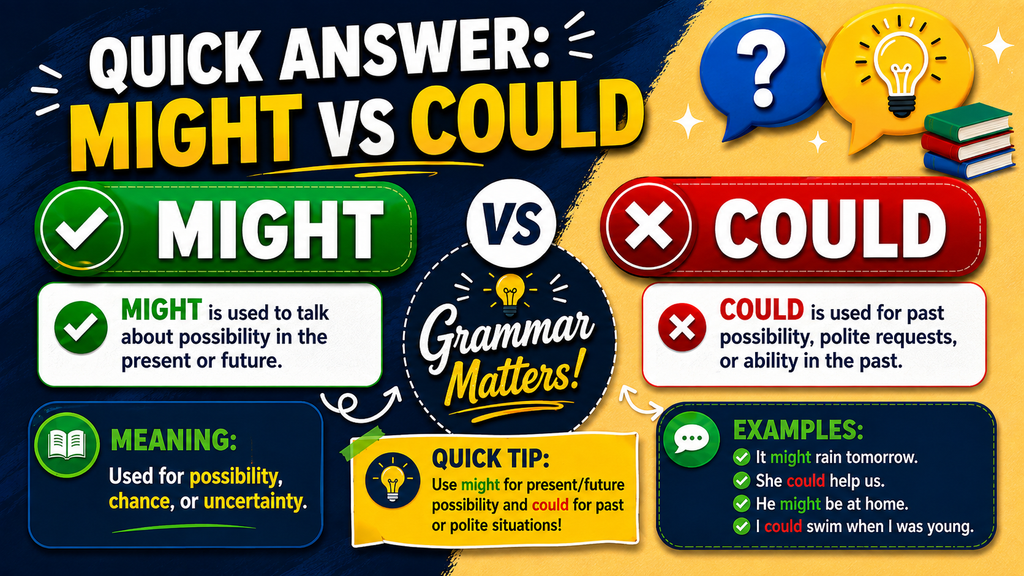
In short: might and could both express possibility, and in that sense they’re often interchangeable (“It might rain” and “It could rain” mean almost the same thing). The real difference appears outside of possibility — could also expresses past ability (“I could swim at age five”) and polite requests (“Could you help me?”), roles that might doesn’t fill in the same way.
Understanding the Basics of Might vs Could
Both words belong to a group called modal verbs — helping verbs like can, could, may, might, must, and should that add meaning (possibility, ability, permission, obligation) to a main verb. Might and could specifically belong to the “possibility” family, alongside may.
Basic Comparison Table
| Feature | Might | Could |
|---|---|---|
| Present/future possibility | ✅ Yes | ✅ Yes |
| Past ability | ❌ No | ✅ Yes |
| Polite requests | ⚠️ Rare, very formal | ✅ Common |
| Suggestions | ✅ Yes (softer) | ✅ Yes (common) |
| Permission (formal/old-fashioned) | ✅ Yes | ⚠️ Less common |
| Past tense of another modal | Loosely tied to “may” | Past tense of “can” |
| Tone | Tentative, uncertain | Flexible, slightly more assertive |
Core Difference
The core difference is range of function. Might mainly does one job: expressing possibility, usually with a tentative or uncertain tone. Could does that same job, plus several others — describing past ability, softening requests, and offering suggestions. So while they frequently overlap, could simply covers more ground.
Correct Meanings and Uses
Using “Might” for Possibility 🌤️
Use “might” when something is possible but far from certain — you’re hedging.
- She might join us for dinner tonight.
- I might take the job if the salary works out.
- They might not have seen the email yet.
Test Tip: On grammar exams, “might” usually signals a lower-confidence guess. If a sentence feels speculative or uncertain, “might” is often the safer choice.
Using “Could” for Possibility
“Could” expresses the same kind of possibility as “might,” often with no real change in meaning.
- The traffic could be bad this afternoon.
- This idea could work if we adjust the budget.
- He could be running late.
Test Tip: If the question asks about a general possibility (not past ability or a request), both “might” and “could” are typically accepted as correct — check whether the answer choices offer both before assuming only one is right.
Using “Could” for Past Ability
This is a use “might” simply doesn’t share. “Could” acts as the past tense of “can” when describing a skill or capability someone had before.
- When I was younger, I could run five miles without stopping.
- She could speak three languages by age ten.
Using “Could” for Polite Requests
“Could” softens a request, making it sound more courteous than “can.”
- Could you send me the report by Friday?
- Could I borrow your charger for a minute?
Using “Could” for Suggestions
“Could” is the go-to modal for offering an option without pressuring anyone to take it.
- You could try restarting your router first.
- We could meet at the coffee shop instead.
Using “Might” in Conditional Situations
“Might” often appears in conditional or hypothetical sentences, describing what would possibly happen under certain conditions.
- If we left earlier, we might avoid the traffic.
- If I had more time, I might learn to paint.
Case Study: Workplace Email Example
Small modal-verb choices change how confident or professional an email sounds. Here’s a quick before-and-after.
Incorrect Version
“I could be interested in the new role, but I’m not sure yet. Could you also confirm the deadline — I might have missed it, but I could be wrong.”
This version stacks modal verbs awkwardly and blurs the writer’s actual level of certainty.
Better Version
“I might be interested in the new role, but I’d like more details first. Could you confirm the deadline? I may have missed it in the original email.”
The revised version keeps “might” for genuine uncertainty about interest, and “could” for the polite request — each modal doing the job it’s best suited for.
Grammar Rules Explanation
Rule 1
Use “might” or “could” interchangeably when expressing present or future possibility, especially in casual speech and writing.
Rule 2
Only use “could” for past ability. “Might” cannot substitute for “can” in its past form.
Rule 3
For polite requests, “could” is standard. “Might” can technically form a request (“Might I ask a question?”), but it sounds old-fashioned or overly formal in everyday English.
Rule 4
For negative possibility, “might not” and “may not” work fine, but “couldn’t” usually implies impossibility rather than simple uncertainty — a subtle but important distinction.
Common Mistakes
Common Grammar Confusions
- Confusing “could” (possibility) with “couldn’t” (impossibility) — they aren’t simple opposites in meaning.
- Using “might” for past ability instead of “could.”
- Treating “may” and “might” and “could” as always fully interchangeable, when tone and formality can shift meaning.
Mistake Examples
| Incorrect | Corrected | Why |
|---|---|---|
| “When I was a kid, I might climb trees easily.” | “When I was a kid, I could climb trees easily.” | Past ability requires “could.” |
| “It couldn’t rain later.” (meaning uncertain possibility) | “It might not rain later.” | “Couldn’t” implies impossibility, not mere doubt. |
| “Can you please to help me?” | “Could you please help me?” | “Could” + base verb, no “to.” |
Usage in Different Contexts
Everyday Conversation
In casual speech, might and could are used loosely and interchangeably for possibility — precision matters less than tone.
Professional Writing
Business writing benefits from “could” for requests and suggestions, and “might” when flagging genuine uncertainty without sounding evasive.
Creative Writing ✍️
Fiction writers often lean on “might” to build suspense or ambiguity, letting readers sit with unresolved possibilities.
Social Media and Texting 📱
Both words get shortened in tone but rarely in spelling — “might” and “could” stay intact even in casual texts, since there’s no common informal contraction for either.
Why It Matters 🌟
Clarity
Choosing the right modal verb helps readers understand exactly how confident — or unsure — you actually are.
Professionalism
Polished modal usage (especially “could” in requests) signals professionalism in emails, reports, and client communication.
Better Digital Communication
In fast-paced digital spaces, correctly used modals prevent misunderstandings that plain text can’t fix with tone of voice.
Special Exceptions
A few edge cases trip people up:
- “Might have” vs. “could have”: “He might have missed the bus” expresses genuine uncertainty. “He could have missed the bus” can express the same uncertainty, but it can also imply a missed opportunity or a criticism (“You could have called me”).
- “Might” as formal permission: “You might leave the room now” is grammatically valid but sounds dated — most modern English uses “may” or “can” for permission instead.
- “Could” implying capability, not permission: “You could park here” often just means it’s physically possible, not that it’s officially allowed.
Quick Recap Checklist ✅
- ✅ Use either for general possibility: “It might/could snow tonight.”
- ✅ Use only “could” for past ability: “I could swim young.”
- ✅ Use “could” for polite requests: “Could you help me?”
- ✅ Use “might” for tentative, hedging statements.
- ✅ Don’t confuse “couldn’t” with simple uncertainty — it usually means impossibility.
Practice Examples
- When she was in college, she ______ speak fluent French. (could)
- ______ you pass the salt, please? (Could)
- It ______ snow later, but the forecast isn’t clear. (might/could)
- If I studied harder, I ______ pass the exam. (might/could)
- He ______ not have seen your message yet. (might)
Frequently Asked Questions: Might vs Could
Is “might” more polite than “could”?
Not necessarily — “could” is the standard choice for polite requests, while “might” is used more for expressing uncertainty.
Can I use “might” and “could” interchangeably?
Yes, when talking about general possibility, but not for past ability or requests, where “could” is required.
What’s the past tense of “might”?
“Might” doesn’t have a distinct past tense form; “might have” is used to talk about possibility in the past.
Is “could” the past tense of “can”?
Yes, “could” functions as the past tense of “can” when describing past ability.
Which is more formal, might or could?
“Might” often sounds slightly more formal or tentative, though both are acceptable in professional writing.
Can “might” be used for requests?
Rarely — “Might I ask a question?” is grammatically correct but sounds very formal and old-fashioned compared to “Could I ask a question?”
Conclusion
Might and could overlap far more than they conflict. For everyday possibility, you can usually pick whichever sounds more natural. But once you step into past ability, polite requests, or professional writing, “could” takes the lead — while “might” stays reserved for genuine uncertainty and hedged, tentative statements. Keep this guide handy, and you’ll never second-guess your modal verbs again.
