

If you’ve ever paused mid-sentence wondering whether to write “in fact” or “infact,” you’re not alone. This is one of the most common spelling mix-ups in English, and autocorrect doesn’t always catch it. The confusion usually comes down to how the phrase sounds when spoken quickly versus how it’s actually built grammatically.
This guide breaks down the correct spelling, explains exactly why one version is right and the other isn’t, and gives you real examples so you never second-guess yourself again.
Quick Answer: In Fact or Infact
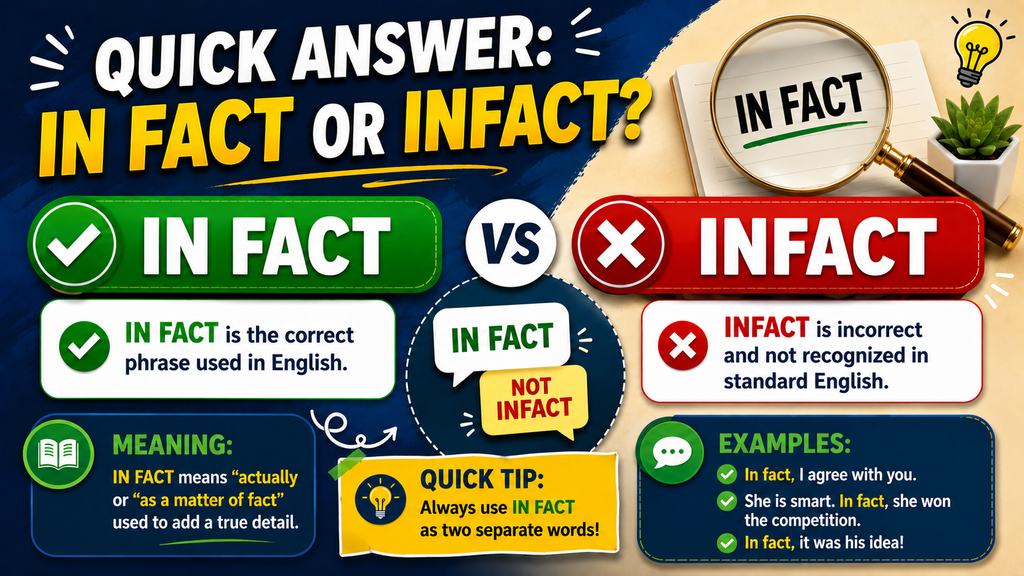
“In fact” is the only correct form. It’s written as two separate words — a preposition (“in”) plus a noun (“fact”) — and it’s used to emphasize, clarify, or add surprising detail to a statement.
“Infact” is not a recognized English word. It doesn’t appear in Merriam-Webster, the Oxford English Dictionary, or any standard style guide. It’s simply a run-together misspelling of “in fact.”
Understanding the Basics of In Fact or Infact
“In fact” functions as an adverbial phrase. It sits at the start, middle, or end of a sentence to strengthen or clarify what’s being said. Because “in” and “fact” are two independent words with their own grammatical roles, English doesn’t merge them into a single compound — unlike words such as “indeed” or “insight,” which evolved into single units centuries ago.
“Infact” likely spreads because of:
- Phonetic blending — when spoken quickly, “in fact” sounds like one word.
- Autocorrect and typing speed — people often skip the space without noticing.
- Analogy with real compound words — since “indeed” and “instead” are single words, some writers assume “infact” follows the same pattern.
None of these reasons make “infact” grammatically valid.
Comparison Table
| Feature | In Fact ✅ | Infact ❌ |
|---|---|---|
| Word count | Two words | One word (incorrect merge) |
| Dictionary status | Listed in all major dictionaries | Not a recognized word |
| Grammar function | Prepositional/adverbial phrase | None — not standard English |
| Formal writing use | Acceptable | Never acceptable |
| Common in | Essays, emails, articles, speech | Typos, texting, informal chats |
Correct Meanings and Uses of “In Fact”
1. To Emphasize a Statement
“In fact” adds weight to a claim you’ve already made, confirming it strongly.
Example: She works hard every day. In fact, she’s the first one in the office every morning.
Sentence Breakdown: The second sentence doesn’t introduce new information — it reinforces the first with added emphasis.
Test Tip: If you can replace the phrase with “to emphasize this,” the sentence still makes sense — that confirms correct usage.
2. To Correct or Clarify Information
Use it to fix a misconception or sharpen a previous statement.
Example: People assume the meeting was cancelled. In fact, it was only rescheduled.
Sentence Breakdown: The phrase signals a correction, steering the reader away from a false assumption.
Test Tip: If the sentence before it contains something inaccurate or incomplete, “in fact” is doing its job correctly.
3. To Add Surprising Information
This use introduces a fact that’s unexpected or more dramatic than what came before.
Example: The project wasn’t just successful — in fact, it exceeded every target we set.
Sentence Breakdown: “In fact” bridges a moderate statement to a stronger, more surprising one.
Test Tip: Read the sentence aloud — if your voice naturally rises for emphasis, the phrase is being used correctly.
4. To Strengthen an Argument
Writers use it to back up a claim with supporting evidence or logic.
Example: Remote work boosts productivity. In fact, several studies confirm output increases by over 10%.
Test Tip: If a stat, source, or hard evidence follows, “in fact” is functioning as an argument-strengthener.
Case Study: Real-Life Workplace Email
Incorrect Email
“Hi team, infact, our numbers this quarter were better than expected. Infact, we should celebrate this win.”
Correct Email
“Hi team, in fact, our numbers this quarter were better than expected. We should absolutely celebrate this win.”
Why It Matters
Using “infact” in professional communication signals a lack of attention to detail. Clients, managers, and colleagues often judge credibility based on small grammar choices — a misspelled phrase can undercut an otherwise strong message.
Grammar Rules Explained
Why is “In Fact” Correct?
Because “in” is a preposition and “fact” is a noun, English grammar keeps them as separate words, just like “in truth,” “in reality,” or “in essence.” Two-word prepositional phrases don’t collapse into single words in standard usage.
Why is “Infact” Incorrect?
There’s no grammatical or historical basis for merging these two words. Unlike genuine compound words that formed naturally over time, “infact” is simply a spacing error with no dictionary backing.
Common Mistakes
- Writing “infact” at the start of a sentence
- Leaving out the comma after “in fact”
- Using “in fact” when no emphasis or clarification is actually needed
Why the Mistake Happens
Fast typing, voice-to-text tools, and casual texting habits all encourage word-merging. Since spoken English doesn’t pause between “in” and “fact,” writers often carry that habit into text.
Similar Grammar Confusions
- “A lot” vs. “alot” (alot is incorrect, same pattern as infact)
- “All right” vs. “alright” (alright is informal, debated by style guides)
- “In to” vs. “into” (these actually have different meanings, unlike in fact/infact)
Usage in Different Contexts
Everyday Conversation 😊
Casual and natural: “In fact, I was just about to call you.”
Professional Writing 💼
Adds authority to reports, proposals, and emails when used sparingly.
Academic Writing 🎓
Useful for transitioning between a claim and supporting evidence in essays.
Creative Writing ✍️
Helps build tension or reveal a twist in narrative prose.
Social Media and Texting 📱
Even in informal spaces, “in fact” (two words) is still the correct spelling — informality doesn’t excuse the merge.
Why It Matters ⭐
1. Better Clarity
Correct spelling keeps your reader focused on your message, not your mistakes.
2. Professionalism
Polished writing builds trust in workplace and academic settings.
3. Writing Accuracy
Following standard grammar rules keeps your writing consistent and credible.
4. Digital Communication
Emails, resumes, and social posts are often judged instantly — small errors carry outsized weight.
Special Exception
The only place you’ll legitimately see “Infact” as one word is as a brand, app, or domain name — some companies stylize it that way for branding purposes. Outside of proper nouns like these, “infact” has no valid use in standard English grammar.
Quick Recap Checklist ✅
- Always write “in fact” as two words
- Use a comma after “in fact” when it starts a sentence
- Reserve it for emphasis, correction, or surprising information
- Never use “infact” in formal or professional writing
- Double-check autocorrect suggestions before sending
Practice Examples
Example 1
Wrong: Infact, the store closes at 9 PM. Right: In fact, the store closes at 9 PM.
Example 2
Wrong: I thought it was expensive, but infact it was on sale. Right: I thought it was expensive, but in fact it was on sale.
Example 3
Wrong: He’s infact one of the best players on the team. Right: He’s in fact one of the best players on the team.
More Examples for Better Understanding
Example A
In fact, the report confirms our earlier predictions.
Example B
Sales didn’t just meet the goal — in fact, they doubled it.
Example C
Many believe coffee is dehydrating; in fact, moderate intake has little effect on hydration.
Example D
In fact, the entire team volunteered to work over the weekend.
Example E
The film wasn’t just good — in fact, critics called it the best of the year.
Common Synonyms of “In Fact”
- Actually
- Indeed
- In reality
- In truth
- As a matter of fact
- Truly
- Honestly speaking
Tips to Remember the Correct Form 🧠
- Say the phrase slowly in your head — “in” then “fact” — to reinforce the space.
- Remember that “fact” is a standalone noun that can’t be glued to a preposition.
- Run a spell-check before submitting formal documents.
- If in doubt, swap in “actually” — if it fits, “in fact” will too.
Frequently Asked Questions: In Fact or Infact
Is “infact” ever correct in English?
No, “infact” is not a recognized word in standard English grammar or any major dictionary.
Should I use a comma after “in fact”?
Yes, when it starts a sentence, a comma typically follows it for proper pacing.
Can “in fact” be used in academic essays?
Yes, it’s commonly used to introduce supporting evidence or clarify a claim.
Is “in fact” formal or informal?
It works in both formal and informal writing, making it a versatile transitional phrase.
Why do so many people write “infact”?
It usually comes from typing quickly, autocorrect habits, or mimicking how the phrase sounds when spoken aloud.
Is “in fact” the same as “actually”?
They’re close synonyms, though “in fact” often carries slightly more emphasis or formality.
Conclusion
The rule is simple: “in fact” is always two words, and “infact” is a spelling error with no place in correct English. Whether you’re writing an email, an essay, or a quick text, using “in fact” properly adds clarity and credibility to your message. Keep this guide handy, run through the checklist when you’re unsure, and you’ll never trip over this common mix-up again.
