

If you’ve ever paused mid-sentence wondering whether to type “usage” or “useage,” you’re not alone. This is one of the most common spelling mix-ups in English writing, and it trips up students, professionals, and even experienced writers. The good news? The answer is simple, and once you understand the rule behind it, you’ll never second-guess yourself again.
This guide breaks down the correct spelling, the meaning behind the word, the grammar rule that explains the confusion, and real examples so you can use it confidently in any type of writing.
Quick Answer: Usage or Useage?
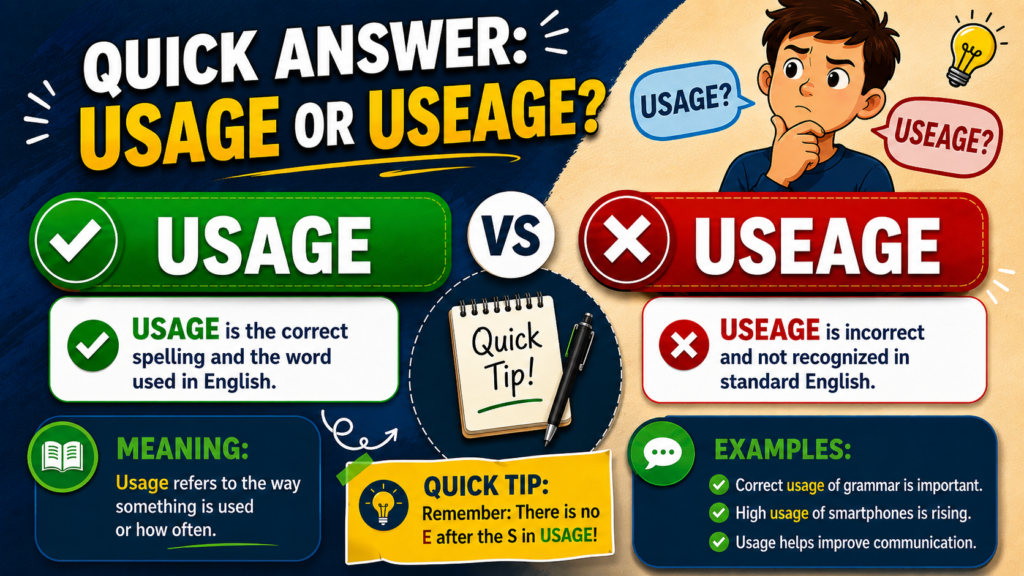
“Usage” is the only correct spelling. “Useage” is a common misspelling that does not appear in any standard English dictionary — not Merriam-Webster, not Oxford, not Cambridge.
No dialect, region, or style guide treats “useage” as an acceptable variant. If you’re unsure which one to type, always default to usage.
Understanding the Basics of Usage vs Useage
The confusion makes sense at first glance. The base verb “use” ends in a silent “e,” so it feels natural to keep that “e” when turning it into a noun. But English spelling rules don’t work that way here.
Key Difference
| Feature | Usage ✅ | Useage ❌ |
|---|---|---|
| Dictionary status | Recognized standard word | Not a real word |
| Part of speech | Noun | N/A |
| Common in | Grammar, tech, business, academic writing | Nowhere — always an error |
| Origin | “Use” + suffix “-age” (silent e dropped) | Incorrect retention of the silent “e” |
| Spellcheck result | Accepted | Flagged as an error |
Correct Meanings and Uses
What Does “Usage” Mean?
“Usage” is a noun that describes how, how often, or in what way something is used. It shows up in three main senses.
Usage Meaning #1: The Act of Using Something
This refers to the general act or manner of using an object, tool, or resource.
Sentence Breakdown: In “Proper usage of safety equipment prevents accidents,” usage refers to the correct way the equipment is handled.
Test Tip: If you can replace the word with “how something is used,” usage is the right choice.
Usage Meaning #2: Established Practice or Custom
Usage also describes accepted habits or conventions, especially in language.
Sentence Breakdown: “Modern usage allows sentences to end in a preposition” refers to an accepted grammatical convention, not a physical action.
Test Tip: If the sentence is about tradition, convention, or “the way things are commonly done,” this is the meaning at play.
Usage Meaning #3: Consumption or Utilization
This sense is common in technology, utilities, and data contexts — referring to the amount consumed.
Test Tip: If a number or meter is involved (data usage, water usage, electricity usage), you’re looking at this meaning.
Case Study Section
Workplace Email Example
Real-world writing mistakes often show up in professional communication, where spelling errors can quietly damage credibility.
| Version | Example |
|---|---|
| ❌ Incorrect | “Please review your monthly data useage before the billing cycle ends.” |
| ✅ Correct | “Please review your monthly data usage before the billing cycle ends.” |
Why This Matters
A single misspelled word in a client email, report, or proposal can shift how a reader perceives your attention to detail — even if the rest of the message is flawless.
Grammar Rules Explanation
Why Is “Usage” Correct?
English has a long-standing spelling rule: when a word ends in a silent “e” and you add a suffix that starts with a vowel, the silent “e” is dropped.
“Use” + “-age” → the silent “e” is removed → usage
Similar Examples
- move + ing → moving (not “moveing”)
- write + er → writer (not “writeer”)
- achieve + able → achievable (not “achieveable”)
Important Rule
This “drop the silent e” pattern applies broadly across English, which is exactly why “usage” — not “useage” — is the grammatically consistent form.
Common Mistakes
Why Do People Write “Useage”?
1. Fast Typing ⌨️
When typing quickly, it’s easy to instinctively add the “e” from “use” without thinking about the suffix rule.
2. Autocorrect Issues 📱
Some autocorrect tools inconsistently catch this error, especially on mobile keyboards, letting the mistake slip through.
3. Lack of Knowledge 📚
Many writers simply haven’t been taught the silent-e-drop rule, so the error feels logical rather than wrong.
4. Influence of Similar Words
Words like “mileage,” “lineage,” and “package” keep their “e” before “-age,” which creates false pattern-matching that leads writers to misspell “usage.”
Similar Grammar Confusions
“Usage vs useage” isn’t the only word pair that causes hesitation. A few others worth knowing:
- Advice vs advise — noun vs verb
- Effect vs affect — result vs influence
- Its vs it’s — possession vs contraction
- Practice vs practise — American vs British spelling by part of speech
Usage in Different Contexts
Everyday Conversation
“I need to cut down on my phone usage” is a natural, casual way the word appears in daily speech.
Professional Writing
Business and academic writing rely on “usage” constantly — in reports, contracts, policies, and technical documentation.
Creative Writing
Authors use “usage” when discussing dialect, tone, or how a character’s word choices reflect their background.
Social Media and Texting
Even in casual digital spaces, “usage” is the version that reads as correct — “useage” stands out as an obvious typo.
Why It Matters
Clarity in Communication
Correct spelling ensures your reader focuses on your message, not on decoding an unfamiliar word.
Professionalism
Consistent, accurate spelling signals credibility in resumes, emails, and formal documents.
Writing Accuracy in Digital Communication
Search engines, spellcheckers, and readers alike treat “usage” as the standard — using it correctly keeps your content polished and trustworthy.
Word choice shapes how language is perceived over time — and small details, like a single silent letter, often carry more weight in written communication than they first appear to.
Special Exception
Are There Any Exceptions?
No. Unlike some words with regional or historical variant spellings, “useage” has no accepted exception, archaic form, or dialectal use. It is simply incorrect in every context.
Remember
- Usage = correct, always
- Useage = incorrect, always
- The silent “e” in “use” is dropped before “-age”
Quick Recap Checklist
- ✅ Use “usage” for the act, custom, or amount of something being used
- ✅ Drop the “e” from “use” before adding “-age”
- ❌ Never write “useage” — it isn’t a recognized word
- ✅ Double-check with a dictionary or spellcheck tool if unsure
- ✅ Read your sentence aloud before finalizing formal writing
Practice Examples
Example 1
Fill in the blank: “Internet ___ has increased across most households this year.” Answer: usage
Example 2
Fill in the blank: “Correct word ___ improves the clarity of your writing.” Answer: usage
Example 3
Fill in the blank: “Monitor your energy ___ to reduce your monthly bill.” Answer: usage
Frequently asked question: Usage Or Useage
Is “useage” ever correct?
No. “Useage” is not recognized in any standard English dictionary or style guide.
Is “usage” a noun or a verb?
“Usage” is a noun. The related verb form is “use.”
Why do people confuse usage and useage?
Because the base word “use” ends in “e,” writers mistakenly assume that “e” should carry over when adding “-age.”
Is “usage” different in British and American English?
No. Both British and American English use the same spelling: usage.
What’s the difference between “use” and “usage”?
“Use” is the action of employing something; “usage” describes the manner, frequency, or pattern of that use.
Will spellcheck catch “useage”?
Yes, most modern spellcheckers and grammar tools flag “useage” as an error automatically.
Conclusion
The debate between usage and useage has a clear, permanent answer: usage is correct, and useage is not. The mix-up comes from a simple, common misunderstanding of English’s silent-e spelling rule — not from any legitimate alternate spelling. Once you remember that “use” drops its final “e” before adding “-age,” the correct form becomes second nature. Keep this guide handy, and you’ll never second-guess this word again.
