

If you’ve ever paused mid-sentence wondering whether to write “every person” or “every people,” you’re not alone. This mix-up shows up in emails, essays, and even native-speaker conversations. The confusion usually comes from one simple fact: “people” feels like it should work with “every” because it means the same thing as “persons.” But English grammar has other plans.
This guide breaks down exactly which phrase is correct, why the rule exists, and how to avoid this mistake for good — with real examples, a comparison table, and quick test tips you can use anytime you’re unsure.
Quick Answer: Every Person or Every People
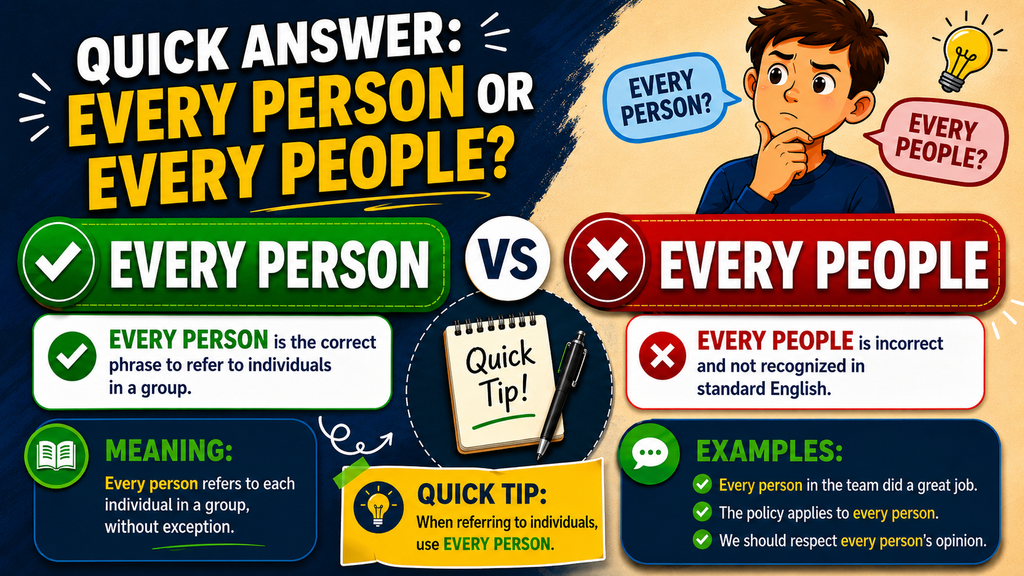
“Every person” is correct. “Every people” is not.
“Every” is a singular determiner, meaning it must be followed by a singular noun. “Person” is singular, so “every person” works perfectly. “People” is a plural noun (the plural of “person”), so pairing it with “every” breaks the rule. If you want to talk about a group as a whole, use “all people” instead.
Understanding the Basics of “Every Person” vs. “Every People”
English words like every, each, and any belong to a small group of determiners that only combine with singular nouns. This is one of the most consistent rules in English grammar, which makes it a favorite topic for grammar quizzes, ESL lessons, and English proficiency tests.
Comparison Table
| Phrase | Grammatically Correct? | Noun Type | Best Used For |
|---|---|---|---|
| Every person | ✅ Yes | Singular | Referring to one individual within a group |
| Every people | ❌ No | Plural | Never correct in standard English |
| All people | ✅ Yes | Plural | Referring to a group collectively |
| Each person | ✅ Yes | Singular | Emphasizing individuals one at a time |
| Every peoples | ❌ No | Plural | Never correct in standard English |
Simple Rule
If the word right after “every” is plural, stop — it’s wrong. Swap it for “all,” or make the noun singular. That one check solves the problem almost every time.
Correct Meanings and Uses
Using “Every Person” Correctly
“Every person” singles out each individual in a group, one at a time, rather than describing the group as a unit.
Examples:
- Every person has a right to be heard.
- Every person on the team submitted their report.
- Every person deserves a second chance.
- Every person in the room turned to look.
Sentence Breakdown
Take the sentence: “Every person must complete the form.”
- Every = a singular determiner meaning “each one, without exception”
- Person = the singular noun it modifies
- Must complete = a singular verb form, matching “every person” grammatically
Even though the sentence is really talking about a whole group of people, grammatically it treats them one at a time — which is why the verb stays singular.
Test Tip ✅
Replace “every” with “each.” If the sentence still makes sense, “person” is the correct word to use. “Each person must complete the form” works, confirming “every person” is correct too.
Understanding “People”
“People” is the everyday plural of “person.” It’s used when referring to more than one individual as a group.
Examples:
- Many people enjoy hiking on weekends.
- People often forget small details under pressure.
- Several people asked the same question.
Incorrect Example
❌ Every people should follow the rules.
Correct Version
✅ All people should follow the rules. ✅ Every person should follow the rules.
Test Tip ✅
If you can naturally swap in “many,” “some,” or “all” before the word and it fits, you’re dealing with a plural noun — and “every” doesn’t belong there.
The Rare Use of “Peoples”
“Peoples” is the plural form of “people” used in its other meaning — a distinct nation, ethnic group, or cultural group. This usage shows up mostly in academic, historical, or anthropological writing.
Examples:
- The exhibit explores the traditions of Indigenous peoples across North America.
- Ancient trade routes connected the peoples of the Mediterranean.
- Several peoples share this region’s mountainous terrain.
Here, “a people” acts as a singular noun meaning “a nation,” and “peoples” is simply its plural — similar to how “nation” becomes “nations.” It’s a completely different grammatical case from “every people,” and it’s still never paired with “every.”
Case Study: A Real Workplace Email Example
Small grammar slips like this often sneak into professional writing, especially when someone is typing quickly.
Incorrect Version
“Every people in the department should submit their timesheet by Friday.”
Correct Version
“Every person in the department should submit their timesheet by Friday.”
Why It Works
Swapping “people” for “person” fixes the subject-determiner mismatch without changing the sentence’s meaning at all. The email still communicates the same deadline and expectation — it just reads as polished and professional instead of slightly off. In workplace communication, small grammar details like this shape how carefully written (and how credible) a message feels.
Grammar Rules Explained
Rule 1: Every + Singular Noun
“Every” always attaches to a singular countable noun, even when the overall meaning refers to a large group.
- Every student passed the exam.
- Every employee received a bonus.
- Every dog needs regular exercise.
Rule 2: Every Does Not Usually Take Plural Nouns
You’ll almost never see “every” directly before a plural noun in standard English. Instead, plural ideas are expressed with “all,” “many,” or “most.”
- ❌ Every students passed.
- ✅ All students passed.
Why?
“Every” functions distributively — it looks at members of a group individually rather than as a bundle. Grammatically, that distributive function requires a singular noun to distribute to. Plural nouns already represent a collected group, which conflicts with what “every” is doing.
Common Mistakes People Make
| Mistake | Correction |
|---|---|
| Every people attended the event. | Every person attended the event. / All people attended the event. |
| Every persons must sign in. | Every person must sign in. |
| Every people have their own opinion. | Every person has their own opinion. |
| Each people should participate. | Each person should participate. |
Why These Mistakes Happen
Fast Typing ⌨️
When writing quickly — in emails, chats, or social posts — it’s easy to default to the more common word “people” instead of pausing to check the grammar rule.
Autocorrect 📱
Autocorrect and predictive text tools sometimes suggest “people” simply because it’s used more frequently in everyday writing, especially on mobile keyboards.
Lack of Knowledge 📚
Many English learners assume “person” and “people” are always interchangeable since they share the same core meaning, without realizing the grammar rules around them differ.
Similar Grammar Confusions
This isn’t the only “every + noun” pairing that trips people up. A few related mix-ups worth knowing:
- Everyone vs. every one — “Everyone” means “all people”; “every one” emphasizes individual items or people separately.
- Each vs. every — Both take singular nouns, but “each” often implies a smaller, more specific group, while “every” implies the group as a whole, considered individually.
- Every day vs. everyday — “Every day” means “each day”; “everyday” is an adjective meaning “ordinary.”
- Any person vs. any people — “Any person” is correct for singular reference; “any people” is grammatically odd outside of the “ethnic group” sense of “people.”
Usage in Different Contexts
Everyday Conversation
Casual speech uses “every person” and “everyone” almost interchangeably — “Every person I met was so friendly.”
Professional Writing
Emails, reports, and HR policies rely on “every person” or “each employee” for precision, especially where individual responsibility matters.
Creative Writing
Writers sometimes use “every person” deliberately for rhythm, drawing attention to each individual rather than the crowd as a whole.
Social Media and Texting
Because speed beats polish online, “every people” mistakes appear more often here — though they still read as noticeably off to attentive readers.
Why It Matters
Clarity in Communication
“Every person” keeps meaning sharp — it signals individuals, not a vague, undefined group.
Professionalism
Slips like “every people” can distract readers, especially in resumes, cover letters, and business writing where accuracy is expected.
Accuracy in Digital Communication
Since so much writing now happens in emails, chats, and posts, getting this small rule right keeps your writing consistent across every platform.
Good grammar doesn’t just follow rules — it removes friction, so the reader focuses on your message instead of your mistakes.
Special Exception
There’s one edge case worth knowing: when “people” is used in its “nation” sense (a singular noun, as covered above), it can technically follow “every” — as in “Every people has its own history and customs.” Here, “people” means “nation,” not “persons,” so it behaves as a singular noun. This usage is rare, mostly limited to formal, historical, or academic writing, and shouldn’t be confused with the incorrect “every people” meaning “every person.”
Example
- Every people has its own language, traditions, and history. (correct — “people” = “nation”)
- Every people love pizza. (incorrect — “people” here means “persons”)
Quick Recap Checklist
- ✅ Use every person when referring to individuals one at a time
- ✅ Use all people when referring to a group collectively
- ✅ Use peoples only when talking about multiple nations or ethnic groups
- ❌ Never use every people to mean “every person”
- ❌ Never use every persons — “every” takes the singular “person,” not “persons”
Which Form Should You Use?
| If you mean… | Use this |
|---|---|
| One individual out of a group | Every person |
| A group as a whole | All people |
| Multiple nations or ethnic groups | Peoples |
| A single nation or ethnic group | A people / Every people (formal) |
Practice Examples
Example 1
Fill in the blank: “_____ in this office has a badge.” Answer: Every person in this office has a badge.
Example 2
Fill in the blank: “_____ deserve access to clean water.” Answer: All people deserve access to clean water.
Example 3
Spot the error: “Every people should read the updated policy.” Correction: Every person should read the updated policy.
Frequently asked question: Every Person or Every People
Is “every people” ever grammatically correct?
Only when “people” means “nation” or “ethnic group” in formal writing. As a substitute for “every person,” it’s always incorrect.
What’s the difference between “every person” and “all people”?
“Every person” focuses on individuals one at a time, while “all people” refers to the group as a whole.
Can I say “every peoples”?
No. “Peoples” is already plural, and “every” only pairs with singular nouns, so this combination is never correct.
Is “everyone” the same as “every person”?
They mean almost the same thing, but “everyone” is a single pronoun, while “every person” is a determiner-plus-noun phrase — both are grammatically correct.
Why doesn’t “every” work with plural nouns like “people”?
Because “every” distributes meaning across individual members of a group, which requires a singular noun rather than an already-collective plural one.
Is “each person” also correct?
Yes. “Each” follows the same rule as “every” and pairs correctly with the singular noun “person.”
Final Thoughts
The rule behind “every person” vs. “every people” comes down to one consistent pattern: “every” always needs a singular noun beside it. Once that clicks, the mistake becomes easy to catch and correct — whether you’re writing a quick text, a formal email, or a full report. Keep “every person” for individuals, “all people” for groups, and save “peoples” for nations and ethnic groups, and you’ll never second-guess this one again.
