

Have you ever typed a sentence, paused at “in between,” and wondered if it should be one word instead? You’re not alone. This is one of the most common spacing mix-ups in English, and it trips up native speakers and learners alike. The good news is that the rule is simple once you see it clearly and this guide breaks it down with examples, a comparison table, and a few memory tricks you’ll actually remember.
Quick Answer: Inbetween or In Between ⚡
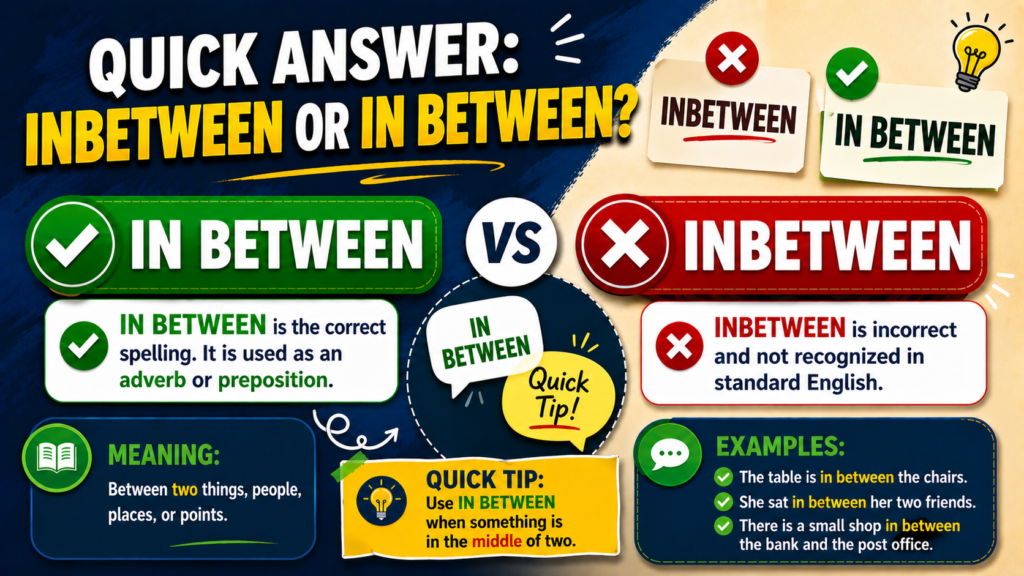
Here’s the short version before we dig into the details:
- ✅ In between — always two words when used as a preposition or adverb (“She sat in between her friends”).
- ❌ Inbetween — never correct. It’s simply a misspelling of “in between.”
- ✅ In-between — correct only when hyphenated, used as an adjective or noun (“an in-between stage,” “there’s no in-between”).
If you remember nothing else from this article, remember this: “inbetween” as a single word does not exist in standard English.
Understanding the Basics of Inbetween or In Between 🧩
The confusion makes sense. English is full of compound words that started as two separate terms and eventually merged — think “however,” “nevertheless,” or “background.” Naturally, people assume “in” and “between” follow the same path. They don’t. Despite how often it appears in casual texts, emails, and social captions, “inbetween” has never been accepted by major dictionaries or style guides.
Comparison Table 📊
| Form | Word Count | Correct? | Function | Example |
|---|---|---|---|---|
| Inbetween | One word | ❌ Never correct | N/A | ~~The gap inbetween the shelves~~ |
| In between | Two words | ✅ Correct | Preposition / Adverb | The gap in between the shelves |
| In-between | Hyphenated | ✅ Correct | Adjective / Noun | An in-between size |
Key Rule 🔑
If you can swap the phrase for plain “between” and the sentence still makes sense, drop the “in” especially in formal writing. If the phrase describes a thing (noun) or describes another word (adjective), hyphenate it as “in-between.”
Correct Meanings and Uses ✅
Using “In Between” for Physical Location 📍
“In between” often describes a position located between two physical points.
Examples:
- The bakery sits in between the pharmacy and the bank.
- Leave a small gap in between the tiles.
Test Tip: 💡 Try replacing it with “between.” If “the bakery sits between the pharmacy and the bank” reads naturally, either form works — but “between” alone is usually the cleaner, more formal choice.
Using “In Between” for Time ⏰
The phrase also marks a period that falls between two events.
Examples:
- We grabbed coffee in between meetings.
- She squeezed in a workout in between calls.
Test Tip: 💡 If the sentence still makes sense without “in,” standard style guides recommend cutting it for formal or academic writing.
Using “In Between” for Situations 🌗
When describing an intermediate stage, condition, or state of uncertainty, “in between” (or its hyphenated cousin) fits naturally.
Examples:
- The project is in between phases right now.
- It’s an in-between stage — not quite finished, not quite started.
Test Tip: 💡 If the phrase sits before a noun and describes it, hyphenate it: “an in-between stage,” not “an in between stage.”
Using “In Between” for Relationships 💞
People also use the phrase to describe emotional or interpersonal middle ground.
Examples:
- He felt caught in between his two closest friends during the argument.
- There’s no real in-between with her — she either loves an idea or hates it.
Test Tip: 💡 As a noun (referring to “the middle ground” itself), it always takes the hyphen: “there’s no in-between.”
Case Study: Fixing a Workplace Email 📝
Here’s how this small grammar slip plays out in real professional writing.
Incorrect Version ❌
“Please schedule the call inbetween our two department meetings, since that’s the only inbetween slot available.”
Correct Version ✅
“Please schedule the call in between our two department meetings, since that’s the only in-between slot available.”
Why It Matters 🎯
Notice the two different corrections: “in between” (two words) works as an adverbial phrase describing timing, while “in-between” (hyphenated) works as an adjective describing the slot. Getting both right in a single message shows attention to detail something colleagues and clients quietly notice.
Grammar Rules Explanation 📐
Why Is It Two Words? ❓
“In” and “between” are two separate function words — a preposition (“in”) layered onto another preposition/adverb (“between”) for emphasis. English never fused them into a single compound word the way it did with terms like “outside” or “underneath,” so no dictionary lists “inbetween” as valid.
Grammar Structure 🧱
| Function | Structure | Example |
|---|---|---|
| Preposition | in between + noun/pronoun | in between the trees |
| Adverb | in between (standalone) | We stopped in between |
| Adjective (hyphenated) | in-between + noun | an in-between size |
| Noun (hyphenated) | the in-between | living in the in-between |
Common Mistakes 🚫
- Writing “inbetween” as a single word in emails, essays, or captions.
- Forgetting the hyphen when using it as an adjective (“in between stage” instead of “in-between stage”).
- Using “in between” in formal writing where plain “between” would be more concise.
- Applying “in between” to more than two clearly separate items instead of “among.”
Why These Mistakes Happen 🤷
⌨️ Fast Typing: When typing quickly on a phone or keyboard, it’s easy to let two words blur into one without noticing.
**Autocorrect Issues:🔄 ** Some autocorrect and predictive-text tools don’t flag “inbetween” as an error, letting the mistake slip through unnoticed.
**Lack of Knowledge:📖 ** Many writers simply were never taught the hyphenation rule that separates “in between” from “in-between,” so they default to whichever “feels” right.
Similar Grammar Confusions 🔀
This isn’t the only spacing trap in English. A few close cousins:
- All together vs. altogether
- A lot vs. alot
- Any more vs. anymore
- Every day vs. everyday
The pattern is the same in each case: the two-word form is usually the default, while the single-word (or hyphenated) form only applies in a specific grammatical role.
Usage in Different Contexts 🗣️
Everyday Conversation 💬
In casual speech, “in between” flows naturally and rarely gets scrutinized.
Examples:
- “I’ll call you in between errands.”
- “It’s kind of in between sizes, honestly.”
Professional Writing 💼
Formal writing favors precision, so trimming “in” is often the stronger stylistic choice.
Examples:
- “The deadline falls between the two milestones.” (preferred over “in between”)
- “This is an in-between solution until the full system launches.”
Creative Writing ✍️
Writers often lean on “in-between” as a noun or adjective to evoke liminal, transitional imagery — dusk, adolescence, doorways, unfinished journeys.
Examples:
- “She lived in the in-between, neither fully home nor fully away.”
- “Twilight is nature’s in-between hour.”
Social Media and Texting 📱
Because captions and texts prioritize speed over polish, “inbetween” shows up constantly online — but that doesn’t make it correct. Even in informal spaces, using “in between” or “in-between” correctly signals stronger writing instincts.
Why It Matters 🌟
Clarity in Communication 🔍
Correct spacing helps readers process meaning instantly, without a mental stumble.
Professionalism 🎓
Small grammar details shape how credible your writing appears to colleagues, clients, and readers.
Writing Accuracy ✏️
Consistently applying the hyphenation rule strengthens your overall command of English mechanics.
Digital Communication 💻
Search engines and readers alike favor clean, correctly formatted text — sloppy spacing can quietly undercut otherwise strong content.
“Good grammar isn’t about rules for their own sake — it’s about making sure your reader never has to guess what you meant.” 💭
Special Exception ⚠️
In some song titles, brand names, or stylized creative writing, you may spot “inbetween” used deliberately as a stylistic choice. This is an intentional exception, not a grammar rule — in standard writing, it’s still considered incorrect.
**Important Note:📌 ** Dictionaries such as Cambridge and Oxford list “in-between” (hyphenated) as the standard adjective/noun form, while “in between” (two words) remains standard for prepositional and adverbial use.
Quick Recap Checklist ✔️
- ❌ Never write “inbetween” as one word.
- ✅ Use “in between” (two words) for location, time, and adverbial use.
- ✅ Use “in-between” (hyphenated) before a noun or as a noun itself.
- 🔍 Test: if “between” alone works, use it in formal writing.
Which Form Should You Use? 🧭
| If your sentence needs… | Use this form |
|---|---|
| A simple preposition of place/time | between (or in between) |
| Emphasis on a middle position | in between |
| A word describing a noun | in-between |
| A noun meaning “the middle ground” | in-between |
| One combined word | Never — always incorrect |
Practice Examples 🎯
1️⃣ Example 1
“The store is located ___ the cafe and the bookstore.” → in between (or between)
2️⃣ Example 2
“It’s not quite summer or winter — just an ___ season.” → in-between
3️⃣ Example 3
“He grabbed a snack ___ classes.” → in between
frequently asked question:About Inbetween or In Between ❔
Is “inbetween” ever correct?
No. “Inbetween” as a single word is always considered a misspelling in standard English.
Should I use “in between” or just “between”?
Both often work, but “between” alone is usually more concise and preferred in formal writing.
When do I hyphenate “in-between”?
Hyphenate it when it functions as an adjective before a noun or as a standalone noun.
Is “in-between” a real word in the dictionary?
Yes — major dictionaries like Cambridge and Oxford recognize “in-between” as a hyphenated adjective and noun.
Can “in between” be used with more than two things?
Not ideally — for three or more items, “among” is usually the better grammatical choice.
Why do people keep misspelling it as one word?
Fast typing, unreliable autocorrect, and unfamiliarity with the hyphenation rule are the most common causes.
Conclusion 🏁
The rule behind “inbetween or in between” is simpler than it first appears: “inbetween” is never correct, “in between” works as a preposition or adverb, and “in-between” takes a hyphen when it acts as an adjective or noun. Once you internalize that one distinction, you’ll never second-guess this phrase again — in emails, essays, captions, or anywhere else you write.
