

If you’ve ever paused mid-sentence wondering whether to say “I run” or “I ran,” you’re not alone. These two words trip up native speakers and English learners alike because run is one of the most irregular verbs in the language. This guide breaks down the difference in plain English, backed by real examples, a rule summary table, and a mistake-proof checklist so you never second-guess yourself again ✅.
Quick Answer: Run or Ran
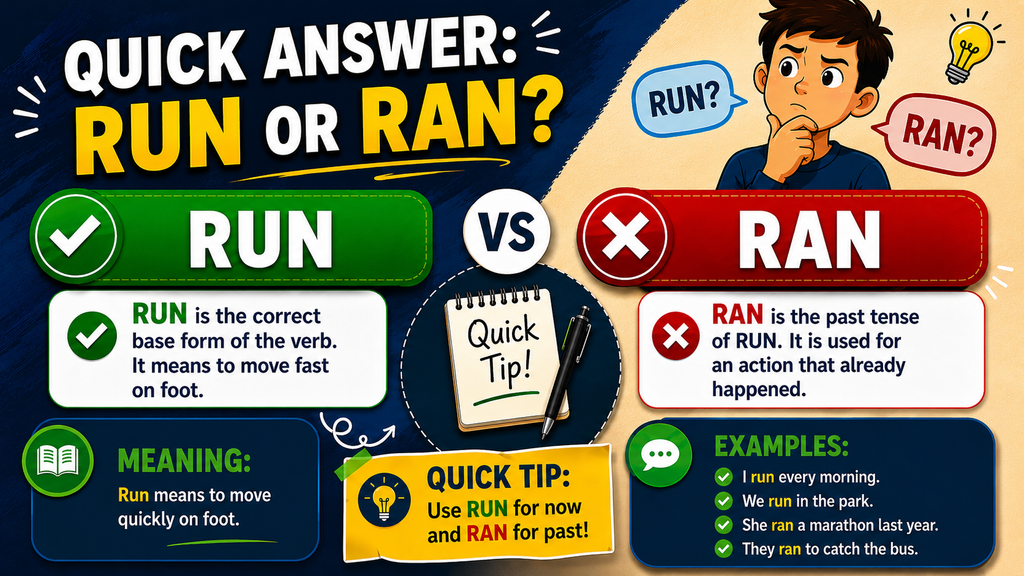
Run is the present tense (and the base form), while ran is the simple past tense. Use run for actions happening now, habits, or facts — use ran for actions that already finished. There’s one twist: run also doubles as the past participle, so it pairs with have, has, or had even when you’re talking about the past 🔁.
| Form | Tense | Example |
|---|---|---|
| Run | Present / Base | I run every day. |
| Ran | Simple Past | I ran yesterday. |
| Run | Past Participle | I have run before. |
Understanding the Basics of Run or Ran
English verbs generally follow a predictable pattern: add “-ed” and move on. Run refuses to play by those rules 🚫. It belongs to a small group of irregular verbs whose past tense forms don’t follow the standard pattern, which is exactly why run and ran cause so much confusion.
Key Idea
Think of it as a timeline, not a vocabulary choice. The word you pick depends entirely on when the action happens, not on what the action means. Whether you’re jogging, managing a business, or a printer is “running” out of ink, the tense rule stays exactly the same.
Correct Meanings & Uses
Both words describe the same core action, but they sit at different points on the timeline. Here’s how to use each one correctly.
Using “Run” (Present Tense)
Use run when the action is happening now, happens regularly, or is a general truth. It’s also the form you use in the future tense (after will) and as the infinitive (after to).
- I run three miles every morning.
- She runs a small bakery downtown.
- This laptop runs a little slow.
- They will run the marathon next spring. 🌸
Notice the “-s” added for third-person singular subjects (he, she, it) — a small detail that many writers forget under pressure.
Using “Ran” (Past Tense)
Use ran for an action that already happened and is completely finished. It never needs a helping verb, and it never changes form based on the subject.
- He ran to catch the last train.
- We ran into an old friend at the mall. 👋
- The company ran a holiday promotion last December.
- She ran for city council in the last election.
Special Note: Past Participle (Often Confused)
This is where most mistakes happen. The past participle of run is run, not ran — that means anytime you use a helping verb like have, has, or had, the correct word is always run.
❌ I have ran five miles today. ✅ I have run five miles today.
A simple test: if you can swap in another irregular verb like eaten or gone and the sentence still makes grammatical sense, run is the word you need.
Case Study: Real-Life Usage
Grammar rules are easier to remember when you see them applied in everyday situations. Here are two quick scenarios.
Workplace Email Example
“I ran the quarterly report last night and have run the numbers twice to confirm accuracy. The system currently runs smoothly, and we will run a final check before Monday’s meeting.”
This single paragraph uses all three forms correctly: ran for a finished action, have run for a completed action linked to the present, and runs/will run for present and future actions.
Why It Matters
In a professional setting, mixing up run and ran can make a well-written email look careless. Clients and colleagues notice small grammar slips, even if they can’t always explain why a sentence feels “off” 👀.
Conversation Example
A: “Did you run this morning?” B: “Yeah, I ran about four miles before work. I usually run on weekends too, but today felt right.”
This kind of natural back-and-forth shows how both words can appear in the same short exchange without ever being interchangeable.
Grammar Rules Explanation
At its core, the run/ran distinction follows the standard English verb pattern of base form → simple past → past participle, except two of those three slots share the same spelling.
Why This Matters
Verb tense tells your reader when something happened. Get it wrong, and the timeline of your sentence becomes confusing, even if every other word is correct.
Rule Summary:
| Situation | Correct Form | Example |
|---|---|---|
| Habit or general fact | run | I run every weekend. |
| Action happening right now | run(s) | She runs the meeting today. |
| Completed action in the past | ran | They ran the test yesterday. |
| After “have,” “has,” or “had” | run | We have run out of milk. |
| After “will” (future) | run | He will run the errand later. |
| Storytelling / narrative past | ran | He ran, jumped, and slid to safety. |
Common Mistakes with Run or Ran
Even confident writers slip up occasionally. Here’s why it happens and how to fix it.
Why Mistakes Happen
Most errors come from three sources: rushing while typing, translating directly from another language, or simply forgetting that run pulls double duty as both the base form and the past participle.
Common Errors
| Mistake | Correction |
|---|---|
| “I have ran the report.” | “I have run the report.” |
| “Yesterday I run five miles.” | “Yesterday I ran five miles.” |
| “She rans every morning.” | “She runs every morning.” |
| “He runned to the store.” | “He ran to the store.” |
| “I ran the machine every day.” (habitual) | “I run the machine every day.” |
Similar Grammar Confusions
Run/ran isn’t the only irregular verb pair that causes trouble. These follow the same base–past–participle pattern.
| Base Form | Simple Past | Past Participle |
|---|---|---|
| Run | Ran | Run |
| Begin | Began | Begun |
| Drink | Drank | Drunk |
| Swim | Swam | Swum |
| Sing | Sang | Sung |
| Go | Went | Gone |
Once you understand how run changes across tenses, spotting the pattern in these other verbs becomes much easier.
Usage in Different Contexts
The rules stay constant, but tone and formality shift depending on where you’re writing.
1. Everyday Conversation
Casual speech leans heavily on ran for storytelling (“I ran into traffic”) and run for habits (“I run most mornings”). Contractions and shorter sentences are common here.
2. Professional Writing
Business emails, reports, and proposals favor precision. Using have run correctly (instead of have ran) signals attention to detail — something readers subconsciously associate with credibility.
3. Creative Writing
Fiction often uses ran to drive fast-paced, sequential action (“She ran, ducked, and vanished into the alley”), since the simple past creates urgency and momentum in a narrative.
4. Social Media / Texting
Informal platforms are more forgiving, but the core rule doesn’t disappear. “Just ran 5k 🏃” is correct; “Just run 5k” changes the meaning entirely, since it now reads like an instruction rather than a completed action.
Why It Matters (Important Section)
Choosing the wrong verb form doesn’t just look like a typo — it can genuinely confuse your reader about when something happened. A resume that says “I have ran three departments” reads less polished than one that correctly says “I have run three departments,” even though the meaning seems obvious in context.
Quote:
“Small grammar choices, like run versus ran, quietly shape how professional and credible your writing feels — even to readers who can’t explain the rule themselves.”
Special Exception Section
Idioms and phrasal verbs built around run — like run out of time, run into trouble, run a business, or run for office — follow the exact same tense rules as the plain verb. The idiom changes the meaning, but never the grammar.
- ✅ We ran out of coffee this morning. (past)
- ✅ We have run out of coffee. (past participle)
- ✅ We always run out of coffee by Friday. (present habit)
No idiom overrides the base tense rule — treat the “run” inside it exactly as you would the standalone verb.
Quick Recap Checklist
- ✅ Use run for present actions, habits, and general facts.
- ✅ Use ran only for completed, simple-past actions.
- ✅ Always pair have / has / had with run, never ran.
- ✅ Use run after will for future actions.
- ✅ Remember: runned is never correct — run is irregular.
Practice Examples
Test yourself by choosing the correct word:
- Yesterday, she ______ (run/ran) her first half-marathon.
- He has ______ (run/ran) this route a hundred times.
- Every summer, we ______ (run/ran) a lemonade stand.
- They ______ (run/ran) out of gas on the highway last night.
- The printer usually ______ (run/ran) out of ink by Friday.
Answers: 1. ran, 2. run, 3. run, 4. ran, 5. runs
Frequently Asked Questions: Run or Ran
Is “have ran” correct or incorrect?
“Have ran” is incorrect. The correct phrase is “have run,” since run is the past participle used with helping verbs.
What is the past participle of “run”?
The past participle of run is run — the same spelling as the base form, not ran.
Which is correct: “I run” or “I ran” yesterday?
“I ran yesterday” is correct because yesterday signals a completed past action, requiring the simple past tense.
Is “runned” a real word?
No. Runned is not a standard English word — run is irregular, so its past tense is ran, not runned.
What tense is “ran”?
Ran is the simple past tense, used only for actions that are already finished.
Can “run” be used for future actions?
Yes. Run is used after will to describe future actions, such as “I will run tomorrow morning.”
Conclusion
The difference between run and ran comes down to one question: has the action already finished, or is it happening now (or regularly)? Once that timeline clicks, the confusion disappears. Keep the rule summary table handy, watch for helping verbs like have and has, and you’ll choose the correct form every time — in emails, essays, or everyday conversation 🎉.
