

If you’ve ever paused mid-sentence wondering whether to write “she showed me” or “she has shown me,” you’re not alone 🙋. This is one of the most common irregular verb mix-ups in English 📝, and it trips up native speakers just as often as learners 😅.
The good news is simple 🎉: once you understand one rule, you’ll never second-guess yourself again ✅.
⚡ Quick Answer: Showed or Shown
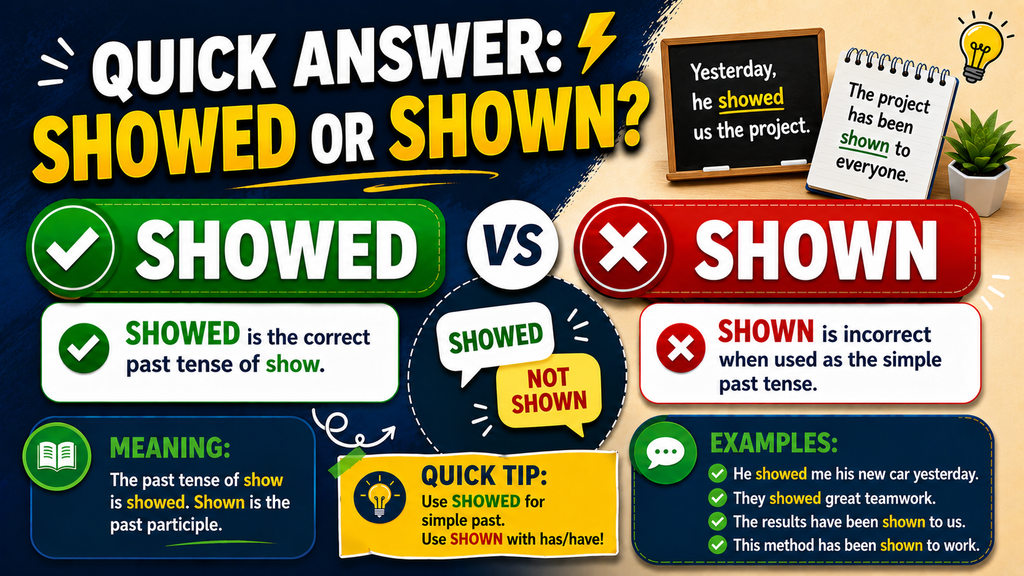
Both words are correct 👍. They’re just used in different situations 🔀.
- Showed is the simple past tense 🕒. Use it alone, with no helping verb 🚫: “He showed me the report.” 📄
- Shown is the past participle 🔗. It always needs a helping verb like has, have, had, or was/were 🤝: “He has shown me the report.” 📄
If there’s no helper verb before it, “showed” is right ✔️. If there’s a helper verb, “shown” is right ✔️.
📖 Understanding the Basics of Showed vs Shown
The verb show is irregular 🌀. That means it doesn’t follow the standard “add -ed” pattern all the way through 🚫. Most regular verbs look like walk → walked → walked 📏. Show breaks that pattern 💥:
show → showed → shown 🔁
This puts it in the same family as verbs like break → broke → broken, speak → spoke → spoken, and steal → stole → stolen 👥. In each case, the simple past and the past participle take different forms 📌.
💡 Key Insight
The real difference between showed and shown isn’t about meaning at all 🙅. Both describe the act of displaying, revealing, or demonstrating something 👀. The difference is purely grammatical ⚙️: it depends on whether a helping verb is present in the sentence 🔍.
✅ Correct Meanings & Uses
🕒 1. When to Use “Showed”
Use showed for a completed action in the simple past tense 📆, with no auxiliary verb attached 🚫.
- She showed me her new apartment. 🏠
- The teacher showed us how to solve the equation. 📐
- They showed great kindness during the crisis. ❤️
- The results showed a clear improvement. 📈
Notice that each sentence works fine without “has,” “have,” or “had” 🧐. That’s the giveaway that showed is correct 🔑.
🔗 2. When to Use “Shown”
Use shown whenever there’s a helping verb involved 🤝. This includes present perfect, past perfect, and future perfect tenses ⏳.
| Tense | Structure | Example |
|---|---|---|
| Present perfect | has/have + shown | She has shown real leadership this year. 🏆 |
| Past perfect | had + shown | They had shown interest before the deadline. ⏳ |
| Future perfect | will have + shown | By June, he will have shown measurable progress. 🚀 |
🔄 3. Passive Voice Usage
“Shown” also appears in the passive voice 🔄, where the subject receives the action rather than performing it 🎯. Passive constructions use a form of “to be” (is, are, was, were, been) followed by the past participle 🧩.
- The documents were shown to the committee. 📄
- The film was shown in theaters nationwide. 🎬
- New evidence has been shown to support the theory. 🔬
🧪 Test Tip
Not sure which form fits? Try the “eaten” test 🍰. Swap “shown” or “showed” for the verb “eaten” in your sentence 🔄:
- “He has eaten the cake” sounds natural ✅. So does “He has shown the report.” ✅
- “He eaten the cake” sounds wrong on its own ❌. So does “He shown the cake” alone ❌.
If the sentence needs a helping verb to sound complete, reach for shown 🔗. If it stands on its own, use showed 👌.
📊 Case Study Section
📧 Workplace Email Example
Consider this line from a real marketing update 💼:
❌ “The campaign has showed strong results across all channels.”
✅ “The campaign has shown strong results across all channels.”
❓ Why?
The sentence uses the helping verb “has,” which signals present perfect tense 🧠. Present perfect always pairs with the past participle “shown,” never the simple past form “showed” 🚫. A small slip like this can undercut an otherwise polished piece of business writing 📉, especially in reports, emails, and presentations where precision reflects credibility 💼.
📚 Grammar Rules Explanation
The underlying logic is simple once you break it down 🧩:
- Simple past tense describes a finished action tied to a specific point in time, like yesterday or last year 🕰️. It never needs a helper verb 🚫. → showed ✔️
- Perfect tenses connect a past action to another point in time, often now ⏱️. They always need a helper verb like has, have, had, or will have 🤝. → shown ✔️
- Passive voice shifts focus from the doer to the receiver of the action 🔄. It uses a “to be” verb plus the past participle 🧩. → shown ✔️
📋 Rule Summary
| Situation | Correct Form | Helper Verb Needed? |
|---|---|---|
| Simple past action | showed | No ❌ |
| Present/past/future perfect | shown | Yes (has/have/had/will have) ✅ |
| Passive voice | shown | Yes (is/are/was/were/been) ✅ |
| Standing alone as main verb | showed | No ❌ |
⚠️ Common Mistakes Section
The single most common error is writing “has showed” or “have showed” instead of “has shown” or “have shown” 🙅. In standard English, this is considered nonstandard 🚫, and it gets flagged in formal writing, academic papers, and professional communication 📝.
Another mix-up worth flagging: confusing shown with shone 🌞. “Shone” is the past tense of shine, not show 🔀.
- ❌ The sun has shown brightly all day. (wrong verb entirely)
- ✅ The sun has shone brightly all day. ☀️
- ✅ She has shown great patience today. 🙏
🤷 Why Do People Confuse “Showed” and “Shown”?
Most learners default to whichever form “sounds right” from casual speech 🗣️. In relaxed spoken English, “have showed” sometimes slips through unnoticed 😬. But in writing, especially formal or professional writing, the distinction matters 📌. Only “have/has/had shown” is grammatically standard ✔️.
🔀 Similar Grammar Confusions
This same simple-past-vs-past-participle pattern trips people up with other irregular verbs, too 🌀:
- Went vs gone (go → went → gone) 🚶
- Wrote vs written (write → wrote → written) ✍️
- Ate vs eaten (eat → ate → eaten) 🍽️
- Broke vs broken (break → broke → broken) 💔
🌍 Usage in Different Contexts
💬 Everyday Conversation
In casual speech, “showed” dominates 🗣️. Most day-to-day talk revolves around simple past events: “I showed him the pictures last night.” 📸
💼 Professional Writing
Reports, emails, and academic papers lean heavily on perfect tenses and passive voice to describe findings and outcomes 📊. That means shown shows up constantly: “Studies have shown a link between sleep and productivity.” 😴
✍️ Creative Writing
Fiction writers often mix both forms depending on the tense of the narrative 📖. Past tense storytelling favors “showed” 🕰️, while a character reflecting on prior events might use “had shown” 💭.
📱 Social Media/Texting
Informal platforms are more forgiving 😌. But “have showed” still reads as a mistake to grammar-conscious readers 🧐, so it’s worth getting right even in a quick tweet or caption 💬.
⭐ Why It Matters (Important Section)
Choosing the correct form isn’t just a technicality 🔍. It signals attention to detail 🎯. In a resume, cover letter, business proposal, or academic submission, an error like “has showed” can distract a reader or reviewer from your actual message 📉. Mastering irregular verbs like show/showed/shown makes your writing sound more polished, confident, and professional 💯.
🚩 Special Exception Section
There’s no true grammatical exception here, but it’s worth noting one thing 🗒️: some regional and informal dialects use “showed” in place of “shown” in casual speech, like “I’ve showed you already” 🗺️. This is common in relaxed conversation 😌, but it’s not accepted in standard, formal, or edited English 🚫. When in doubt, especially in writing, stick with the standard rule 📏.
✅ Quick Recap Checklist
- ✅ No helping verb, simple past action → showed
- ✅ Helping verb (has/have/had/will have) → shown
- ✅ Passive voice (is/are/was/were/been + verb) → shown
- ✅ Don’t confuse “shown” with “shone” (from shine)
- ✅ “Have showed” and “has showed” are incorrect in standard English
✏️ Practice Examples
Try filling in the blanks with “showed” or “shown” 📝:
- She ______ me her new car yesterday. (showed) ✔️
- The results have ______ a significant improvement. (shown) ✔️
- He ______ great courage during the storm. (showed) ✔️
- The film was ______ to a packed theater. (shown) ✔️
- By next year, the data will have ______ a clear trend. (shown) ✔️
❓ FAQs: Showed or Shown
Is “showed” ever correct with a helping verb?
No 🚫. “Showed” is only correct as a standalone simple past tense verb, never after has, have, or had ✔️.
Is “have showed” grammatically correct?
No, “have showed” is considered nonstandard ❌. The correct form is always “have shown” ✔️.
What’s the difference between shown and shone?
“Shown” comes from the verb show 🔗. “Shone” is the past tense of shine ☀️. They’re unrelated words that happen to look similar 🔤.
Do British and American English use showed and shown differently?
No 🌐. Both dialects follow the same grammatical rule: showed for simple past, shown for perfect tenses and passive voice ✔️.
Which form is more common in formal writing?
“Shown” appears more often in formal, academic, and business writing 📑. Those styles rely heavily on perfect tenses and passive voice 🔗.
How can I remember the rule quickly?
Think “showed = past, shown = paired” 🧩. If a helper verb like has, have, or had is present, use shown; otherwise, use showed ✔️.
Can “shown” be used without any helping verb?
No ❌. “Shown” always requires an auxiliary verb such as has, have, had, or a form of “to be” in passive voice 🔗.
