

You text a friend: “Let’s grab dinner next Friday.” 💬 They show up seven days later than you meant. 😅 Now you’re standing at an empty restaurant wondering where they are. 🍽️
This mix-up happens constantly, and it’s not really about grammar — both phrases are correct. ✅ It’s about interpretation. “This Friday” and “next Friday” are relative time expressions, meaning their meaning shifts depending on who’s speaking, what day it is, and even which country they’re from. 🌍
This guide breaks down exactly what each phrase means, why the confusion happens, and how to talk about Fridays — or any day of the week — without anyone showing up on the wrong date. 🗓️
Quick Answer: Next Friday vs This Friday ⚡
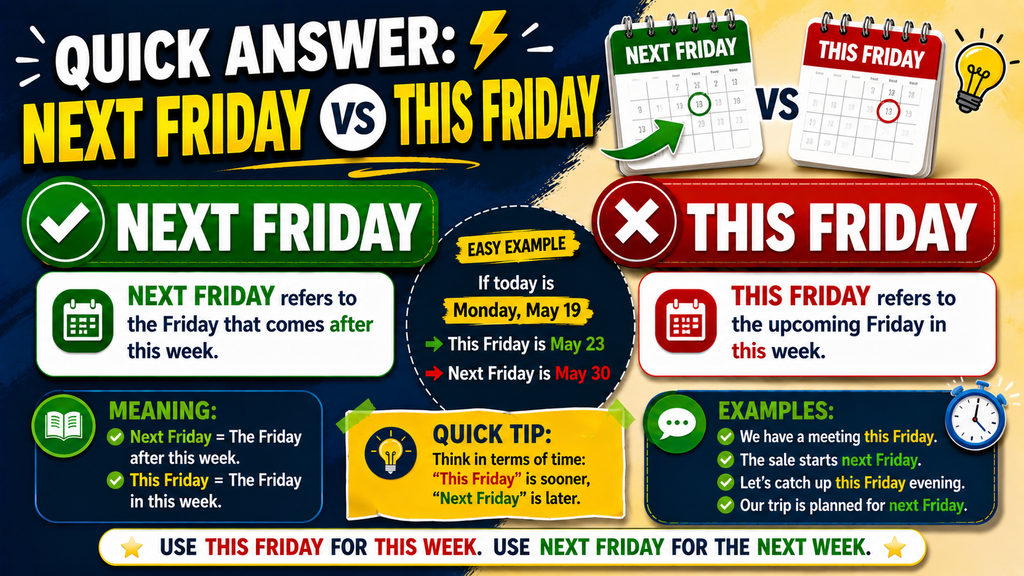
- This Friday = the Friday coming up in the current week (the nearest one on the calendar). ✅
- Next Friday = the Friday of the following week, one week after “this Friday.” ➡️
- Both are grammatically valid. 👍 The confusion comes from regional habits, workplace norms, and where you stand in the week when you say it. 🤔
- When it matters, skip the phrase entirely and use an actual date. 📌
Understanding the Basics 🧩
In English, “this” and “next” are determiners — small words that point to a specific time period relative to now. 🕐 They don’t carry a fixed date on their own; their meaning depends entirely on context. 📖
- “This” signals something inside the current cycle — the week you’re already living in. 🔵
- “Next” signals the cycle that follows — the week after the current one ends. 🟣
That sounds simple in theory. 🙂 In practice, people don’t always agree on when “this week” ends and “next week” begins, which is exactly where the confusion around next Friday vs this Friday starts. ⚠️
Comparison Table 📊
| Aspect | This Friday 🔵 | Next Friday 🟣 |
|---|---|---|
| Meaning | The Friday within the current week | The Friday of the following week |
| Typical distance | 1–5 days away ⏱️ | 7–12 days away ⏳ |
| Best used when | Today is Sunday–Thursday | Referring to a date beyond the current week |
| Common ambiguity | Said on a Friday itself — “today” or “next week”? 🤷 | Sometimes used casually to mean the nearest Friday |
| Safer alternative | “This coming Friday” | “Next Friday, the [date]” |
| Formal writing use | Acceptable with a date attached ✍️ | Best paired with an exact date ✍️ |
Correct Meanings & Uses 📝
What Does “This Friday” Mean? 🔵
“This Friday” almost always points to the closest upcoming Friday — the one that falls inside the week you’re currently in. 📅 If today is Tuesday, this Friday is just three days away. 🙌
Example: 💬 “Our team meeting is this Friday, so let’s finalize the slides by Thursday.”
Sentence Breakdown: 🔍
- This → anchors the reference to the present week. 📍
- Friday → the specific weekday being referenced. 📆
- Combined, the phrase tells the listener the event falls within days, not weeks. ⏱️
What Does “Next Friday” Mean? 🟣
“Next Friday” typically skips the closest Friday and points to the one in the following week — roughly seven to twelve days out, depending on what day it is when you say it. ⏳
Example: 💬 “Let’s push the deadline to next Friday instead of this week.”
Sentence Breakdown: 🔍
- Next → shifts the reference forward by one full cycle (one week). ➡️
- Friday → the day within that later week. 📆
- Together, the phrase communicates a date that’s further out than the immediate future. 🗓️
Test Tip 💡
A quick way to check yourself: count how many Fridays you’d need to “pass” to reach the one you mean. 🧮 If you land on it without skipping any, it’s this Friday. ✅ If you have to jump over the nearest one to get there, it’s next Friday. ⏭️
Case Study Section 📁
Workplace Scenario 🏢
Problem: ❌ A project manager emailed the team: “Let’s finalize the report next Friday.” Half the team assumed she meant the upcoming Friday (three days away). The other half assumed she meant the Friday after that. The report was submitted at two different times, and the client noticed. 😬
Improved Version: ✅ “Let’s finalize the report next Friday, September 11, by 5 PM.” 📌
Lesson: 🎯 Adding the actual date removes all guesswork. In professional writing, a relative day reference should never stand alone when a deadline is on the line. 📆
Grammar Rules Explanation 📚
Both “this Friday” and “next Friday” are grammatically correct noun phrases built from a determiner + weekday. ✅ English doesn’t enforce a universal rule for how far “this” or “next” stretches — that’s a gap filled by convention, not syntax. 🤷
A useful mental model: 🧠
- Ask how often the event occurs (weekly, for Friday). 🔁
- Ask whether it has already happened in the current cycle. ❓
- If it hasn’t happened yet, “this Friday” refers to it. ✅
- If it has already passed, people naturally shift to “next Friday” for the following occurrence. ⏭️
This logic works well from Sunday through Thursday. 👍 It breaks down on Fridays themselves, when “today” and “next week” start to blur together. 😵💫
Common Mistakes Section ❌
- Using “next Friday” to mean the very next occurrence, without realizing the listener expects it a week later. 😕
- Saying “this Friday” late on a Friday, when the day already feels “over” to the listener. 🌙
- Assuming everyone shares your definition of when the week starts (Sunday vs. Monday matters here). 📆
- Skipping a specific date in emails, texts, or calendar invites when the stakes are high. 📧
- Mixing British and American conventions without realizing the phrase can flip meaning across regions. 🌎
Why Do Mistakes Happen? 🤔
Because English treats time as relative rather than fixed. ⏳ Unlike a calendar date, “this Friday” isn’t anchored to anything permanent — it’s anchored to the speaker’s personal sense of where the week begins and ends, which varies from person to person. 🧍♂️🧍♀️
Similar Grammar Confusions 🔄
The same ambiguity shows up in other common phrases:
- This weekend vs. next weekend 🏖️
- This week vs. next week 📅
- This month vs. next month 🗓️
- Tonight vs. tomorrow night (less ambiguous, but still context-dependent) 🌃
Usage in Different Contexts 🎭
1. Everyday Conversation 💬
In casual speech, people lean on tone and shared context. 🗣️ Friends who talk often usually develop a shared understanding of what each other means — but new acquaintances or distant relatives may not. 👥
2. Professional Writing 💼
Business communication should avoid relying on “this Friday” or “next Friday” alone. 🚫 Pair the phrase with a calendar date: “next Friday, October 2” leaves no room for misread deadlines. ✅
3. Creative Writing ✍️
Writers sometimes use the ambiguity intentionally, letting a character’s uncertainty about “next Friday” mirror confusion or tension in the story. 📖 In fiction, vagueness can be a stylistic choice rather than an error. 🎨
4. Social Media / Texting 📱
Quick, informal messages often use “this Fri” or “next Fri” as shorthand. ⚡ Because there’s no tone of voice to clarify intent, misunderstandings are common — a quick date or emoji calendar reference helps. 📅
Why It Matters ⭐
A missed meeting because of a misread “next Friday” isn’t just an inconvenience — it can mean a lost client, a rescheduled flight, or a mismatched wedding vendor. 💔 The words are small, but the cost of misreading them can be real: wasted time, rebooking fees, or a damaged professional reputation. 💸 Precision in scheduling language is a communication skill, not just a grammar rule. 🎯
Special Exception Section ⚠️
- On Fridays themselves: “this Friday” can mean today, while “next Friday” jumps a full week ahead. 😲
- Weekends: Saying either phrase on a Saturday or Sunday often resets people’s mental sense of “this week,” making both terms less reliable. 🌀
- British English: Many UK speakers use “next Friday” to mean the very next occurrence, and use the phrase “Friday week” to specifically mean the Friday of the following week. 🇬🇧
- Regional US variation: Some dialects, particularly in parts of the South, also use “next Friday” to mean the nearest upcoming Friday rather than the one a week later. 🇺🇸
Quick Recap Checklist ✅
- ✅ “This Friday” = the Friday in the current week.
- ✅ “Next Friday” = the Friday in the following week.
- ✅ Both phrases are grammatically correct.
- ✅ Meaning shifts with the day you’re speaking and your regional habits.
- ✅ When precision matters, attach the actual date.
- ✅ When in doubt, just ask which Friday someone means. 🙋
Practice Examples ✏️
Try filling in the correct phrase, then check your answer below. 👇
- Today is Monday. The event is in 4 days. → ______ Friday
- Today is Wednesday. The event is 10 days away. → ______ Friday
- Today is Friday. The event is today. → ______ Friday
- Today is Sunday. The event is 5 days away. → ______ Friday
- Today is Thursday. The event is 8 days away. → ______ Friday
Answer key: 🔑 1. This Friday, 2. Next Friday, 3. This Friday, 4. This Friday, 5. Next Friday
Frequently Asked Questions: Next Friday vs This Friday ❓
Is “next Friday” always exactly 7 days away? 🕐
Not always — it depends on what day you say it. 📆 It can range from about 7 to 12 days away, since it refers to the Friday of the following week, not a fixed day count.
What does “this Friday” mean if today is Friday? 🤨
Most speakers mean today, though later in the day some shift to meaning the Friday a week from now. 🌇
Is it grammatically correct to use “next Friday” for the nearest Friday? ✍️
Yes, it’s a recognized casual usage in some regions, though it’s considered ambiguous and best avoided in formal writing. ⚠️
How do UK and US English differ on this phrase? 🌍
British English often uses “next Friday” for the immediate upcoming Friday and “Friday week” for the following week’s Friday, while American usage typically treats “next Friday” as one week further out. 🇬🇧🇺🇸
What’s the safest way to avoid confusion entirely? 🛡️
Always pair the phrase with an exact date, like “next Friday, September 11,” especially in professional or time-sensitive communication. 📌
Does “this coming Friday” mean the same thing as “this Friday”? 🔄
Yes, “this coming Friday” is a clearer variant of “this Friday” that many people use to explicitly signal the nearest upcoming one. ✅
Conclusion 🏁
“This Friday” and “next Friday” both describe real, specific days — but which day depends on the speaker, the listener, and the moment the phrase is used. 🕰️ The safest habit is simple: whenever a plan actually matters, swap the relative phrase for a calendar date. 📅 It costs a few extra words and saves everyone a scheduling headache. 🙌
