

If you’ve ever paused mid-sentence wondering whether to type “brake” or “break,” you’re not alone. ✋ These two words are homophones — they sound exactly alike but mean completely different things. Mixing them up is one of the most common English writing mistakes, and it can quietly undercut your credibility in an email, essay, or social post. This guide breaks down (pun intended 😄) everything you need to know about brake vs. break, with clear definitions, real examples, and simple tricks to keep them straight for good.
Quick Answer: Brake vs. Break ⚡
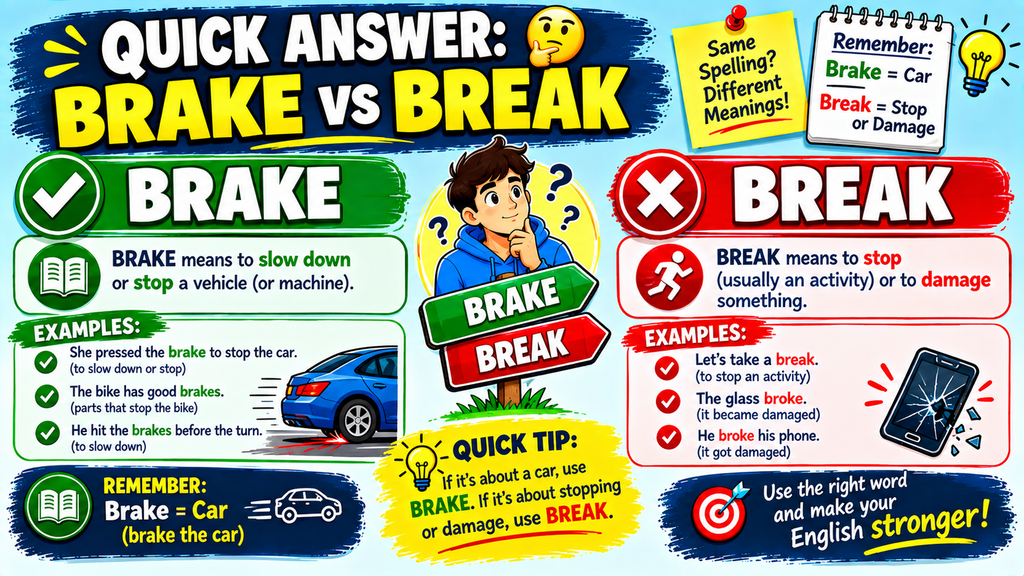
Brake is a noun and verb related to stopping or slowing motion — think of the brake pedal in a car. 🚗 Break is a verb and noun with several meanings: to separate into pieces, to pause or rest, or to violate a rule.
If the sentence is about a vehicle slowing down, use brake. If it’s about damage, rest, or breaking a rule, use break. ✅
Understanding the Basics of Brake vs. Break
Brake and break are classic homophones — words that share the same pronunciation (/breɪk/) but differ completely in spelling, meaning, and origin. 🔊 Brake comes from an old word for a crushing or restraining tool, while break traces back to the Old English “brecan,” meaning to fracture or smash. Because they sound identical, spellcheck often won’t catch the error — only understanding the meaning will.
Comparison Table 📊
| Feature | Brake | Break |
|---|---|---|
| Part of speech | Noun, verb | Noun, verb |
| Core meaning | To stop or slow motion | To separate, pause, or violate |
| Common use | Vehicles, machines | Rest, damage, rules |
| Example | “Press the brake.” | “Take a break.” |
| Past tense (verb) | braked | broke |
| Past participle | braked | broken |
What Does “Brake” Mean? 🛑
Brake almost always relates to stopping or controlling motion, most often in vehicles and machinery.
Brake as a Noun
As a noun, a brake is the physical device — like a brake pedal, hand brake, or parking brake — that slows or stops a car, bike, or machine.
Examples:
- Always check your brake fluid before a long road trip. 🔧
- She pulled the emergency brake on the steep hill.
- His bike brakes squeaked every time he stopped.
Sentence breakdown: In “The car’s brakes failed on the highway,” brakes is the subject — the physical part of the vehicle, usually written in plural since a car has more than one.
Brake as a Verb
As a verb, to brake means to apply that device — to slow down or stop.
Examples:
- Brake gently when roads turn icy to avoid skidding. ❄️
- The driver braked hard to avoid the deer.
- You should brake before entering a curve, not during it.
Test tip: If you can swap the word for “slow down” or “stop,” you need brake — and remember, brake shares its “a” with car. 🚘
What Does “Break” Mean? 💥
Break is one of the most versatile words in English, with dozens of shades of meaning. Here are the three you’ll use most often.
Meaning 1: To Separate Into Pieces
Break means to damage, shatter, or divide something, often suddenly and by force.
Examples:
- Be careful not to break the vase. 🏺
- The branch broke under the snow’s weight.
- I accidentally broke my phone screen.
Sentence breakdown: In “She broke the plate,” broke is the past-tense verb showing an action that physically damaged an object.
Meaning 2: To Take a Pause
Break also means a rest or interruption from an activity — one of its friendliest, most positive uses.
Examples:
- Let’s take a coffee break. ☕
- The kids can’t wait for spring break.
- We’ll break for lunch at noon.
Sentence breakdown: In “I need a break,” break functions as a noun meaning a short period of rest.
Meaning 3: To Violate a Rule
Break can also mean to disobey, disrupt, or fail to keep something — a rule, promise, habit, or record.
Examples:
- Don’t break the law just to save time. 🚫
- He broke his promise to call.
- The sprinter broke the world record.
Test tip: If the sentence involves rules, promises, records, or hearts, it’s always break — never brake. 💔
Real-Life Case Studies: Brake vs. Break in Action 📝
Seeing these words in realistic, everyday writing makes the difference much easier to remember.
Workplace Email Example
❌ Incorrect: “Please take a brake before the client call — you’ve earned it.” ✅ Correct: “Please take a break before the client call — you’ve earned it.”
A single wrong letter here can make otherwise polished writing look careless. ✉️
Everyday Conversation Example
❌ Incorrect: “I had to break hard when the light turned red.” ✅ Correct: “I had to brake hard when the light turned red.”
Since the sentence is about slowing a car, brake — the action of using the brakes — is the only correct choice. 🚦
Grammar Rules: How to Never Mix Them Up Again
Rule 1: Brake Relates to Stopping Motion
Whenever a sentence is about vehicles, machines, or bringing movement under control, use brake. Example: “Cyclists should brake early on wet pavement.” 🚴
Rule 2: Break Relates to Separating, Pausing, or Violating
If the sentence involves damage, rest, interruption, or disobedience, use break. Example: “Don’t break your concentration during the exam.” 📚
Why One Is Correct and the Other Isn’t
✅ Correct: “She slammed on the brakes to avoid the cat.” ❌ Incorrect: “She slammed on the breaks to avoid the cat.”
The sentence describes stopping a moving vehicle, so only the noun brakes — the physical stopping mechanism — fits.
Common Mistakes With Brake and Break (and Why They Happen)
Why the Mistakes Happen
- Fast typing: When typing quickly, fingers often default to the more familiar or frequent word. ⌨️
- Autocorrect: Since both words are spelled correctly on their own, autocorrect and spellcheck rarely flag the error. 📱
- Lack of knowledge: Many writers never learned the distinct meanings, since the words are taught together and sound identical.
Similar Grammar Confusions Table
| Word Pair | Quick Tip |
|---|---|
| Their / There / They’re | Their = possession, There = place, They’re = “they are” |
| Its / It’s | Its = possession, It’s = “it is” |
| Affect / Effect | Affect = verb (to influence), Effect = noun (a result) |
| Then / Than | Then = time, Than = comparison |
| Brake / Break | Brake = stop, Break = separate, pause, or violate |
Using Brake and Break in Different Contexts
| Context | Brake Example | Break Example |
|---|---|---|
| Everyday conversation | “Hit the brakes!” | “I need a break.” |
| Professional writing | “Inspect the brake system monthly.” | “Let’s break down the quarterly report.” |
| Creative writing | “The train’s brakes screamed against the rails.” | “Her heart broke at the news.” |
| Social media & texting | “Brake check on the freeway 😅” | “Taking a mental-health break today 🌿” |
On social media, the most common error is typing “brakes” when you mean a rest (❌ “I need brakes”) instead of “breaks” (✅ “I need a break”) — often because mobile autocomplete favors whichever word you’ve typed most recently.
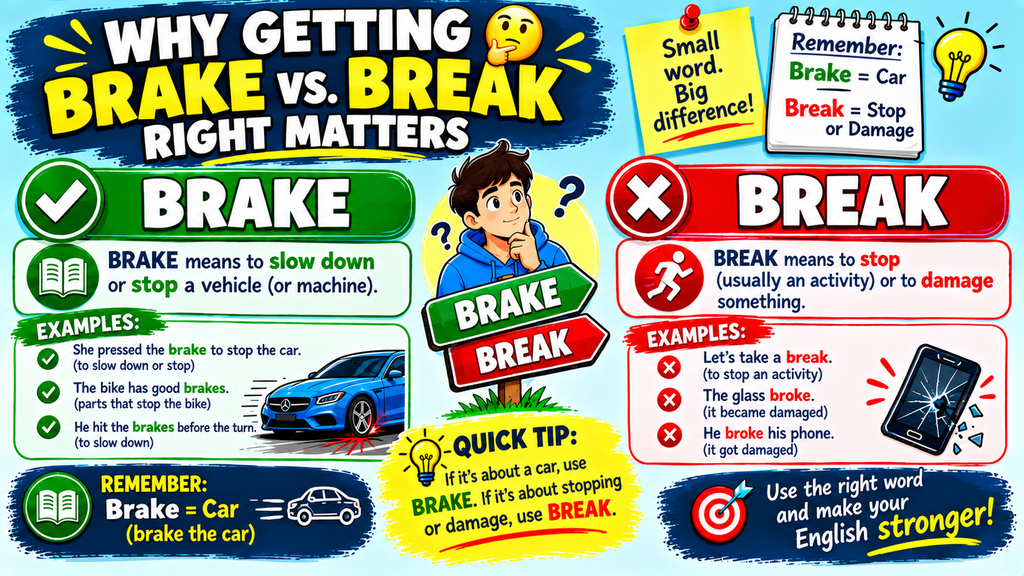
Why Getting Brake vs. Break Right Matters
Clarity in Communication
Using the wrong word can genuinely confuse a reader, even for a split second. “I need to brake from studying” reads oddly, since it briefly suggests a vehicle instead of a rest. 🤔
Professionalism
In resumes, emails, and reports, a brake/break mix-up is a small error that can still make writing look rushed — exactly the kind of detail editors and hiring managers notice.
Writing Accuracy in the Digital Age
With so much writing now happening on phones and in a hurry, homophone slip-ups like this one have become more common, not less — which is exactly why a quick mental check before hitting send is worth the extra second. ⏱️
Special Exception: The Metaphorical “Brake”
Brake isn’t limited to literal vehicles — it’s often used figuratively to describe slowing any process, such as an economy, a trend, or a plan.
Example: “Regulators want to put the brakes on rising inflation.” Here, brakes describes control over an abstract system, not an actual car. 📉
Quick Recap Checklist ✅
- Use brake for vehicles, machines, or stopping motion. 🚗
- Use break for damage, pauses, or broken rules. 🧩
- Remember: brake shares its “a” with car; break shares its energy with “rest” and “rules.”
- When unsure, try substituting “stop” (brake) or “pause/separate” (break) into the sentence.
Brake or Break? Decision Table
| Ask Yourself | If Yes → Use | If No → Use |
|---|---|---|
| Is it about a vehicle or machine slowing down? | Brake | Break |
| Is something being damaged or divided? | Break | Brake |
| Is it a pause, rest, or interruption? | Break | Brake |
| Is a rule, promise, or record being violated? | Break | Brake |
Practice Examples: Test Yourself 🧠
- I need to ______ before I finish this report. (break)
- She had to ______ suddenly to avoid the pothole. (brake)
- Don’t ______ the news to him over text. (break)
Frequently Asked Questions ❓
Is “brake” pronounced the same as “break”?
Yes, both words are pronounced identically as /breɪk/, which is exactly why they’re so easy to confuse in writing. 🔊
Is it “lunch break” or “lunch brake”?
It’s always “lunch break,” since it refers to a pause from work, not a vehicle part.
Can “break” ever mean to stop?
Not directly — “break” means to pause or interrupt an activity, while “brake” is the word for physically stopping motion.
What is the past tense of “break”?
The past tense is “broke,” and the past participle is “broken,” as in “I broke my phone.”
Is “brake” always plural in sentences about cars?
Not always, but “brakes” is common since most vehicles have more than one brake.
Does “breakfast” relate to “brake”?
No — “breakfast” comes from “break” + “fast,” meaning to end an overnight fast, with no connection to brakes. 🍳
What does “give me a break” mean?
It’s an idiom asking for leniency or patience, unrelated to vehicles, and it’s always spelled with break.
Conclusion
Brake and break may sound identical, but their meanings couldn’t be more different — one stops a car, the other separates, pauses, or breaks a rule. 🚗💨 Anchor brake to vehicles and machines, and break to everything else — damage, rest, and rule-breaking — and you’ll never have to second-guess yourself again. Keep this guide handy, and let your writing hit the right word every time. ✅
