

If you’ve ever paused mid-sentence wondering whether it’s “choosing” or “chosing,” you’re not alone. 😅 This tiny spelling mix-up shows up in emails, essays, and social captions every single day. The good news? The answer is simple, and once you learn the rule, you’ll never second-guess it again. 🎯
Quick Answer: Choosing or Chosing
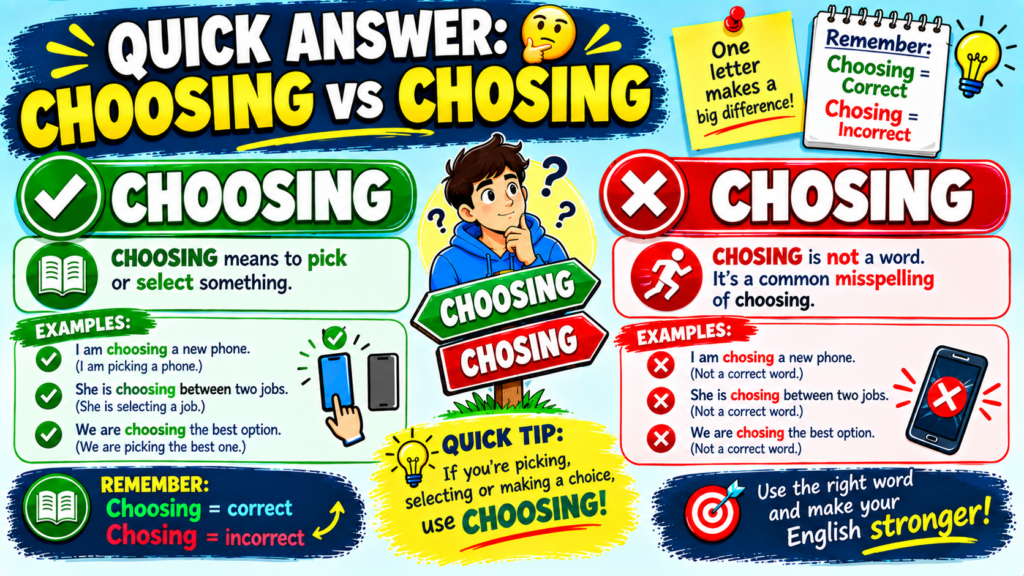
“Choosing” is correct. “Chosing” is always a misspelling. ✅
“Choosing” is the present participle (or gerund) of the verb “choose,” and it keeps both “o” letters from the base word. 📝 “Chosing” doesn’t appear in any standard English dictionary, no matter how it’s used in a sentence. ❌
Understanding the Basics: Choosing or Chosing
The confusion usually starts because “choose” has a past-tense form, “chose,” with only one “o.” 🧩 Writers sometimes blend that spelling with the “-ing” ending and accidentally drop a letter, landing on “chosing” instead of “choosing.” The fix is easy once you remember that “-ing” always attaches to the full base verb, “choose,” not its past-tense cousin. 💡
Comparison Table
| Feature | Choosing ✅ | Chosing ❌ |
|---|---|---|
| Dictionary status | Recognized standard word | Not a real word |
| Part of speech | Present participle / gerund | N/A |
| Spelling origin | Base verb “choose” + “-ing” | Incorrect blend of “chose” + “-ing” |
| Example sentence | She is choosing a career path. | She is chosing a career path. |
| Use in formal writing | Always acceptable | Never acceptable |
Correct Meanings and Uses
What Does “Choosing” Mean?
“Choosing” describes the ongoing act of selecting or deciding between options. 🎯 It’s the “-ing” form of “choose,” used in continuous tenses (“is choosing,” “was choosing”) and as a gerund (a verb acting like a noun).
Examples
- I am choosing a new laptop for work. 💻
- They are choosing between two apartments. 🏠
- Choosing a career path takes patience. 🧭
- Thank you for choosing our service. 🙏
Test Tip
Say the word slowly: “choo-sing.” 🗣️ If you can hear that long “oo” sound, both o’s belong in the spelling.
Why “Chosing” Is Wrong
“Chosing” borrows the single “o” from “chose,” the past-tense form of “choose,” and mistakenly pairs it with “-ing.” 🚫 That combination has no place in standard English grammar.
Incorrect Examples
- She is chosing a gift. ❌
- We were chosing the venue. ❌
Correct Versions
- She is choosing a gift. ✅
- We were choosing the venue. ✅
Test Tip
If a spell-checker underlines the word in red, that’s your sign to double the “o.” 🔍
Case Study Section
Workplace Email Example
A small mistake like this can slip into professional writing more often than people expect. 📧
Incorrect Version
“We are currently chosing a vendor for the new project.” ❌
Correct Version
“We are currently choosing a vendor for the new project.” ✅
Lesson Learned
One missing letter can make an otherwise polished email look careless. 🧠 Proofreading for common misspellings like this protects your credibility at work.
Grammar Rules Explanation
Rule 1: Present Participles End in “-ing”
Every present participle is formed by adding “-ing” to a base verb, and that base verb’s spelling is preserved as much as possible. 📘
Rule 2: The Verb “Choose” Retains Its Double “O”
Since “choose” is spelled with two o’s, its “-ing” form logically keeps both: c-h-o-o-s-i-n-g. 🔤 Only the silent “e” at the end is dropped before adding the suffix.
Rule 3: Standard Dictionary Recognition
Merriam-Webster, Oxford, and Cambridge all list “choosing” as the correct form. 📖 None of them recognize “chosing” as a word, which settles the debate for good.
Common Mistakes
- Writing “chosing” instead of “choosing” in emails and essays ✍️
- Confusing “choosing” (present) with “chose” (past) or “chosen” (past participle) 🔄
- Relying on autocorrect instead of checking the spelling manually 📱
- Typing quickly and skipping the second “o” by accident ⌨️
Why the Mistake Happens
1. Fast Typing
When typing quickly, it’s easy to drop a repeated letter without noticing. ⚡
2. Autocorrect Dependence
Some keyboards fail to flag “chosing” as an error, letting the mistake slip through. 📲
3. Lack of Knowledge
Many people simply haven’t learned the “-ing” spelling rule for verbs like “choose.” 🎓
4. Pronunciation Confusion
Because “chose” and “choosing” sound somewhat similar when spoken fast, writers sometimes mirror the wrong spelling. 🗣️
Similar Grammar Confusions
This isn’t the only verb that trips people up when adding “-ing.” Similar mix-ups include:
| Base Verb | Correct “-ing” Form | Common Misspelling |
|---|---|---|
| Choose | Choosing | Chosing |
| Lose | Losing | Loosing |
| Believe | Believing | Beleiving |
| Argue | Arguing | Aruging |
Usage in Different Contexts
Everyday Conversation
In casual speech, “choosing” flows naturally: “I’m choosing pizza tonight.” 🍕
Professional Writing
In reports, resumes, and emails, correct spelling signals attention to detail. 💼
Creative Writing
Authors use “choosing” to show a character’s inner conflict or decision-making moment. 📚
Social Media and Texting
Even in casual captions, “choosing” stays the same — texting shorthand doesn’t change spelling rules. 📱
Why It Matters (Important)
Clarity in Communication
Correct spelling keeps your message clear and prevents readers from pausing over an odd-looking word. 🔎
Professionalism
Small errors like “chosing” can quietly undermine trust in resumes, proposals, and client emails. 🧑💼
Digital Communication Accuracy
Search engines and readers alike favor clean, accurate writing, which also helps content rank better online. 📈
Quote
“Words are the only bridge between what we think and what others understand.” 🌉
Special Exception
Are There Any Exceptions?
No. 🚫 “Chosing” is never correct, in any dialect, tense, or context of standard English. The only acceptable form of this “-ing” verb is “choosing.”
Quick Recap Checklist
- ✅ Use “choosing” for the present participle or gerund form.
- ✅ Keep both o’s from the base verb “choose.”
- ✅ Use “chose” for simple past tense.
- ✅ Use “chosen” for the past participle.
- ❌ Never write “chosing” — it isn’t a real word.
Decision Table
| If you mean… | Use this word |
|---|---|
| An action happening now | Choosing |
| A completed action (past) | Chose |
| Paired with “have/has/had” | Chosen |
| A single-o spelling of any kind | Never correct |
Practice Examples
Example 1
Fill in the blank: “She is ______ a college major.” → Answer: choosing ✅
Example 2
Fill in the blank: “They ______ a restaurant last night.” → Answer: chose ✅
Example 3
Fill in the blank: “He has ______ his path in life.” → Answer: chosen ✅
Conclusion
The choice between “choosing” and “chosing” really isn’t a choice at all. 😊 “Choosing” is the only correct spelling, and remembering the double “o” from its base verb “choose” is all it takes to get it right every time. Whether you’re writing a work email, a school essay, or a quick text, using the correct spelling keeps your communication clear, professional, and polished. ✨
frequently asked questions: Choosing or Chosing
Is “chosing” ever correct in British or American English?
No, “chosing” is not recognized as correct in either British or American English. 🚫
Why do people misspell “choosing” as “chosing”?
Most people confuse it with the past-tense word “chose,” which only has one “o.” 🔄
What part of speech is “choosing”?
“Choosing” functions as a present participle or a gerund, depending on the sentence. 📘
How do you remember the correct spelling of “choosing”?
Say it slowly as “choo-sing” and remember the base verb “choose” keeps both o’s. 🗣️
Is “choosing” the same as “choose”?
No, “choose” is the base present-tense verb, while “choosing” is its continuous “-ing” form. ⏳
Can “chosing” be used informally, like in texting?
No, even informal writing should use “choosing,” since “chosing” isn’t a real word in any context. 📱
