

If you’ve ever paused mid-sentence wondering whether to say “how long” or “how much time,” you’re not alone 😅. These two phrases look like they mean the same thing, and honestly, most of the time they do — but native speakers pick between them based on subtle cues like formality, tone, and sentence structure. Get this wrong in a job interview or a business email, and it can make your English sound slightly “off,” even if no rule was technically broken ✍️.
This guide breaks down exactly when to use “how long” versus “how much time,” with real examples, a comparison table, common mistakes, and quick tests you can use to check yourself in seconds ⏱️.
Quick Answer: How Long vs How Much Time
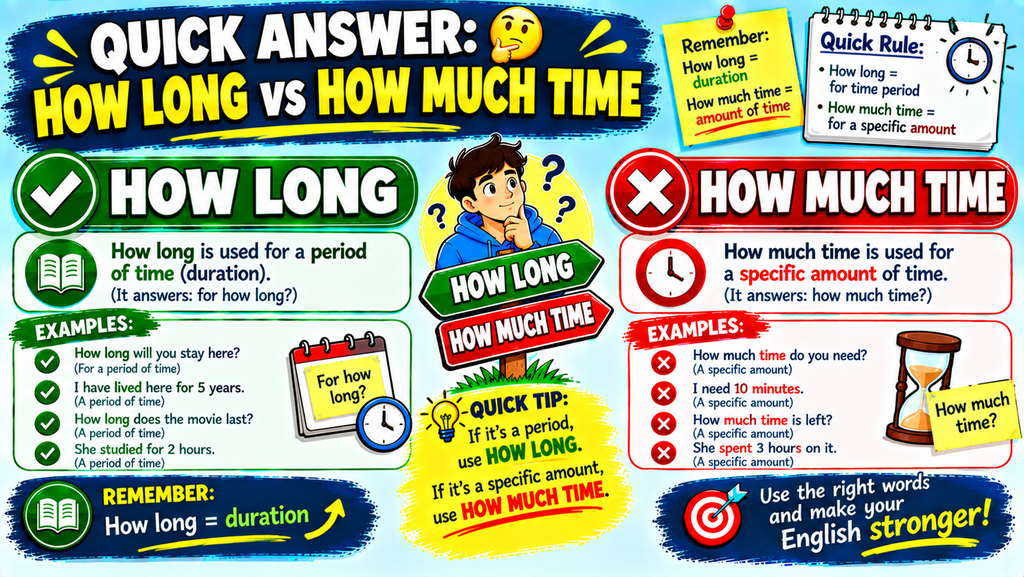
“How long” asks about the duration of something — how many minutes, hours, days, or years it takes or has taken ⏳. “How much time” asks about the quantity of time available, needed, or remaining, and tends to sound slightly more deliberate or formal 📋. In casual speech, they’re often interchangeable, but “how long” is far more common in everyday conversation.
Understanding the Basics: How Long vs How Much Time
Both phrases function as question starters used to ask about time, and both are grammatically correct in almost every situation 👍. The real difference lies in emphasis and register:
- “How long” treats time as a stretch or span — think of a timeline being measured end to end.
- “How much time” treats time as a resource — something you have, need, spend, or run out of.
This is why you’ll hear “how much time do I have left?” in a countdown-style situation, but “how long will this take?” when someone is simply curious about duration.
Comparison Table
| Feature | “How Long” | “How Much Time” |
|---|---|---|
| Core meaning | Duration / length of time | Quantity / amount of time |
| Formality level | Neutral to informal | Slightly more formal |
| Common tense | Present perfect, past simple | Present simple, future simple |
| Typical use case | General duration questions | Time management, deadlines, allocation |
| Sentence position | Start of question | Start of question |
| Example | “How long have you worked here?” | “How much time do we have for the meeting?” |
| Followed directly by “time”? | ❌ Never (“how long time” is incorrect) | ✅ Always includes “time” |
Correct Meanings & Uses
1. “How Long” — Asking About Duration
“How long” is the go-to phrase when you want to know the total span of an action, event, or state 📏. It’s used constantly in spoken and written English alike.
Examples:
- How long have you lived in this city?
- How long does the flight take?
- How long did the meeting last?
- How long will you be away?
Sentence Breakdown: The structure is simple: How long + auxiliary verb (have/does/did/will) + subject + main verb. Notice that “how long” is almost always paired with a verb that implies a span — live, take, last, stay — rather than a fixed quantity.
Test Tip: If you can naturally answer with a time span like “three years” or “two hours,” “how long” is the correct choice ✅.
2. “How Much Time” Asking About Quantity
“How much time” treats time as something countable and finite, similar to asking “how much water” or “how much money” 💧. It’s often used when time is being measured, allocated, or running out.
Examples:
- How much time do you need to finish this report?
- How much time is left before the deadline?
- How much time should I spend on each section?
- How much time do we have until the flight boards?
Sentence Breakdown: Here the structure leans on “time” as a noun being quantified: How much time + do/does/is + subject + verb. The phrase works especially well when there’s a limit, budget, or countdown involved.
Test Tip: If the sentence is really asking “what quantity” rather than “for how long,” “how much time” fits more naturally ⏰.
Case Study Section
Workplace Email Example
Imagine two versions of the same email to a manager:
Version A: “How long will the onboarding process take?” Version B: “How much time will the onboarding process take?”
Both are correct, but Version A sounds slightly more natural and is what most native English speakers would write 📧.
Why?
“How long” is the default, unmarked choice for asking about process duration in professional writing. “How much time” is reserved for moments where time is explicitly being budgeted, such as scheduling a meeting.
Another Example:
- Natural: “How long is the project timeline?”
- Also natural (budgeting context): “How much time should we allocate for testing?”
Grammar Rules Explanation
Key Rule:
“How long” is never followed directly by the word “time.” Saying “how long time” is a common non-native error and is grammatically incorrect ❌. If you want to include the word “time,” you must use “how much time” instead.
Important Note:
You can say “how long a time,” though it sounds formal and slightly old-fashioned — for example, “How long a time will we have to wait?” This is grammatically valid but rare in modern conversational English.
Common Mistakes Section
Why Do People Get Confused?
The confusion usually comes from direct translation. In many languages, the equivalent of “how long” literally translates to “how much time,” so learners assume the English phrases work identically — but English separates duration (“long”) from quantity (“much time”) 🌍.
Frequent Mistakes:
- ❌ “How long time did it take?”
- ❌ “How many long is the movie?”
- ❌ “How much long do you need?”
Correct Forms:
- ✅ “How long did it take?”
- ✅ “How long is the movie?”
- ✅ “How much time do you need?”
Similar Grammar Confusions
This mix-up sits alongside other commonly confused time-related question words:
- How long vs How often — duration vs frequency (“How long do you exercise?” vs “How often do you exercise?”)
- How long vs How far — time vs distance (“How long is the drive?” vs “How far is it?”)
- How many vs How much — countable vs uncountable nouns (“How many hours?” vs “How much time?”)
Usage in Different Contexts
1. Everyday Conversation
“How long” dominates casual speech: “How long till dinner?” 🍽️
2. Professional Writing
Both appear, but “how much time” is common in project planning and scheduling documents 📊.
3. Creative Writing
Writers often use “how long” for emotional or reflective tone: “How long had she waited for this moment?” 📖
4. Social Media & Texting
Shortened, informal versions dominate: “how long tho 😭” — “how much time” is rarely used in casual texting.
Why It Matters
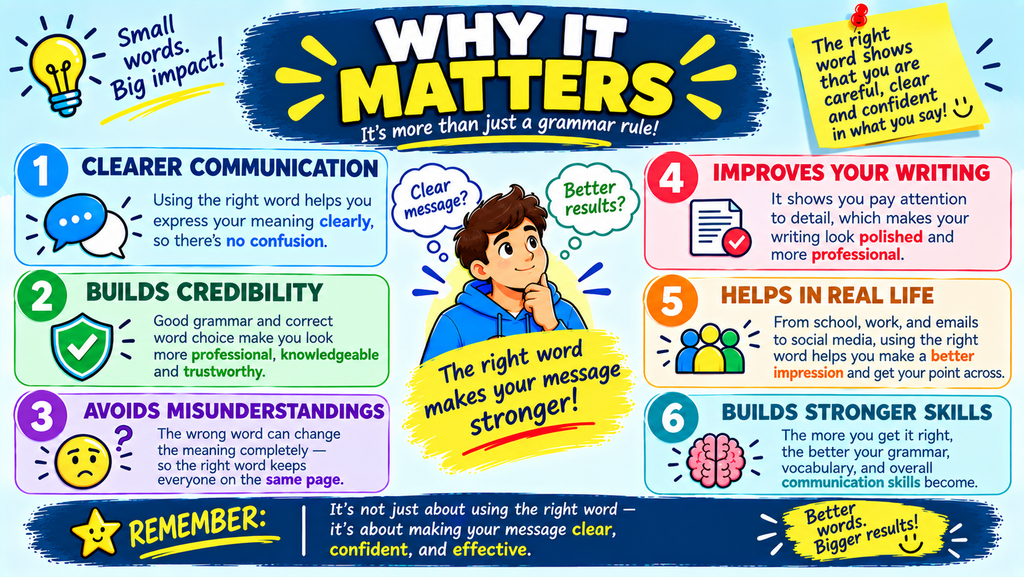
Choosing the right phrase affects how natural, professional, or fluent your English sounds 🎯. Mixing them up rarely causes miscommunication, but it can signal non-native phrasing in interviews, essays, and formal writing — places where precision counts.
Special Exception Section
There’s one notable exception: when asking about a specific remaining quantity, “how much time” is strongly preferred over “how long,” even in casual speech. For example, during an exam or a game show, you’d naturally hear “How much time is left?” rather than “How long is left?” — because the emphasis is on remaining quantity, not total span ⏳.
Quick Recap Checklist
- ✅ Use “how long” for general duration questions
- ✅ Use “how much time” when time is a resource being measured or allocated
- ✅ Never say “how long time”
- ✅ “How much time” always includes the word “time”
- ✅ “How long” pairs well with present perfect tense
- ✅ Both are grammatically correct — context decides which sounds natural
Practice Examples:
- _____ have you been studying English? (how long)
- _____ do we have before the store closes? (how much time)
- _____ does it take to bake a cake? (how long)
- _____ should I budget for revisions? (how much time)
frequently asked questions Section
Is “how long” more common than “how much time”?
Yes, “how long” is used far more frequently in both spoken and written English 🗣️.
Can “how long” and “how much time” be used interchangeably?
In many casual contexts, yes — but “how much time” fits better when time is being measured or allocated.
Is “how long time” grammatically correct?
No, this is a common error. Use either “how long” alone or “how much time.”
Which phrase is more formal?
“How much time” tends to sound slightly more formal or precise than “how long.”
What verb tense goes best with “how long”?
“How long” is frequently paired with the present perfect tense, as in “How long have you lived here?”
Does “how much time” work in the past tense?
Yes — for example, “How much time did you spend on that project?” is correct.
Is “how long a time” acceptable to say?
It’s grammatically correct but sounds formal and is rarely used in everyday speech.
Mastering “how long” vs “how much time” comes down to one simple habit: ask yourself whether you’re measuring a span or a quantity 🧭. Once that distinction clicks, choosing the right phrase becomes automatic — and your English will sound noticeably more natural in conversations, emails, and everyday questions alike 🌟.
