

If you’ve ever paused mid-sentence wondering whether to write “scrap that idea” or “scrape that idea,” you’re not alone 🤔. These two words look alike, sound almost alike, and even share a common word history — but they mean very different things.
This guide breaks down scrap vs scrape in plain English, with clear definitions, real-life examples, a comparison table, and quick tips so you never mix them up again.
Quick Answer: Scrap or Scrape Meaning
Here’s the short version before we dig deeper 👇
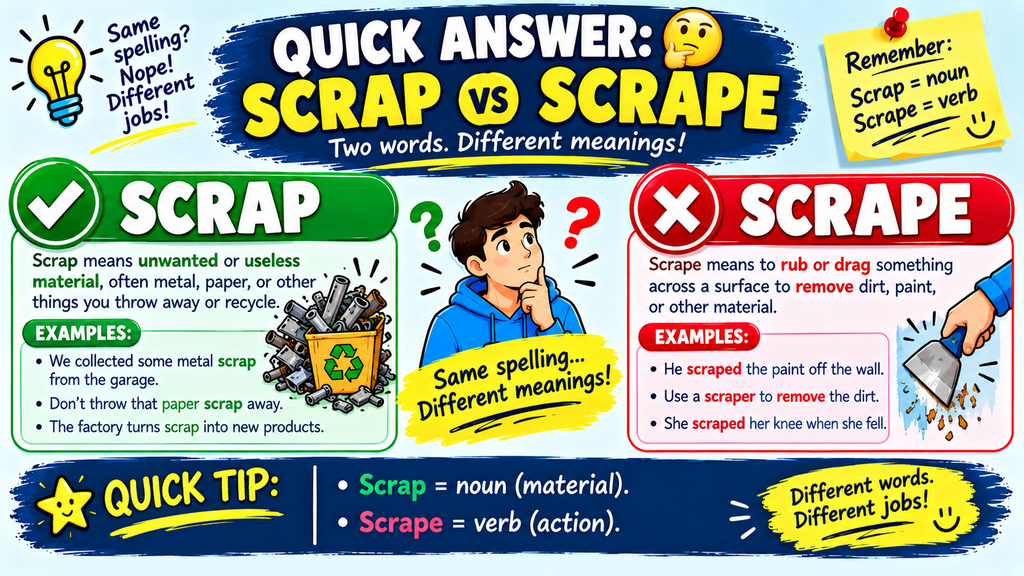
- Scrap = a small leftover piece or waste material (noun), or to cancel/abandon something (verb).
- Scrape = to rub, scratch, or drag something across a surface, or to gather something with effort (verb).
If you’re canceling a plan, you scrap it. If you’re rubbing paint off a wall, you scrape it. ✅
Understanding the Basics: Scrap vs Scrape
Basic Definitions
Scrap most often shows up as a noun describing a small piece of something — paper, metal, fabric, or food — or as a verb meaning to throw out a plan entirely. Think of “scrap paper” or “scrap the proposal.”
Scrape, on the other hand, is almost always about motion. It describes the physical act of dragging, rubbing, or scratching one surface against another, or the effort of collecting something bit by bit — like when you “scrape together” enough cash for rent. 💰
Comparison Table: Scrap vs Scrape
| Feature | Scrap | Scrape |
|---|---|---|
| Part of speech | Noun & verb | Verb (& noun, less common) |
| Core meaning | Small piece / waste; to cancel | To rub, scratch, or drag; to gather with effort |
| Past tense | Scrapped | Scraped |
| Common phrases | scrap metal, scrap paper, scrap the plan | scrape by, scrape together, scrape off |
| Example | “We scrapped the trip.” | “She scraped mud off her boots.” |
| Pronunciation | Short “a” (rhymes with “cap”) | Long “a” (rhymes with “tape”) |
Correct Meaning and Uses of “Scrap” ✂️
1. Scrap as a Verb (To Cancel or Abandon)
When used as a verb, scrap means to drop a plan, idea, or project completely — usually because it’s no longer useful or workable.
Examples:
- The company decided to scrap the merger after the board raised concerns. 📉
- We had to scrap our vacation plans due to the storm.
- The government scrapped the outdated policy last year.
2. Scrap as a Noun (Small Piece or Waste Material)
As a noun, scrap refers to a leftover fragment, discarded material, or a small bit of something.
Examples:
- She jotted the address on a scrap of paper. 📝
- The workshop floor was covered in scrap wood.
- He sold the old car for scrap metal.
Test Tip for “Scrap” 💡
If you can replace the word with “cancel” or “small piece,” it’s scrap — not scrape.
Correct Meaning and Uses of “Scrape” 🧽
1. Scrape as a Verb (To Scratch or Rub)
This is the most familiar use — scrape describes the physical action of rubbing or dragging something rough against a surface.
Examples:
- Be careful not to scrape your knee on the pavement. 🩹
- He scraped the ice off the windshield before driving.
- The chair scraped loudly across the wooden floor.
2. Scrape as a Verb (To Collect or Remove)
Scrape also means to gather something slowly and with effort, or to remove something layer by layer.
Examples:
- They managed to scrape together enough money for tuition. 🎓
- Analysts often scrape data from websites for research.
- We barely scraped by during the first year of business.
Test Tip for “Scrape” 💡
If the sentence involves rubbing, scratching, or gathering something with effort, scrape is correct.
Case Study: Scrap or Scrape in Real Life 📋
Workplace Email Example
“After reviewing the budget, we’ve decided to scrap the Q3 marketing campaign. Please scrape together any usable assets from it before the files are archived.”
Explanation
Notice both words appear naturally in one message — “scrap” cancels the campaign, while “scrape together” describes salvaging leftover materials. This is exactly how native speakers use both words in the same context without confusion. ✅
Real Conversation Example
A: “Are we still doing the rooftop event?” B: “Nah, we scrapped it — too expensive. I did scrape up a backup venue, though.”
Grammar Rules Behind the Confusion 📚
Why the Confusion Happens
Interestingly, scrap and scrape actually share a common ancestor. Both trace back to an Old Norse root meaning “to scratch or cut away.” Over centuries, English speakers split the word into two distinct paths — one for physical scratching (scrape) and one for leftover fragments and cancellation (scrap). That shared history is exactly why the two words still feel so closely linked today. 🧬
Another grammar quirk worth knowing: because “scrap” has a short vowel sound, its past tense doubles the consonant — scrapped. Because “scrape” has a long vowel sound, its past tense does not double the consonant — scraped.
Common Mistakes: Scrap vs Scrape ⚠️
| Incorrect | Correct | Why |
|---|---|---|
| “They scrape the project.” | “They scrapped the project.” | Cancelling requires “scrap,” not “scrape.” |
| “He scrap his knee.” | “He scraped his knee.” | Physical injury requires “scrape.” |
| “We need to scrape this idea.” | “We need to scrap this idea.” | Abandoning an idea uses “scrap.” |
| “She scrap the wall clean.” | “She scraped the wall clean.” | Removing a layer requires “scrape.” |
Why People Confuse Scrap and Scrape
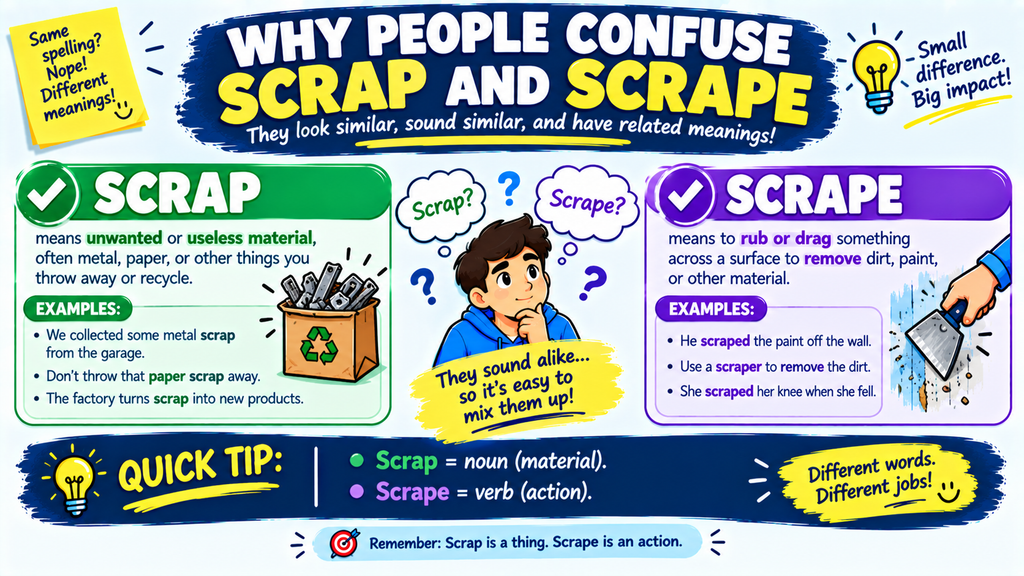
- Nearly identical spelling with just one extra letter 🔤
- Similar pronunciation, especially in fast or casual speech
- Shared etymological root (both from Old Norse “skrapa”)
- Both words can relate to “old” or “used” materials in certain contexts
Common Grammar Confusion Table
| Word Form | Base Verb | Past Tense | Meaning |
|---|---|---|---|
| Scrap → Scrapped | scrap | scrapped | cancelled / discarded |
| Scrape → Scraped | scrape | scraped | rubbed / gathered |
Usage in Different Contexts 🌍
1. Everyday Conversation
“I scraped my elbow on the fence” or “we scrapped the picnic” — both are common in casual speech. 🗣️
2. Professional Writing
Business writing often uses “scrap” for cancelled projects and “scrape” for data collection, as in “we scraped customer reviews for sentiment analysis.” 💼
3. Creative Writing ✍️
Writers use “scrape” for vivid, sensory imagery (a knife scraping against a plate) and “scrap” for finality (scrapping a character’s storyline).
4. Social Media/Texting
Shortened, casual usage is common: “lol scrap that plan 😂” or “just scraped by on the exam 😅.”
Why It Matters
Mixing up scrap and scrape might seem minor, but it can confuse readers or make professional writing look careless. ✅ Using the correct word signals attention to detail — something that matters in emails, resumes, reports, and content that needs to rank well on search engines.
Special Exception Section
One tricky overlap: the phrase “scrap heap” refers to a pile of discarded materials, while “scrape by” refers to barely managing financially. They sound similar in rhythm but serve completely different purposes — so context, not sound, should always guide your choice. 🎯
Quick Recap Checklist ✅
- Use scrap for cancelling plans or referring to small leftover pieces.
- Use scrape for rubbing, scratching, or gathering something with effort.
- Past tense: scrapped (double p) vs scraped (single p).
- When unsure, ask: “Am I cancelling something, or physically rubbing/gathering something?”
Practice Examples 📝
Fill in the blank with scrap or scrape:
- He _______ the paint off the old door. (scraped)
- The team decided to _______ the entire redesign. (scrap)
- She kept a _______ of fabric from her wedding dress. (scrap)
- They had to _______ together enough supplies for the trip. (scrape)
- My car got a _______ in the parking lot. (scrape)
Frequently Asked Questions
Is it “scrap that idea” or “scrape that idea”?
It’s “scrap that idea” — meaning to abandon or cancel it. 🎯
What is the past tense of scrap?
The past tense of scrap is “scrapped,” with a doubled consonant.
What is the past tense of scrape?
The past tense of scrape is “scraped,” without a doubled consonant.
Can “scrape” ever mean the same as “scrap”?
No — scrape always relates to rubbing or gathering, never to cancelling a plan.
What does “scrape by” mean?
“Scrape by” means to manage or survive with just barely enough resources.
What does “scrap metal” mean?
“Scrap metal” refers to discarded or leftover metal collected for recycling or reuse.
Why do scrap and scrape sound so similar?
Both words come from the same Old Norse root meaning “to scratch,” which is why they still feel closely related today.
Conclusion
The difference between scrap and scrape comes down to intent: one is about cancelling or leftover pieces, the other is about physical rubbing or gathering. Once you remember that “scrap” ends a plan and “scrape” describes an action of friction or effort, you’ll never confuse the two again. 🙌 Keep this guide handy, run through the practice examples, and you’ll be using both words with total confidence.
