

Two words. One letter apart. Completely different meanings. 😅 If you’ve ever paused mid-sentence wondering whether you meant “impatient” or “inpatient,” you’re not alone this is one of the most commonly mixed-up word pairs in English. 🤔
This guide breaks down the exact difference, when to use each word, and how to never confuse them again. ✅
Quick Answer: Impatient vs Inpatient 🔑
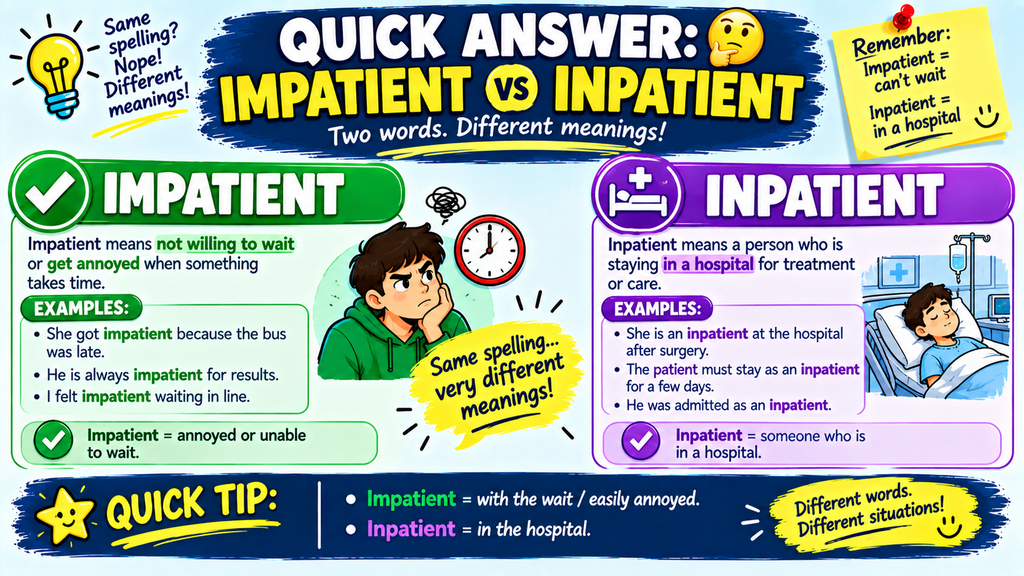
- Impatient is an adjective describing a lack of patience — someone who feels restless, irritated, or frustrated while waiting. 😤
- Inpatient is a noun or adjective used in healthcare for a person admitted to a hospital for overnight or extended treatment. 🏥
In short: impatient is about emotions, inpatient is about medical care. 🎯
Understanding the Basics of Impatient vs Inpatient
These two words look almost identical on the page, but they don’t share a meaning, a root context, or even the same grammatical role every time. 📌 The confusion usually comes down to spelling — swap one letter (“m” for “n”) and the entire meaning shifts. 🔄
Key Differences Overview
| Feature | Impatient 😤 | Inpatient 🏥 |
|---|---|---|
| Part of speech | Adjective | Noun or adjective |
| Context | Everyday emotions, behavior | Medical, hospital care |
| Core meaning | Lacking patience | Admitted to a hospital for treatment |
| Common opposite | Patient | Outpatient |
| Example | “He was impatient in traffic.” | “She was admitted as an inpatient.” |
Simple Explanation
Here’s an easy way to picture it: impatient starts with “im,” which can remind you of a feeling — like “I’m annoyed.” 😅 Inpatient starts with “in,” which can remind you of going in to a hospital. 🏨 That one mental shortcut solves most of the confusion instantly. ✅
Correct Meaning and Usage of “Impatient”
What Does “Impatient” Mean?
Impatient describes someone who struggles to wait calmly, often showing frustration, restlessness, or irritation. 😩 It almost always describes a personality trait, mood, or reaction in a specific moment.
Example Sentences
- She grew impatient after waiting 40 minutes for her coffee. ☕
- The impatient customer kept checking his watch. ⏰
- Kids are often impatient during long car rides. 🚗
Sentence Breakdown
In “She grew impatient waiting for the bus,” impatient works as an adjective describing her emotional state. 🧠 It typically follows a linking verb (grew, became, seemed, is) and answers the question “how did she feel?” 💭
Test Tip
If you can swap the word for “annoyed” or “restless” and the sentence still makes sense, “impatient” is the correct choice. ✅
Correct Meaning and Usage of “Inpatient”
What Does “Inpatient” Mean?
Inpatient refers to a patient who stays in a hospital or medical facility overnight, or longer, for treatment, monitoring, or recovery. 🏥 It contrasts directly with “outpatient,” someone who receives care and goes home the same day. 🚪
Example Sentences
- He was treated as an inpatient after his surgery. 🩺
- The hospital’s inpatient unit has 200 beds. 🛏️
- Her insurance covers inpatient rehabilitation programs. 📋
Sentence Breakdown
In “He was admitted as an inpatient,” the word works as a noun naming his hospital status. 📖 In “the inpatient ward is on the third floor,” it works as an adjective describing the ward itself. 🏢
Test Tip
If the sentence involves a hospital admission, overnight stay, or medical facility, “inpatient” is the correct word. 🏥✅
Case Study: Real-Life Confusion Example
A hospital once circulated internal memos referring to their “impatient department” instead of “inpatient department.” 😳 The mix-up went unnoticed for weeks because both spellings looked grammatically fine on their own.
What Went Wrong?
The writer relied on how the word sounded rather than what it actually meant. 🔤 Spell-check didn’t catch it either, since “impatient” is a real, correctly spelled word — just the wrong one for the context. ⚠️ It’s a good reminder that meaning matters more than spelling alone. 🧩
Grammar Rules Behind Impatient vs Inpatient
Why “Impatient” is Correct in Emotional Contexts
Impatient belongs to a family of “im-” prefixed words that signal a negative or opposite state, similar to impossible or impolite. 🚫 It’s built specifically to describe internal feelings and reactions. 💢
Why “Inpatient” is Medical
Inpatient uses the “in-” prefix to indicate direction or location — literally describing someone who is “in” a hospital setting. 🏥 It’s a compound term rooted in healthcare terminology rather than emotion. 📚
Grammar Authority Note
Dictionaries and style guides consistently list these as two completely separate entries with no overlapping definitions. 📖 Mixing them up is treated as a usage error, not a stylistic option. ✍️
Common Mistakes with Impatient vs Inpatient
Common Confusion Table
| Incorrect ❌ | Correct ✅ | Why |
|---|---|---|
| “He’s an inpatient driver.” | “He’s an impatient driver.” | Describes personality, not medical status |
| “She works in the impatient ward.” | “She works in the inpatient ward.” | Refers to a hospital department |
| “The impatient was discharged.” | “The inpatient was discharged.” | Refers to the hospitalized person |
Why These Mistakes Happen
Autocorrect, similar spelling, and rushed typing are the usual culprits. ⌨️ Since both words are valid dictionary entries, spell-checkers rarely flag the swap. 🚨
Usage in Different Contexts
1. Everyday Conversation
“Impatient” shows up constantly in daily talk — waiting rooms, traffic, parenting, and customer service moments. 🗣️
2. Professional Writing
“Inpatient” dominates medical reports, insurance paperwork, and hospital communications. 📄
3. Creative Writing
Writers reach for “impatient” to build character tension and control emotional pacing in a scene. ✍️📚
4. Social Media/Texting
Casual posts almost always use “impatient” for everyday frustration — “inpatient” stays reserved for medical context. 📱
Why It Matters
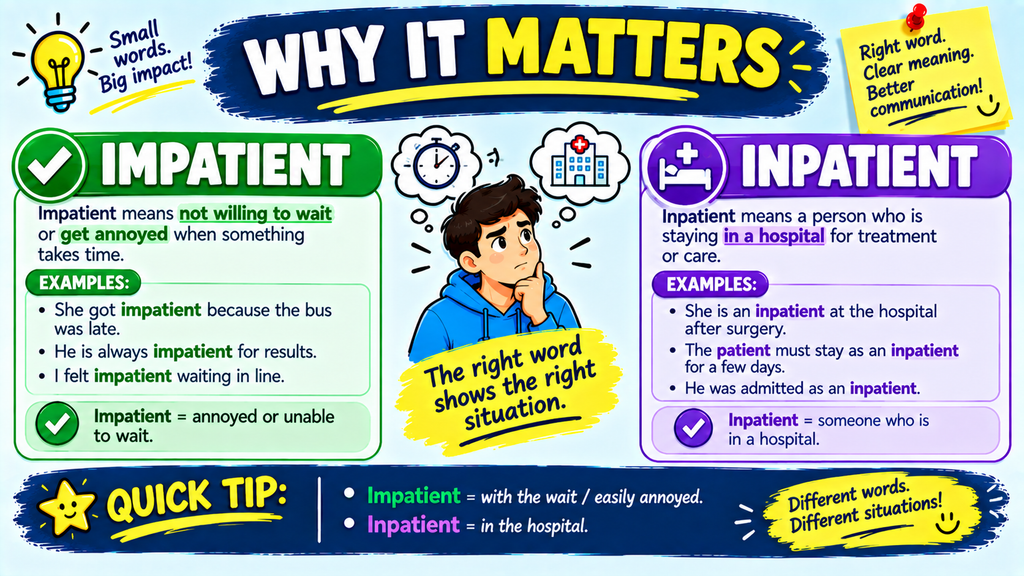
Mixing these words up in professional or medical writing can create real confusion, sometimes changing a sentence’s meaning entirely. ⚠️
Key Benefits of Using the Right Word:
- Clearer communication 🗣️
- More credibility in professional writing ✅
- Fewer misunderstandings in medical or healthcare content 🏥
- Better reading comprehension for your audience 📈
Quote
“Precision in language is precision in thought — one letter can change an entire meaning.” 💬
Special Exception Section
There’s one tricky overlap worth knowing: a hospitalized patient can absolutely feel impatient while waiting for treatment. 😤🏥 In that case, both words show up correctly in the same sentence — for example, “The inpatient grew impatient waiting for his discharge papers.” ✅ That’s not a grammar mistake; it’s simply two different words doing two different jobs at once. 🎯
Quick Recap Checklist ✅
- Impatient = emotional state, lacking patience 😤
- Inpatient = hospital admission status 🏥
- Impatient is almost always an adjective 📌
- Inpatient can be a noun or an adjective 📖
- Opposite of impatient = patient 🙂
- Opposite of inpatient = outpatient 🚪
Practice Examples
- The nurse checked on the new ______ every hour. (inpatient) 🏥
- He tapped his foot, clearly ______ with the delay. (impatient) 😤
- The ______ clinic added twelve new beds this year. (inpatient) 🛏️
- She’s rarely ______, even in long lines. (impatient) 🙂
Frequently Asked Questions
Is “inpatient” one word or two?
Yes, “inpatient” is written as a single word, both as a noun and an adjective. ✅
What is the opposite of “inpatient”?
The opposite of “inpatient” is “outpatient,” someone treated without an overnight hospital stay. 🚪
Can “impatient” describe emotions?
Yes, “impatient” specifically describes emotional restlessness or a lack of patience. 😤
Is “impatient” a noun or an adjective?
“Impatient” is an adjective, describing a person’s mood or behavior. 📖
What’s an example of inpatient care?
Surgery recovery, mental health treatment, and overnight hospital monitoring are all examples of inpatient care. 🏥
How do you remember the difference?
Link “im” in impatient to a feeling, and “in” in inpatient to going into a hospital. 🧠
Is “impatient” ever hyphenated?
No, “impatient” is never hyphenated in standard English. ✅
Can someone be both inpatient and impatient at once?
Yes — a hospitalized patient (inpatient) can easily feel impatient while waiting for care. 😤🏥
Conclusion
Impatient and inpatient may look nearly identical, but they live in two completely different worlds — one describes emotion, the other describes medical status. 🎯 Once you connect “im” to feelings and “in” to hospitals, the mix-up disappears for good. ✅ Keep this guide handy the next time autocorrect tries to talk you out of the right word. 😊
