

If you’ve ever typed a sentence and paused wondering whether it should be “that’s” or “thats,” you’re not alone. 🤔 This tiny apostrophe trips up native speakers, students, and professionals alike, especially when autocorrect doesn’t step in to save you.
The good news? The rule is short, simple, and easy to remember once you see it broken down. Below, we’ll cover the correct meaning, the grammar rule behind it, real-world examples, and the common mistakes that cause this confusion in the first place. ✅
Quick Answer: That’s or Thats? 🤔
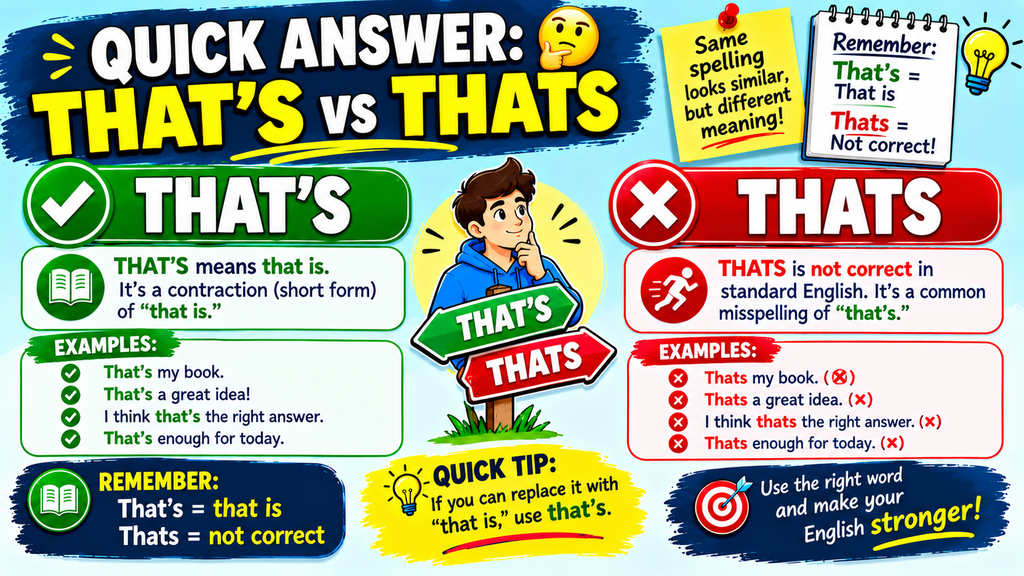
“That’s” is always correct. “Thats” is not a real word in standard English.
- ✅ That’s = a contraction of “that is” or “that has”
- ❌ Thats = a misspelling caused by a dropped apostrophe
If you remember nothing else from this guide, remember this: whenever you mean “that is” or “that has,” the apostrophe is non-negotiable. 📌
Understanding the Basics: That’s or Thats?
English contractions combine two words into one by replacing missing letters with an apostrophe. “That’s” follows this exact pattern — it merges “that” with “is” or “has” and uses the apostrophe to show where letters were removed.
“Thats” simply removes the apostrophe without replacing anything, which breaks the basic rule of how contractions work in English. 🚫
Core Difference
| Form | Status | What It Means | Example |
|---|---|---|---|
| That’s | ✅ Correct | Contraction of “that is” / “that has” | “That’s a great idea!” |
| Thats | ❌ Incorrect | Not a recognized English word |
Correct Meanings and Uses
That’s = That Is
The most common use of “that’s” replaces “that is.” It’s used to point something out, describe something, or confirm a fact. 🗣️
Example: “That’s the restaurant we went to last week.”
Sentence Breakdown
- That → points to a specific thing
- ‘s → stands for “is”
- Full sentence expands to: “That is the restaurant we went to last week.”
Test Tip
Swap “that’s” for “that is” in your sentence. If it still makes sense, the apostrophe belongs there. 💡
That’s = That Has
Less commonly, “that’s” replaces “that has,” usually before a past participle (like “been,” “gone,” or “happened”).
Example: “That’s been the plan all along.”
Sentence Breakdown
- That → refers to the plan
- ‘s → stands for “has”
- Full sentence expands to: “That has been the plan all along.”
Test Tip
Try substituting “that has.” If the sentence still flows naturally, you’ve confirmed the correct usage. ✔️
Why “Thats” Is Incorrect
“Thats” fails because it skips the apostrophe that signals a missing letter. English doesn’t allow contractions to simply lose their apostrophe and become new words — the same way “its” (possessive) is never written as “it’s” when you mean ownership. Dictionaries, style guides, and grammar checkers all treat “thats” as a spelling error, not an accepted variant. 📖
Case Study Section: Real-Life Example 💼
Workplace Email Example
Small mistakes like this one can quietly damage how professional your writing looks, especially in a work setting where every message reflects on you.
Incorrect Email
Hi team, thats the final version of the report. Let me know if thats not what you expected.
Correct Email
Hi team, that’s the final version of the report. Let me know if that’s not what you expected.
Why It Matters
A missing apostrophe won’t confuse most readers, but it can make writing look rushed or careless — something recipients often notice in emails, proposals, or client-facing documents. 📧
Grammar Rules Explanation 📏
The rule behind “that’s” is the same rule that governs every contraction in English: an apostrophe replaces the letters that were removed when two words became one.
| Full Phrase | Contraction | Apostrophe Replaces |
|---|---|---|
| that is | that’s | the “i” in “is” |
| that has | that’s | the “ha” in “has” |
| it is | it’s | the “i” in “is” |
| who is | who’s | the “i” in “is” |
Important Note
There’s one rare exception worth knowing: in very informal or old-fashioned usage, “thats” occasionally appears as a plural noun meaning “those things” — as in “a mix of thises and thats.” This is extremely uncommon and has nothing to do with the contraction rule above, so it should not be used as a substitute for “that’s” in everyday writing. ⚠️
Common Mistakes Section ⚠️
Why Mistakes Happen
- Autocorrect gaps — some keyboards don’t automatically insert the apostrophe 📱
- Fast typing or texting — apostrophes get skipped for speed
- Confusion with possessives — writers mix up contraction rules with words like “its”
- Non-native speaker patterns — the apostrophe rule isn’t intuitive if your first language doesn’t use contractions this way
Similar Grammar Confusions
| Correct Contraction | Common Mistake | Meaning |
|---|---|---|
| It’s | Its (possessive, different meaning) | “It is” / “It has” |
| Who’s | Whose (possessive, different meaning) | “Who is” / “Who has” |
| You’re | Your (possessive, different meaning) | “You are” |
| They’re | Their / There | “They are” |
| That’s | Thats | “That is” / “That has” |
Usage in Different Contexts 🗣️
Everyday Conversation
In speech, the contraction is standard and expected — saying “that is” every time would sound overly formal. 🎙️
Professional Writing
Emails, reports, and proposals should always use “that’s” correctly, since spelling errors here can undercut credibility. 💼
Creative Writing
Fiction and dialogue lean on “that’s” heavily to sound natural and conversational. ✍️
Social Media and Texting
Casual platforms are more forgiving, but “that’s” still reads as more polished than “thats,” even in a quick tweet or comment. 💬
Why It Matters ✅
Clarity in Communication
The apostrophe helps readers instantly recognize a contraction instead of pausing to figure out what you meant. 🔍
Professionalism
Consistent, correct grammar signals attention to detail — a small thing that adds up in resumes, cover letters, and client communication. 📝
Accuracy in Digital Communication
With so much writing happening over chat, email, and social media, small habits like this shape how your writing is perceived at scale. 🌐
Special Exception Section 🔍
Brand Names or Usernames
Some brands or usernames intentionally drop apostrophes for stylistic reasons (similar to how “Toys R Us” skips grammar norms). This is a branding choice, not a grammar rule, so it doesn’t make “thats” acceptable elsewhere. 🏷️
Search Queries or Informal Typing
People often type “thats” into search bars simply because it’s faster, and search engines are built to understand the intent anyway. This convenience doesn’t extend to formal writing, emails, or published content. 🔎
Quick Recap Checklist ✅
- ✔️ Use “that’s” whenever you mean “that is” or “that has”
- ✔️ Never use “thats” — it isn’t a standard English word
- ✔️ Test your sentence by expanding the contraction
- ✔️ Double-check contractions in professional writing before hitting send
- ✔️ Don’t confuse contraction rules with possessive pronouns like “its” or “whose”
Practice Examples ✍️
Try filling in the blank, then check your answer below. 🧠
- ___ the best idea I’ve heard all week.
- ___ been raining since this morning.
- I think ___ my phone ringing.
- ___ not what I meant.
- ___ exactly the point I was making.
Answers: All five blanks should be filled with “That’s.” ✅
Conclusion
The choice between “that’s” and “thats” isn’t really a choice at all — only “that’s” is grammatically correct. 📚 Once you remember that it stands for “that is” or “that has,” the apostrophe becomes automatic rather than a guessing game. Keep the substitution test in your back pocket, and you’ll never second-guess this one again.
Frequently Asked Questions
Is “thats” ever grammatically correct?
No. “Thats” is considered a misspelling of “that’s” in standard English writing. ❌
What does “that’s” stand for?
It’s a contraction of either “that is” or “that has,” depending on context. ✅
Is “thats” a real English word?
Not in standard usage — it fails the basic apostrophe rule that governs all English contractions. 📖
Can “that’s” mean “that has”?
Yes, especially before words like “been” or “gone,” as in “that’s been a while.” 🕐
Why doesn’t autocorrect always fix “thats”?
Some keyboards and apps don’t flag missing apostrophes in contractions, so the error slips through. 📱
Is it okay to use “thats” while texting?
It’s understood casually, but “that’s” still looks more polished, even in informal chats. 💬
What’s the fastest way to check if I need an apostrophe?
Expand the word into “that is” or “that has” — if the sentence still makes sense, the apostrophe is correct. 💡
