

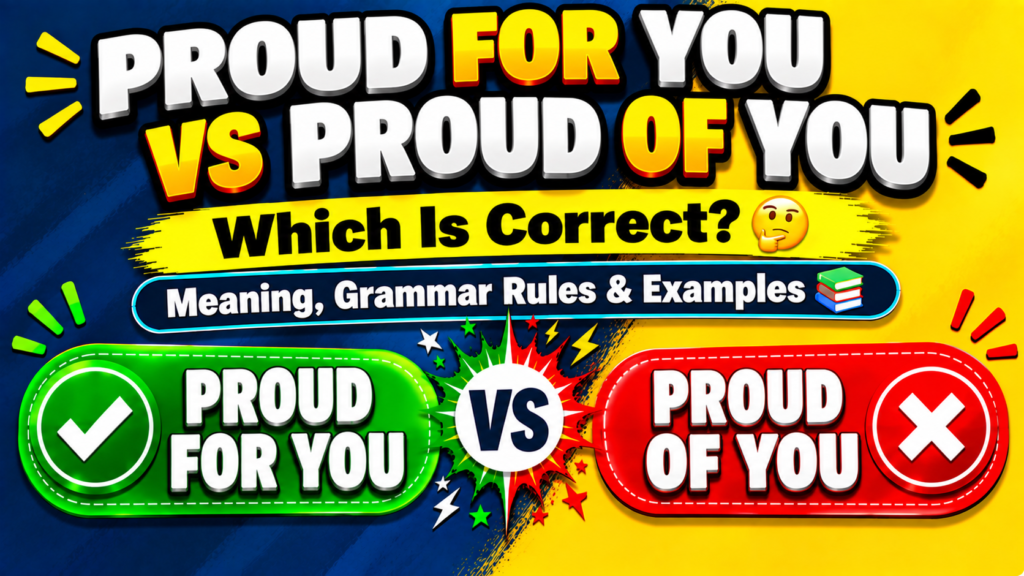
If you’ve ever paused mid-sentence wondering whether to say “I’m proud of you” or “I’m proud for you,” you’re not alone 🤔. This is one of the most common preposition mix-ups in English, and it trips up native speakers and learners alike. Below, you’ll find the correct form, the grammar rule behind it, and plenty of real examples so you never second-guess it again ✅.
Quick Answer: Proud for You vs Proud of You ⚡
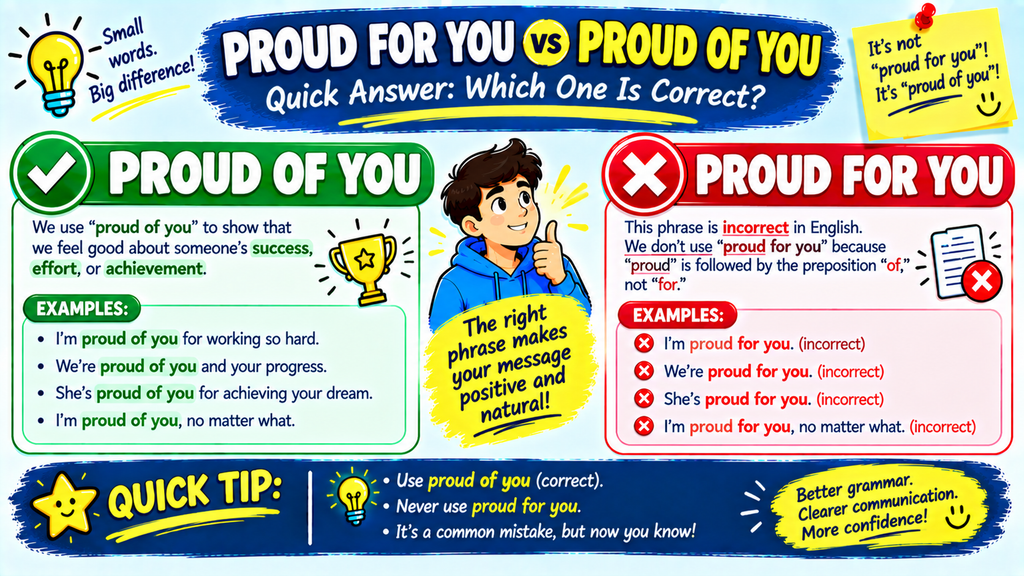
“Proud of you” is the grammatically correct phrase. “Proud for you” is not standard English, even though it sounds like it should work 🙃.
- ✅ Correct: I’m so proud of you for finishing the marathon.
- ❌ Incorrect: I’m so proud for you for finishing the marathon.
- 💡 Quick fix: If you’re tempted to use “for,” swap it for “of” and the sentence instantly becomes correct.
Understanding the Basics: Proud for You vs Proud of You 🧠
English adjectives often pair with one specific preposition, known as a dependent preposition, and that pairing has to be memorized rather than guessed 📖. “Proud” is permanently linked to “of,” the same way “interested” links to “in” and “afraid” links to “of.”
Here’s the pattern in a nutshell:
| Adjective | Correct Preposition | Example |
|---|---|---|
| Proud | of | Proud of your progress |
| Interested | in | Interested in music |
| Afraid | of | Afraid of spiders |
| Good | at | Good at chess |
| Married | to | Married to her |
Comparison Table
| Phrase | Grammatically Correct? | Common Usage | Example Sentence |
|---|---|---|---|
| Proud of you | ✅ Yes | Very common, all contexts | “We are proud of you.” |
| Proud for you | ❌ No | Common speech error | “We are proud for you.” (incorrect) |
| Proud about you | ❌ No | Rare, still incorrect | “We are proud about you.” (incorrect) |
| Happy for you | ✅ Yes (different meaning) | Common, celebratory tone | “I’m happy for you!” |
Correct Meanings & Uses ✅
“Proud of You” The Correct Form
“Proud of you” expresses admiration or satisfaction about something someone has done, earned, or become 🌟. It works whether you’re talking about a small win or a life milestone.
Examples:
- I’m proud of you for standing up for what you believe in 👏
- Your coach is proud of you for never missing a practice 🏆
- We couldn’t be prouder of you and everything you’ve accomplished this year 🎓
- She told him she was proud of him, and he finally smiled 😊
Sentence Breakdown
Look at the structure of “I am proud of you”:
- I → subject
- am → linking verb (a form of “be”)
- proud → adjective describing the subject’s feeling
- of → fixed, dependent preposition
- you → object receiving the pride
Every correct sentence with “proud” as a feeling of admiration follows this same skeleton 🔧.
“Proud for You” Why It’s Incorrect
“Proud for you” feels natural to say because English has several similar phrases that do use “for” — like “happy for you,” “excited for you,” and “sorry for you.” Your brain borrows that pattern and misapplies it to “proud” 🧩.
Why it feels wrong:
- “Proud” simply never takes “for” as its preposition, in any recognized standard usage.
- The confusion comes from analogy, not logic English prepositions aren’t always predictable.
- Even fluent speakers slip into this error in casual conversation and texting.
Incorrect Example:
- ❌ “I’m proud for you that you got the promotion.”
- ✅ “I’m proud of you for getting the promotion.”
Test Tip 💡
Try this trick: mentally replace “proud” with “pleased.” You’d never say “pleased for you” to mean admiration — you’d say “pleased with you” or “proud of you.” That small swap usually reveals the correct preposition instantly 🔍.
Case Study Section 🏢
Real-Life Example: Workplace Email
Here’s a common mistake found in professional emails:
❌ “Hi team, I’m proud for you all for hitting this quarter’s targets.”
The corrected, polished version:
✅ “Hi team, I’m proud of you all for hitting this quarter’s targets.”
That one preposition swap changes how careful and credible the message sounds 📧. In business writing, small grammar slips like this can quietly undercut an otherwise strong message.
Grammar Rules Explanation 📏
Rule:
“Proud” is always followed by “of,” never “for,” regardless of what comes next — a noun, a pronoun, a gerund, or a clause.
| Structure | Example |
|---|---|
| Proud of + noun | Proud of her achievement |
| Proud of + pronoun | Proud of you / them / us |
| Proud of + gerund | Proud of winning the award |
| Proud that + clause | Proud that she finished the race |
| Proud to + infinitive | Proud to be part of this team |
Notice that “proud to” and “proud that” are also correct — the error only happens with “proud for” ⚠️.
Common Mistakes Section ⚠️
Why Do People Say “Proud for You”?
There are a few reasons this mistake is so widespread 🌐:
- Analogy with “happy for you”: Since “happy for you” is correct, people assume “proud” follows the same pattern.
- Direct translation habits: In some languages, the equivalent of “proud” naturally pairs with a word closer to “for.”
- Casual speech drift: Spoken English is forgiving, so incorrect patterns spread through habit rather than grammar rules.
Table of Similar Grammar Confusions
| Correct Phrase | Common Incorrect Version |
|---|---|
| Proud of you | Proud for you |
| Interested in something | Interested about something |
| Married to someone | Married with someone |
| Afraid of something | Afraid from something |
| Good at something | Good in something |
Usage in Different Contexts 🌍
1. Everyday Conversation
“Mom, I got the job!” → “I’m so proud of you, sweetheart!” 🥹 Casual, warm, and instantly emotional.
2. Professional Writing
“Leadership is proud of the team’s dedication throughout this challenging launch.” 💼 Keeps tone formal while still personal.
3. Creative Writing
“He looked at his daughter, chest tight with something he could only call pride, proud of her in a way words rarely captured.” ✍️
4. Social Media / Texting
“So proud of you!! 🎉👏 you earned every bit of this” — short, expressive, still grammatically correct even in casual form 📱.
Why It Matters 🎯
Getting this right isn’t just about sounding “correct” for its own sake — it affects clarity, professionalism, and credibility, especially in:
- Job applications and cover letters 📄
- Congratulatory emails to colleagues or clients 📧
- Academic essays and formal writing 🎓
- Public speaking, toasts, and speeches 🎤
A single wrong preposition can make writing feel slightly “off,” even to readers who can’t explain why 🧐.
Special Exception Section 🔍
There’s one rare case where “for” can technically follow the word “proud” in a sentence — but it’s not the same grammatical function 🧵. In older or literary English, “for” can act as a conjunction meaning “because,” as in: “I am proud, for you have shown great courage.” Here, “for” isn’t attached to “proud” as its preposition at all — it’s introducing a separate clause. This is stylistic and rare, so for everyday and professional writing, “proud of” remains the only rule to follow ✔️.
Quick Recap Checklist ✅
- “Proud of you” = correct, always ✅
- “Proud for you” = incorrect in standard English ❌
- “Proud” pairs with “to” (infinitive) and “that” (clause) correctly too ✅
- “Happy for you” is a different, correct phrase — don’t confuse the two 🔄
- When unsure, mentally swap “proud” with “pleased” to test the preposition 💡
Practice Examples ✏️
Fill in the blank with the correct preposition:
- I am so proud ___ you for graduating. (Answer: of)
- She was proud ___ having finished the project early. (Answer: of)
- We’re proud ___ be part of this community. (Answer: to)
- He felt proud ___ his son’s kindness. (Answer: of)
- They are proud ___ what the team accomplished. (Answer: of)
Frequently Asked Questions ❓
Is “proud for you” ever grammatically correct?
No. “Proud” always pairs with “of,” never “for,” in standard English usage 🚫.
What preposition always follows “proud”?
“Of” is the correct preposition after “proud” in almost every situation 📌.
Can I say “I’m so proud for you”?
It’s understood in casual speech, but it’s still grammatically incorrect — “I’m so proud of you” is the correct form ✅.
What’s the difference between “happy for you” and “proud of you”?
“Happy for you” shares joy about someone’s good news, while “proud of you” expresses admiration for their effort or achievement 🌟.
Is “proud of you” formal or informal?
It works in both — it’s warm enough for personal messages and appropriate enough for professional praise 💬.
How should I respond to “I’m proud of you”?
A simple “thank you, that means so much” works well in almost any context 🙏.
Conclusion 🏁
The rule is short and simple: always say “proud of you,” never “proud for you.” 📚 Once you remember that “proud” is permanently paired with “of,” this common mix-up disappears from your writing and speech for good. Whether you’re texting a friend, writing a work email, or crafting a heartfelt toast, using the correct form adds polish and confidence to your words ✨.
