

If you’ve ever paused mid-sentence wondering whether to type “unaccessible” or “inaccessible,” you’re not alone. 📚 These two words look almost identical, sound similar, and both seem to mean “can’t be reached” — but only one of them is actually correct in modern English. This guide breaks down the meaning, grammar rules, and real-world usage so you never second-guess this word again.
Quick Answer: Unaccessible vs Inaccessible ⚡
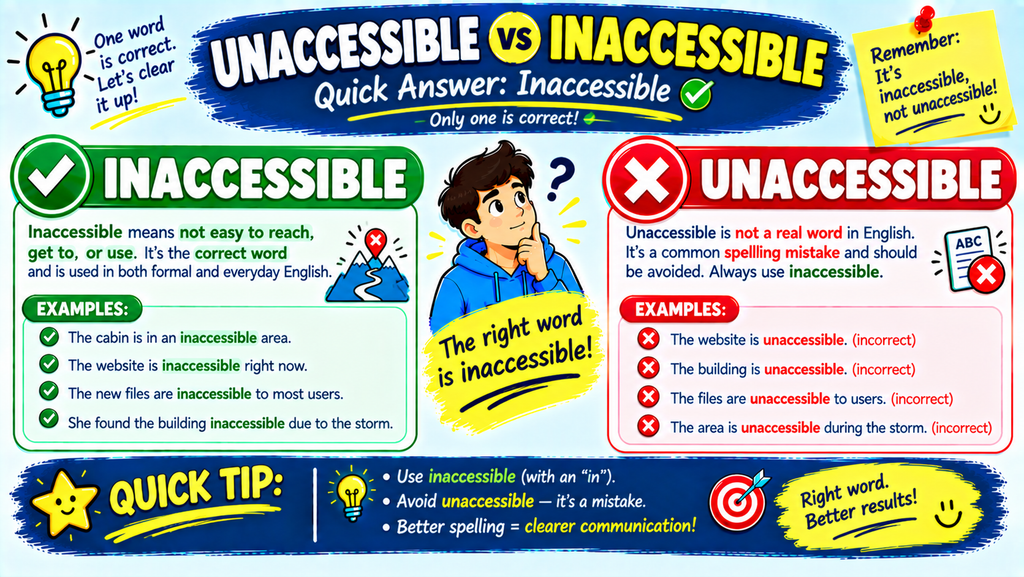
Inaccessible is the correct and only standard word to use today. It means something cannot be reached, entered, obtained, or understood. “Unaccessible” is not considered proper modern English — most dictionaries either omit it entirely or label it archaic and nonstandard. So whenever you’re stuck choosing between the two, go with “inaccessible.” ✅
Understanding the Basics: Unaccessible vs Inaccessible 📖
Core Difference
The core difference comes down to one thing: acceptance. “Inaccessible” is the word taught in schools, printed in dictionaries, and used by professional writers. “Unaccessible” is a historical leftover that has fallen out of use, even though people still type it by mistake. 🙈
Comparison Table
| Feature | Inaccessible ✅ | Unaccessible ❌ |
|---|---|---|
| Standard usage | Yes, widely accepted | No, considered incorrect |
| Found in major dictionaries | Yes, as the main entry | Rarely, sometimes as archaic |
| Prefix used | in- | un- |
| Root word | accessible (Latin origin) | accessible |
| Recommended for writing | Always | Never |
| Common context | Formal, technical, everyday | Historical texts only |
Simple Explanation
Think of it this way: “access” comes from Latin, and Latin-based words in English usually pair with the prefix “in-,” not “un-.” That single grammar habit is the whole story behind why “inaccessible” wins. 💡
Correct Meanings & Uses ✅
1. What Does “Inaccessible” Mean?
“Inaccessible” is an adjective describing something that is difficult or impossible to reach, enter, obtain, or understand. It can apply to physical places, digital systems, people, or even ideas. 🌐
Examples with Breakdown
- “The mountain cabin is inaccessible in winter.” — Describes a physical location that can’t be reached due to conditions.
- “The server has been inaccessible since the outage.” — Refers to a digital system that users cannot connect to.
- “His academic writing is inaccessible to casual readers.” — Describes an idea or text that is hard to understand.
Each example uses “inaccessible” to show a barrier — whether that barrier is physical, technical, or intellectual. 🔍
2. Why “Unaccessible” Is Incorrect
“Unaccessible” tries to do the same job as “inaccessible,” but it breaks a quiet rule of English word-building: native prefixes like “un-” typically attach to native or naturalized words, while Latinate prefixes like “in-” attach to Latin-rooted words. Since “accessible” is Latin-derived, “in-” is the grammatically correct match. 📐
Example (Incorrect)
- ❌ “The files are unaccessible without a password.”
- ✅ “The files are inaccessible without a password.”
Test Tip 💡
Quick trick: if a word entered English through Latin or French (like “accessible,” “audible,” or “credible”), pair it with “in-.” If it’s a native English word (like “happy,” “fair,” or “able”), pair it with “un-.”
Case Study Section 🏢
Real-Life Workplace Example
Grammar mistakes like this show up more often in professional settings than you’d expect — especially in emails written quickly under deadline pressure. 📧
Incorrect Email
“Hi team, please note the shared drive is currently unaccessible due to maintenance. We’ll update you once it’s back online.”
Correct Email
“Hi team, please note the shared drive is currently inaccessible due to maintenance. We’ll update you once it’s back online.”
Why THIS Matters
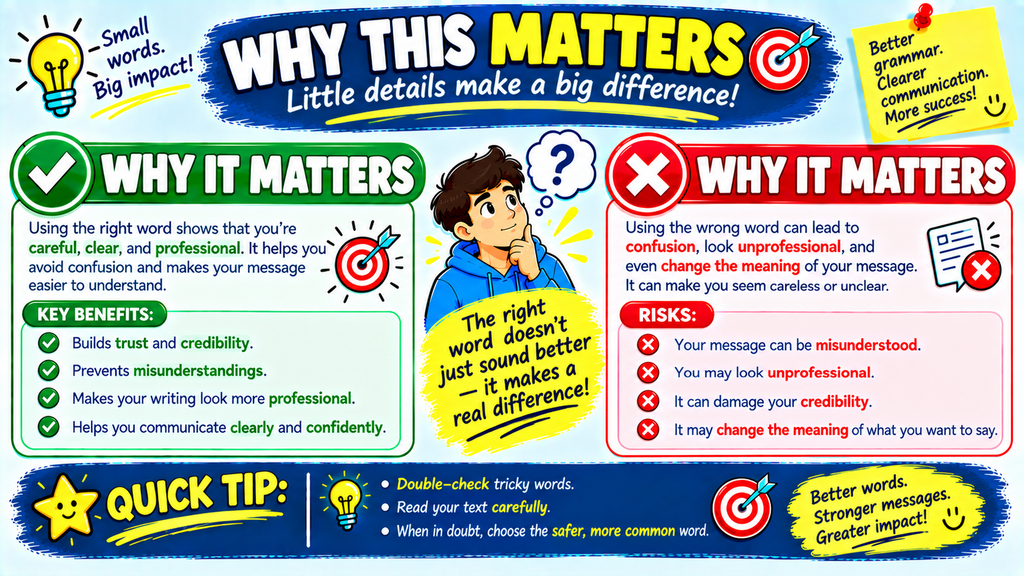
A single word choice like this won’t derail a project, but small grammar slips do chip away at how polished and credible your writing looks — especially in client-facing emails, reports, or public content. 🎯
Grammar Rules Explanation 📐
Why “Inaccessible” Is Correct
The word traces back to the Latin accessibilis, filtered through Old French inaccessible. English simply inherited the “in-” prefix along with the root, keeping the pairing intact for centuries. Dictionaries recognize “inaccessible” as the standard, correctly formed adjective. 📘
Why “Unaccessible” Fails
Interestingly, “unaccessible” isn’t a modern invention — it actually existed in English around the early 1400s, used the same way “inaccessible” is used today. Over time, though, “inaccessible” became the dominant, accepted form, and “unaccessible” quietly faded into obscurity. Using it now reads as either a typo or outdated English. 🕰️
Common Mistakes Section ⚠️
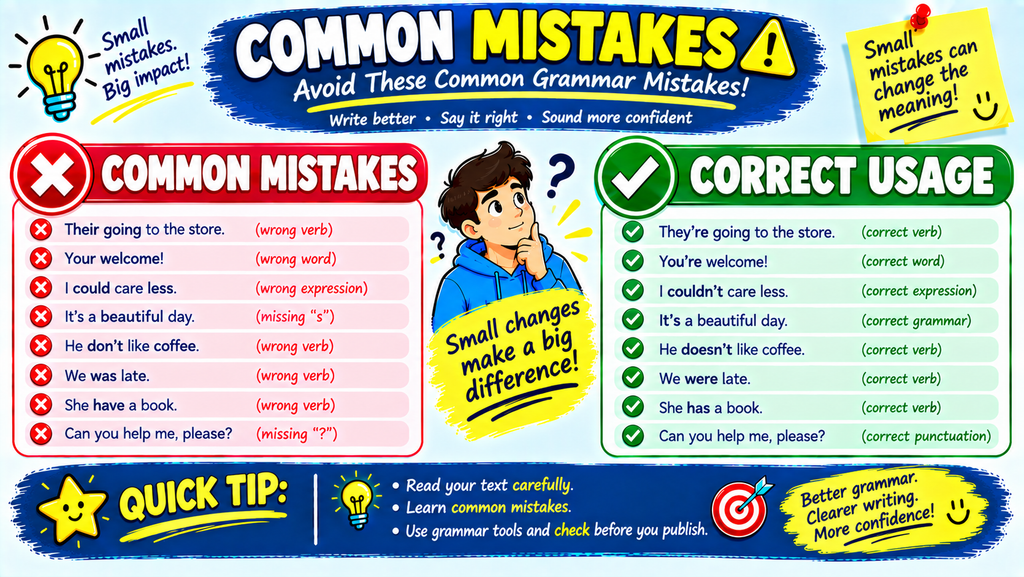
Why Do People Use “Unaccessible”?
- “Un-” feels more familiar — it’s one of the most common prefixes in English (unhappy, unable, unfair). 🔁
- Autocorrect and typing speed — people default to the prefix they use most often.
- Assumed symmetry — writers assume every root word can pair with both “in-” and “un-,” which isn’t true.
Similar Grammar Confusions Table
| Incorrect Form | Correct Form | Notes |
|---|---|---|
| Unaccessible | Inaccessible | Un- doesn’t fit Latin roots |
| Irregardless | Regardless | “Ir-” and “-less” double the negative |
| Unresponsible | Irresponsible | Latin root takes “ir-“ |
| Uncorrect | Incorrect | Latin root takes “in-“ |
| Unpossible | Impossible | Latin root takes “im-“ |
Usage in Different Contexts 🌍
1. Everyday Conversation
“That beach is basically inaccessible unless you have a boat.” 🚤
2. Professional Writing
“Due to a system update, the customer portal will be temporarily inaccessible between 10 PM and 2 AM.” 🖥️
3. Creative Writing
“The old lighthouse stood inaccessible on its rocky cliff, guarding secrets no one had uncovered in a hundred years.” 🏝️
4. Social Media / Texting
Even in casual texts, “inaccessible” is still the safer choice — shortening or simplifying grammar is fine, but swapping in the wrong prefix isn’t a style choice, it’s an error. 📱
Why It Matters (Important Section) 🎯
Key Benefits
- Clarity — readers instantly understand your meaning without pausing on an odd word. ✨
- Credibility — correct grammar signals professionalism in resumes, emails, and content.
- SEO value — search engines and readers both favor content that uses standard, well-recognized language.
- Consistency — using the accepted form avoids confusing collaborators or editors.
Special Exception Section 🕰️
Here’s the twist most articles skip: “unaccessible” isn’t technically “made up.” Etymology records show it was used in English as early as around 1400, before “inaccessible” took over as the standard term. Some historical dictionaries still list it as an obsolete or rare synonym rather than a flat-out invented word. That said, this exception is purely historical — in 2026, “unaccessible” has no place in standard writing. 📜
Quick Recap Checklist ✅
- ✅ Use “inaccessible” in all writing — formal, casual, and digital.
- ✅ Remember: Latin roots pair with “in-,” native words pair with “un-.”
- ✅ Treat “unaccessible” as outdated, not an acceptable alternative.
- ✅ Double-check emails and reports before sending, since this typo slips past some spellcheckers.
Decision Table 🧭
| If you’re describing… | Use this word |
|---|---|
| A place that can’t be reached | Inaccessible |
| A file, system, or account you can’t open | Inaccessible |
| A person who is hard to reach or unapproachable | Inaccessible |
| An idea or text that’s hard to understand | Inaccessible |
| Anything at all, really | Inaccessible |
Practice Examples ✍️
Fill in the blank with the correct word:
- The ancient ruins are almost completely _______ by road. (inaccessible)
- Without admin rights, the settings menu remains _______. (inaccessible)
- Some remote villages become _______ during the rainy season. (inaccessible)
frequently asked questions
Is “unaccessible” a real word?
It existed briefly in Middle English around the 1400s, but it’s considered obsolete and nonstandard in modern English. 📌
What is the difference between inaccessible and unaccessible?
There’s no meaning difference — only “inaccessible” is grammatically correct and accepted today. 🔎
Which is correct: inaccessible or unaccessible?
“Inaccessible” is correct; “unaccessible” should be avoided in all modern writing. ✅
Can I use “unaccessible” in formal writing?
No, formal, academic, and professional writing should always use “inaccessible.” 🚫
What is a synonym for inaccessible?
Common synonyms include unreachable, unattainable, unapproachable, and out of reach. 🔄
Does spellcheck always catch “unaccessible”?
Not always — some tools flag it, but others miss it since “un-” is a valid prefix elsewhere, so manual proofreading still helps. 👀
Conclusion 🏁
When it comes to unaccessible vs inaccessible, the answer is refreshingly simple: always choose “inaccessible.” 🙌 While “unaccessible” has a small footnote in English history, it has no place in today’s writing — whether you’re drafting a formal report, a casual text, or content for the web. Keep this grammar rule in your back pocket, and you’ll never trip over this word pair again. 🎉
