

If you’ve ever paused mid-sentence wondering whether it’s “steer the conversation” or “stear the conversation,” you’re not alone 🤔. This mix-up is one of the most common spelling slips in everyday and professional English. The good news? The answer is simple, and this guide breaks it down completely meaning, grammar rules, real examples, and the exact reason your brain keeps wanting to write it wrong.
Quick Answer: Steer vs Stear
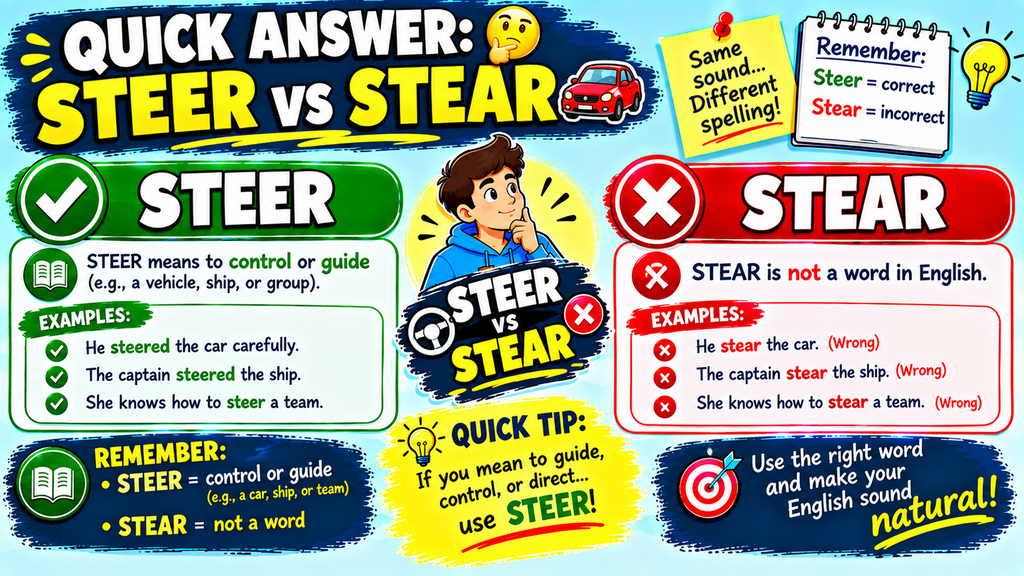
“Steer” is the only correct spelling. ✅ “Stear” is not a standard English word — it’s a common misspelling (and, in old texts, an archaic form of “steer”).
- ✅ Correct: She helped steer the project back on track.
- ❌ Incorrect: She helped stear the project back on track.
Understanding the Basics: Steer vs Stear
What Does “Steer” Mean?
“Steer” is a verb that means to guide, direct, or control the course of something — a car, a conversation, a company, or even a boat 🚗. It can also be a noun referring to a young castrated bull raised for beef.
Simple Explanation:
Think of “steer” the way you think of a steering wheel — you use it to guide direction. If you remember “wheel” and “steer” share that double-vowel ee pattern, the spelling sticks fast.
Comparison Table: Steer vs Stear
| Feature | Steer ✅ | Stear ❌ |
|---|---|---|
| Correct spelling | Yes | No |
| Dictionary status | Standard modern English word | Not a recognized modern word |
| Part of speech | Verb & noun | None (misspelling) |
| Common usage | Driving, guiding, decisions, cattle | N/A |
| Historical use | N/A | Archaic 17th-century spelling of “steer” |
Correct Meanings & Uses of “Steer”
1. Steer as “To Guide a Vehicle”
This is the most familiar use — turning a car, bike, or truck in a chosen direction. 🚗
- He steered the car carefully around the pothole.
2. Steer as “To Guide a Situation”
Figuratively, “steer” describes directing a conversation, project, or outcome.
- The manager steered the meeting away from a heated argument.
3. Steer in Decision-Making
People often “steer” others toward or away from choices.
- Her advisor steered her toward a safer investment.
4. Steer in Navigation (Ships & Aircraft)
Long before cars existed, sailors “steered” ships using a rudder — this is actually the word’s oldest sense. ⛵
- The captain steered the ship through the narrow strait.
Case Study: Real-Life Usage Example
Workplace Email Example
Here’s how “steer” naturally shows up in professional writing:
“Thanks for the update. Let’s steer this project toward the Q4 launch date and revisit the budget next week.”
Notice how natural and clean it reads — swapping in “stear” here would immediately look like a typo to any reader. 📩
Grammar Rules Explanation
Why Is “Stear” Incorrect?
Modern English simply doesn’t recognize “stear” as a word. There’s no dictionary entry, no accepted usage, and every major style guide treats it purely as a spelling error.
Pronunciation vs. Spelling Confusion
Both “steer” and “stear” would be pronounced the same way if “stear” existed — that’s exactly the problem. Since English isn’t always phonetic, sound-alike guessing leads writers to the wrong letters.
Common Mistakes With “Steer” and “Stear”
| Mistake | Why It Happens |
|---|---|
| Writing “stear” instead of “steer” | Confusing it with words like “wear,” “bear,” “clear” |
| Assuming “ear” spelling pattern applies | English spelling isn’t consistent across similar sounds |
| Autocorrect not catching it | Some spellcheckers miss rare misspellings in casual typing |
Why Mistakes Happen:
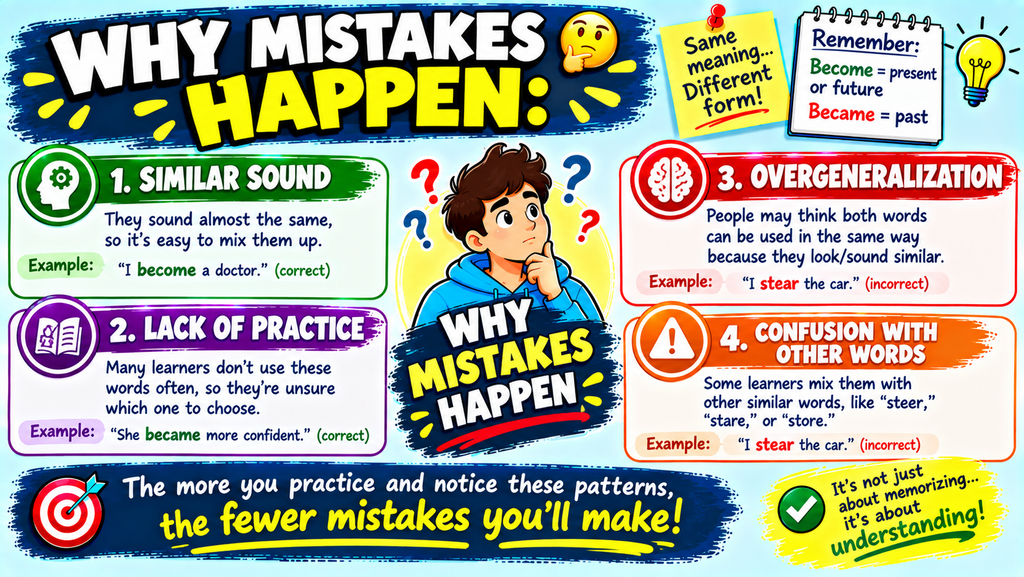
- Many English words ending in the “-eer” sound are actually spelled with -ear (like clear, bear, wear) 📝
- Writers unconsciously apply that pattern to “steer,” creating “stear”
- Fast typing and texting increase the odds of the slip going unnoticed
Similar Confusing Words Table
| Word Pair | Meaning | Quick Note |
|---|---|---|
| Steer vs. Stare | Guide vs. look fixedly | Completely different meanings |
| Steer vs. Stere | Guide vs. a unit of volume (rare, used for firewood) | “Stere” is real but extremely uncommon |
| Steer vs. Stir | Guide vs. mix or provoke | Different meaning and spelling entirely |
Usage in Different Contexts
1. Everyday Conversation
- “Can you steer us toward a good restaurant nearby?”
2. Professional Writing
- “The board will steer the company’s strategy for 2026.”
3. Creative Writing ✍️
- “The old sailor steered his weathered boat toward the storm, unafraid.”
4. Social Media/Texting
- “lol steer clear of that group chat drama 😅”
Why It Matters
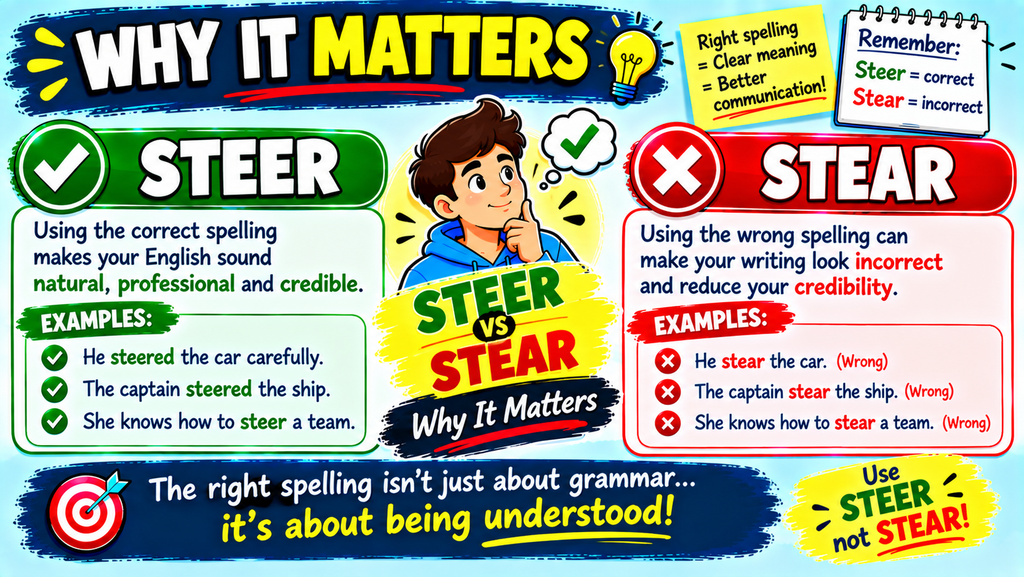
Importance of Using “Steer” Correctly:
- Protects your credibility in emails, resumes, and professional documents 💼
- Avoids embarrassing typos in published or public-facing writing
- Helps readers trust your attention to detail
- Keeps your writing search-engine and spellcheck friendly
Special Exception Section
Here’s a fun linguistic twist: “stear” did technically exist — as an archaic 17th-century spelling of “steer,” appearing in classic literature like Milton’s Paradise Lost. Outside of historical texts (or as an occasional surname), it has zero place in modern writing. 📜
Quick Recap Checklist
- ✅ Use “steer” for guiding, directing, or navigating
- ✅ Use “steer” for the noun meaning a young bull
- ❌ Never use “stear” in modern writing
- ✅ Remember: “steer” pairs with “steering wheel” same double e
Practice Examples:
- Please help me ______ this project toward completion. (steer)
- The rancher raised a young ______ for the county fair. (steer)
- I always ______ clear of Monday traffic. (steer)
frequently asked questions: Steer vs Stear
Is “stear” ever correct in modern English?
No it’s not accepted in any modern dictionary and is always considered a misspelling today. 🚫
What does “steer” mean as a noun?
It refers to a young castrated bull raised for beef.
How do you pronounce “steer”?
It’s pronounced like “steer” rhymes with “here” — /stɪr/.
What’s the difference between “steer” and “stare”?
“Steer” means to guide something; “stare” means to look fixedly at something.
What’s the difference between “steer” and “stere”?
“Stere” is a rare unit of volume (used for measuring wood); “steer” means to guide or direct.
Is “steer clear” spelled with “steer” or “stear”?
Always “steer clear” — “stear clear” is a common but incorrect variant. ✅
Conclusion
“Steer” is the correct spelling every time — whether you’re guiding a car, a conversation, or a ship. 🚗 “Stear” has no place in modern English outside of antique literature. Keep the double e in mind, picture a steering wheel, and you’ll never second-guess this one again. ✅
