

If you’ve ever typed “analysis” and then paused, wondering whether the plural should be “analysises,” “analysis’s,” or something else entirely you’re dealing with one of English’s trickier irregular plurals. 🧠
The good news: once you learn the pattern, you’ll never second-guess it again. Let’s break down exactly how “analysis” and “analyses” work, why the spelling changes, and how to use each one correctly.
Quick Answer: Analysis vs Analyses
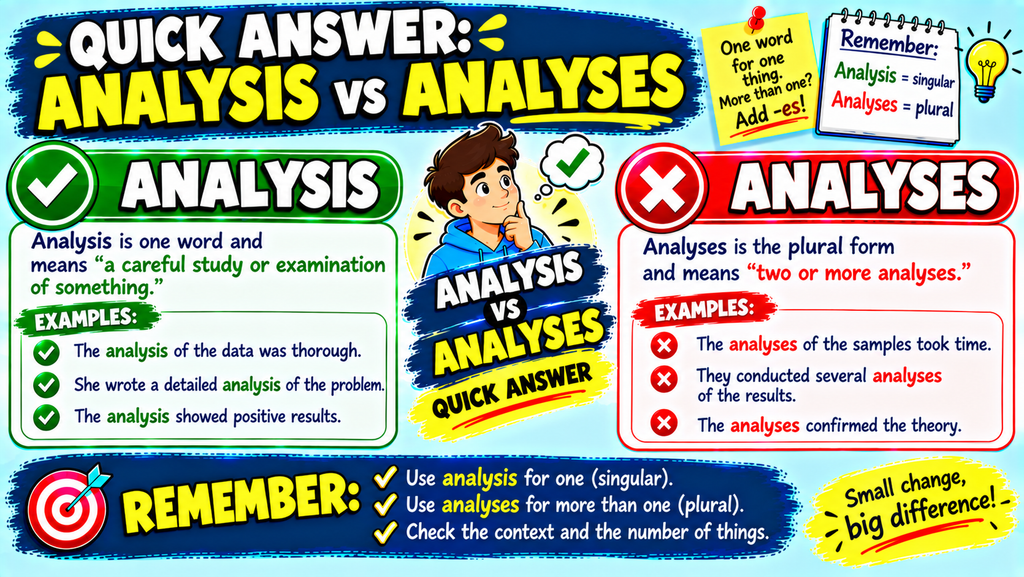
Analysis is singular it refers to one examination, report, or study. Analyses is plural — it refers to two or more.
- Singular: one analysis
- Plural: two or more analyses
There’s no “analysises” that form doesn’t exist in standard English. 🚫
Understanding the Basics of Analysis vs Analyses
“Analysis” comes from Greek, and like several other Greek- and Latin-derived English nouns, it doesn’t follow the usual “just add -s” plural rule. Instead, it belongs to a small family of words that swap “-is” for “-es” when pluralized.
You’ll notice the same pattern in words like:
- Basis → Bases
- Crisis → Crises
- Thesis → Theses
- Hypothesis → Hypotheses
- Diagnosis → Diagnoses
“Analysis” follows this exact same rule, which is why the plural is “analyses,” not “analysises.” 📚
Key Difference Explained
| Feature | Analysis | Analyses |
|---|---|---|
| Number | Singular | Plural |
| Meaning | One examination or study | Two or more examinations or studies |
| Pronunciation | uh-NAL-ih-sis | uh-NAL-ih-seez |
| Example | “The analysis was thorough.” | “The analyses were thorough.” |
| Common error | Using it as a plural | Confusing it with the verb “analyzes” |
Correct Meaning and Uses of “Analysis”
1. Singular Form: Analysis
“Analysis” is a noun that refers to a single, detailed examination of something — data, a text, a situation, or a problem. It’s the word you reach for when you’re describing one instance of that process. 🔍
✔ Example:
“The financial analysis revealed a steady increase in quarterly revenue.”
✍ Sentence Breakdown:
Here, “analysis” is singular because it refers to one specific piece of work — a single financial report. The verb that follows (“revealed”) is also singular, matching the subject correctly.
Test Tip:
If you can put “a” or “one” in front of the word without it sounding odd — “a financial analysis” — you’re using the singular form correctly. ✅
Correct Meaning and Uses of “Analyses”
2. Plural Form: Analyses
“Analyses” is the correct plural of “analysis.” Use it whenever you’re referring to more than one examination, report, or study.
✔ Example:
“The research team compared several analyses before publishing their final conclusions.”
✍ Sentence Breakdown:
In this sentence, “analyses” is plural because multiple separate studies were compared. The verb “compared” pairs naturally with the plural subject, showing subject-verb agreement.
Test Tip:
If you can say “multiple” or “several” before the word — “several analyses” you’re using the plural correctly. If it sounds wrong with “a” in front of it, it’s plural. 💡
Case Study: Real-Life Usage Example
Grammar rules matter most when applied in real contexts especially at work, where clarity and professionalism count.
Workplace Scenario:
Incorrect: “Please review the analysis from last month’s reports before our meeting.” (when referring to multiple monthly reports)
Correct: “Please review the analyses from last month’s reports before our meeting.”
✔ Explanation:
Since the sentence refers to reports (plural), the noun describing the studies of those reports should also be plural — “analyses,” not “analysis.” Getting this right avoids ambiguity about whether one report or several were reviewed. 📊
Grammar Rules Behind Analysis vs Analyses
English inherited a set of nouns from Greek that end in “-is” in their singular form. These nouns form plurals by replacing “-is” with “-es,” rather than simply adding “-s” or “-es” onto the whole word.
Examples:
- Analysis → Analyses
- Synthesis → Syntheses
- Parenthesis → Parentheses
- Axis → Axes
Authority Reference:
Major dictionaries and style guides — including Merriam-Webster and the Oxford English Dictionary — consistently list “analyses” as the only accepted plural of “analysis,” confirming this is standard, non-negotiable English grammar rather than a stylistic preference. 📖
Common Reasons for Mistakes:
- Overgeneralizing plural rules assuming every noun just needs an “-s.”
- Confusing “analyses” (noun) with “analyzes” (verb) — they look and sound similar but serve different grammatical roles.
- Mixing up British and American verb spelling — in British English, “analyses” can also appear as a verb form (like “he analyses the report”), which adds to the confusion.
- Autocorrect errors — some spellcheckers don’t catch this distinction reliably.
Common Confusions Table:
| Word | Type | Meaning |
|---|---|---|
| Analysis | Noun (singular) | One study or examination |
| Analyses | Noun (plural) | Multiple studies or examinations |
| Analyze | Verb (US spelling) | To examine something in detail |
| Analyse | Verb (UK spelling) | Same as “analyze,” British spelling |
| Analyzes | Verb, 3rd person singular | “She analyzes the data daily.” |
Usage in Different Contexts
1. Everyday Conversation
In casual speech, people often just say “analysis” loosely, even when referring to multiple things, but the plural “analyses” is still preferred whenever precision matters.
2. Professional Writing
Business reports, consulting decks, and academic papers rely heavily on the singular/plural distinction — using the wrong form can make a document look less credible. 💼
3. Creative Writing
Writers occasionally use “analysis” figuratively (e.g., “a deep analysis of grief”) — the same singular/plural rules still apply.
4. Social Media/Texting
Both words appear less often here, but when they do, “analysis” tends to dominate simply because people are usually referring to a single post, take, or breakdown.
Why It Matters in Writing
✔ Importance:
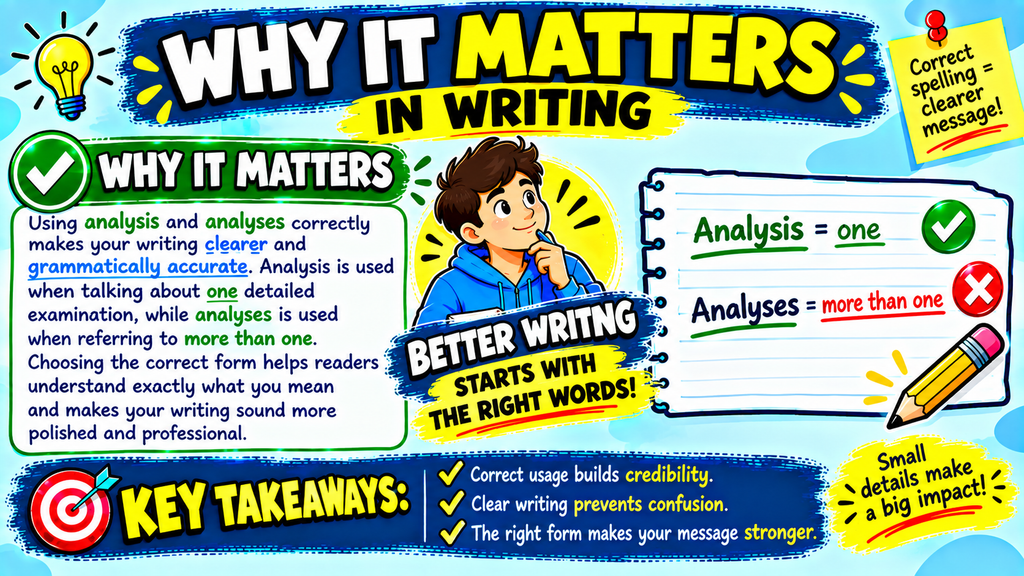
Using “analysis” and “analyses” correctly isn’t just a grammar technicality — it directly affects how clearly your writing communicates scope. Saying “the analyses show” versus “the analysis shows” tells your reader immediately whether you’re citing one study or several, which matters enormously in research, journalism, and business reporting. 🎯
Special Exception Section
Unlike regular English nouns, you can’t apply the standard “add -s” rule here, even informally. There’s no accepted casual plural like “analysises” — not in speech, not in writing, not even in very informal contexts. This makes “analysis/analyses” stricter than many other irregular nouns, where casual alternatives sometimes creep into everyday use. ⚠️
Quick Recap Checklist
- ✅ Use analysis for one study, report, or examination.
- ✅ Use analyses for two or more.
- ❌ Never write “analysises” — it isn’t a word.
- ✅ Don’t confuse “analyses” (noun) with “analyzes” (verb).
- ✅ Match your verb to the correct singular or plural form.
Practice Examples:
- “The __________ (singular) confirmed our initial hypothesis.” → analysis
- “Multiple __________ (plural) were conducted before the launch.” → analyses
- “She __________ (verb) the sales data every Friday.” → analyzes
Frequently asked questions: Analysis vs Analyses
Is “analyses” the plural of “analysis”?
Yes, “analyses” is the correct and only standard plural form of “analysis.”
Is “analysises” a real word?
No, “analysises” is incorrect. The standard plural is always “analyses.”
What’s the difference between “analyses” and “analyzes”?
“Analyses” is a plural noun, while “analyzes” is a verb form used with singular subjects like “he” or “she.”
How do you pronounce “analyses”?
It’s pronounced “uh-NAL-ih-seez,” with the final syllable rhyming with “trees.”
Can “analysis” ever be used as a plural?
No, “analysis” is always singular. Use “analyses” whenever referring to more than one.
Is this rule the same in British and American English?
The noun rule is the same in both, though British English also uses “analyses” as a verb form, which American English spells “analyzes.”
Conclusion
The distinction is simple once it clicks: analysis is one, analyses is many, and there’s no shortcut spelling in between. 🎉 Whether you’re writing a business report, an academic paper, or a quick email, using the correct form signals attention to detail — and that kind of precision quietly builds credibility with every reader.
