

If you’ve ever paused mid-sentence wondering whether to say “did you have” or “did you had,” you’re not alone. This mix-up is one of the most common grammar slips among English learners and even native speakers who are typing quickly. ✍️ The good news? Once you understand one simple rule, you’ll never second-guess yourself again.
Quick Answer: Did You Have or Did You Had
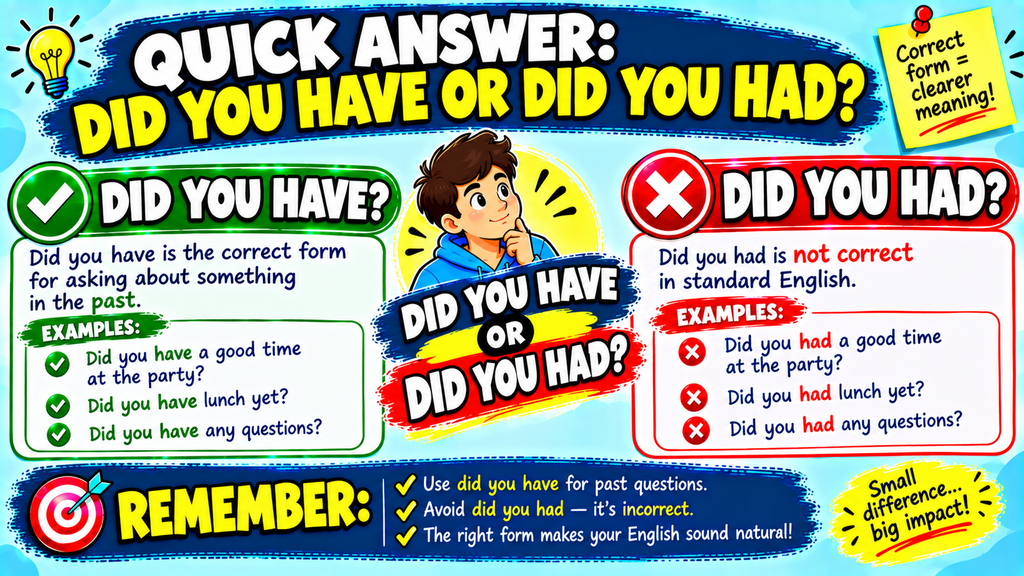
“Did you have” is correct. “Did you had” is always wrong. When the helping verb “did” is used to form a question or negative sentence, the main verb that follows must stay in its base form — “have,” not “had.” This rule applies no matter who or what you’re asking about. ✅
Understanding the Basics: Did You Have or Did You Had
English past-tense questions follow a fixed pattern: did + subject + base verb. The word “did” already tells the listener the action happened in the past, so the verb after it doesn’t need to change again. 📌
Incorrect:
- Did you had breakfast this morning?
- Did you had a good trip?
- What time did you had lunch?
Correct:
- Did you have breakfast this morning?
- Did you have a good trip?
- What time did you have lunch?
Comparison Table
| Sentence | Grammatically Correct? | Reason |
|---|---|---|
| Did you have fun? | ✅ Yes | “Did” + base verb “have” |
| Did you had fun? | ❌ No | Double past tense — incorrect |
| Did she have time? | ✅ Yes | Base verb stays unchanged |
| Did she had time? | ❌ No | “Had” should not follow “did” |
| You had fun. | ✅ Yes | Simple past tense, no “did” needed |
Why “Did You Have” Is Correct
Structure Rule:
English past-tense questions use this formula: Did + subject + base form of verb. Since “did” is already the past-tense form of “do,” it carries all the past-tense meaning the sentence needs. 🧠 The main verb after it in this case, “have” must revert to its base, uninflected form.
Examples:
- Did you have a chance to review the file?
- Did they have enough time to prepare?
- Did he have any questions after the meeting?
- Did you have trouble finding the office?
Notice that “have” never changes form here, regardless of the subject (I, you, he, she, they).
Why “Did You Had” Is Incorrect
Problem:
“Did you had” stacks two past-tense markers into one sentence — “did” and “had” — which creates a grammatical conflict. English doesn’t allow this kind of double past tense in a simple question. 🚫
Correct Logic:
Think of “did” as the verb that’s already doing the “past tense job” for the whole sentence. Once “did” appears, every main verb after it must go back to its plain, dictionary form — “have,” “go,” “eat,” “see,” not “had,” “went,” “ate,” “saw.”
Test Tip 💡
Here’s a quick trick: swap “did” for “do” or “does” and see if the sentence still makes sense.
- “Do you have time?” ✅ sounds natural
- “Do you had time?” ❌ sounds obviously wrong
If “had” sounds odd after “do” or “does,” it’s equally wrong after “did.” This test works because “have” never changes form after any version of the auxiliary verb “do.”
Case Study: Real-Life Usage
Workplace Email Example
Incorrect: “Hi Sarah, did you had a chance to review the attached report?”
Correct: “Hi Sarah, did you have a chance to review the attached report?”
In professional writing, this error can make an otherwise polished email look careless, especially in client-facing communication. 📧
Conversation Example
Incorrect: “Did you had dinner yet?”
Correct: “Did you have dinner yet?”
Native English speakers rarely make this mistake out loud, but it’s extremely common among ESL learners whose first language doesn’t use a separate auxiliary verb system.
Grammar Rules Explanation
Key Rule:
Whenever a sentence starts with “did,” “didn’t,” “do,” “does,” or “don’t,” the main verb that follows must be in its base form never in past tense.
- Did + have (not had)
- Didn’t + go (not went)
- Does + eat (not eats)
Why This Rule Exists:
English tense information is meant to be marked only once per clause. The auxiliary verb “did” already signals that the action is in the past, so adding a second past-tense verb is redundant and grammatically incorrect. This is sometimes called the “one tense marker per clause” principle. 📖
Common Mistakes
- Saying “did you had” instead of “did you have”
- Writing “didn’t had” instead of “didn’t have”
- Using “did he went” instead of “did he go”
- Mixing “have you had” with “did you have” incorrectly
Why These Mistakes Happen:
Many learners translate directly from their native language, where past tense might be marked on every verb in a sentence. Others simply default to “had” because it “feels” more past-tense, even though “did” has already done that job. 🌍
Similar Grammar Confusions Table
| Confusion | Correct Form | Rule |
|---|---|---|
| Did you went / Did you go | Did you go | Base form after “did” |
| Did she saw / Did she see | Did she see | Base form after “did” |
| Didn’t had / Didn’t have | Didn’t have | Base form after “didn’t” |
| Does he has / Does he have | Does he have | Base form after “does” |
| Did you ate / Did you eat | Did you eat | Base form after “did” |
Usage in Different Contexts
Everyday Conversation
“Did you have a good weekend?” is a natural, casual greeting used constantly in spoken English. 🗣️
Professional Writing
In emails, reports, and formal documents, “did you have” is the standard, expected form using “did you had” can undermine credibility.
✍️ Creative Writing
Writers sometimes use “had” correctly in a separate clause, such as: “You did what you had to do.” Here, “had to do” is its own clause, not a continuation of “did,” so it’s perfectly grammatical.
Social Media / Texting
Even in casual texting, “did you have” remains correct — informal tone doesn’t change grammar rules, though people often skip punctuation (“did u have fun 2day”).
Why It Matters
Getting this right isn’t just about sounding “proper” — it affects how clearly and credibly you communicate. 🎯
Key Benefits:
- Improves clarity in written and spoken communication
- Builds credibility in professional and academic writing
- Helps ESL learners master core auxiliary verb rules
- Prevents awkward, distracting errors in emails and resumes
Special Exception Section
There’s one case where “had” legitimately follows “did” — when “had” belongs to a separate clause, not as the main verb of the question itself. For example:
- “You did what you had to do.” (correct)
Here, “did” governs “what,” and “had to do” is a self-contained clause describing an obligation. This is different from asking a direct question like “Did you had to do this?” which is still incorrect. The distinction lies in sentence structure, not vocabulary. ⚠️
Quick Recap Checklist
- ✅ Use “did” + base verb (“have,” not “had”)
- ✅ Apply this rule to all subjects: I, you, he, she, they
- ✅ Test with “do/does” to check if it sounds right
- ❌ Never say “did you had,” “didn’t had,” or “does she has”
Practice Examples:
- ___ you have time to call me back? (did)
- She ___ have any idea what happened. (didn’t)
- ___ they have a good flight? (Did)
- He ___ have breakfast before the meeting. (didn’t)
Frequently Asked Questions: Did You Have or Did You Had
Is “did you have” grammatically correct?
Yes, it’s the correct and standard form used in past-tense questions in English. ✅
Why is “did you had” wrong?
It’s wrong because “did” already marks the past tense, so the verb after it must stay in its base form (“have”).
Can “had” ever follow “did” in a sentence?
Yes, but only when “had” starts a separate clause, like “You did what you had to do.”
What tense is “did you have”?
It’s the simple past tense, used to ask about a completed past action or event.
Is “did you have a good time” correct?
Yes, this is a completely correct and commonly used past-tense question.
What’s the difference between “have you had” and “did you have”?
“Have you had” is present perfect (relevant to now), while “did you have” is simple past (a finished moment in time).
Is it “did you have any” or “did you had any”?
It’s always “did you have any” “had” never follows “did” as the main verb.
Conclusion
The rule behind “did you have” versus “did you had” comes down to one simple principle: once “did” appears in a sentence, the main verb stays in its base form. 🌟 Remembering this small but powerful rule will instantly sharpen your spoken and written English, whether you’re sending a work email, chatting with friends, or studying for an English proficiency test. Keep this guide handy, run through the practice examples occasionally, and “did you had” will soon disappear from your vocabulary for good.
