

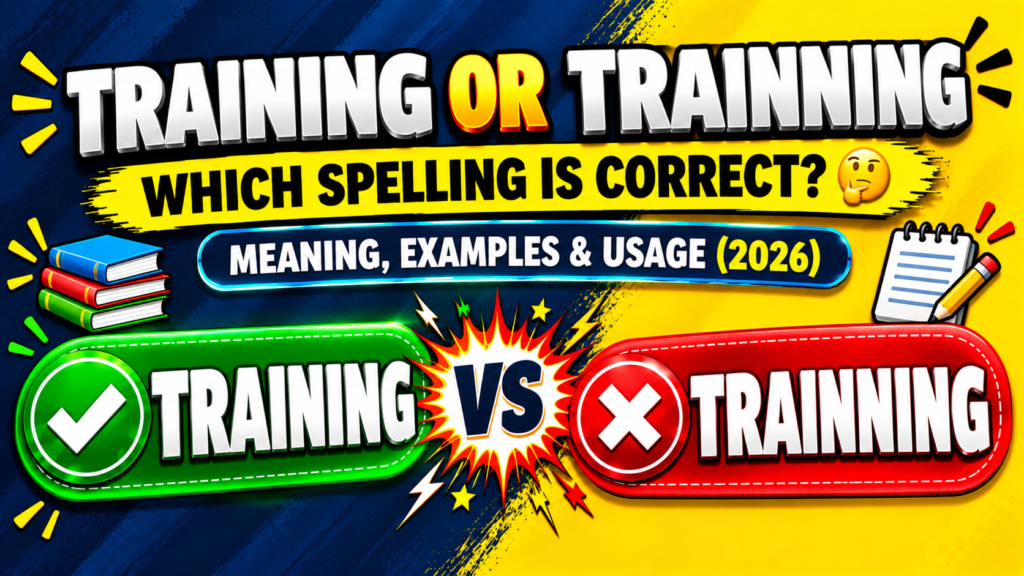
If you’ve ever typed “trainning” and then paused, wondering if that extra “n” belongs there, you’re dealing with one of English’s sneakiest spelling traps. 📝 The confusion makes sense plenty of similar words double their final letter before adding “-ing.” This one just doesn’t follow that pattern, and once you know why, you’ll never misspell it again.
Quick Answer: Training or Trainning
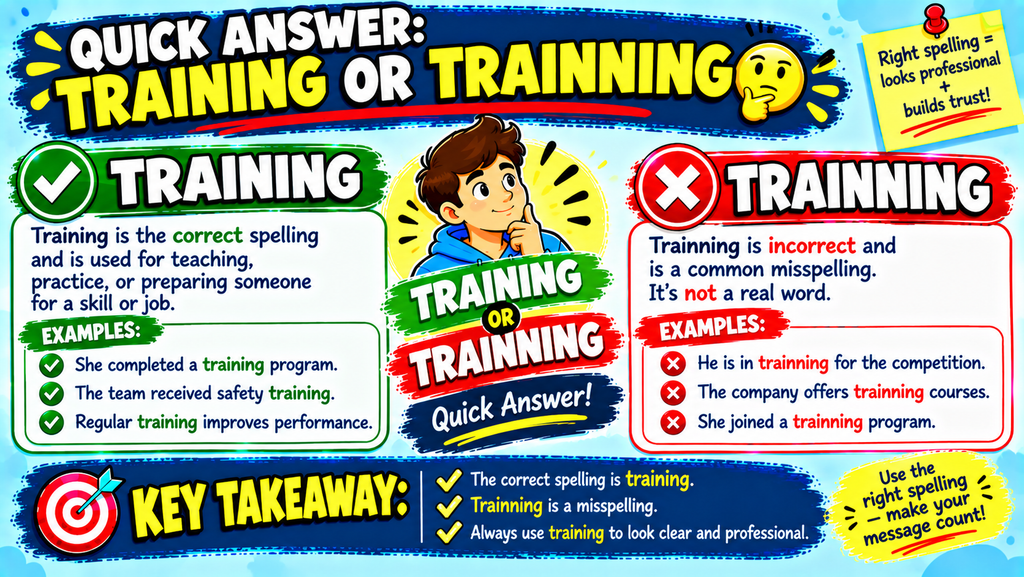
“Training” is the only correct spelling. “Trainning” is always a misspelling, no matter the context. The word “train” does not double its final consonant when adding the “-ing” suffix, because of a specific English spelling rule involving vowel sounds. ✅
Understanding the Basics: Training or Trainning
English has a well-known rule about doubling the last consonant before adding endings like “-ing” or “-ed.” Many learners apply this rule everywhere, which is exactly how “trainning” sneaks into emails, resumes, and social posts. 📌 But the rule only applies under specific conditions and “train” doesn’t meet them.
Core Difference
| Spelling | Correct? | Explanation |
|---|---|---|
| Training | ✅ Yes | Standard, dictionary-approved spelling |
| Trainning | ❌ No | Incorrect double consonant |
| Trainer | ✅ Yes | Correct related noun form |
| Trainned | ❌ No | Incorrect past tense form |
| Trained | ✅ Yes | Correct past tense form |
Correct Meanings & Uses
1. Training as a Noun
“Training” refers to the process of teaching or developing a skill, or the instruction someone receives. 🎯
- She completed her training last week.
- The company offers training for new hires.
- He’s currently in training for the marathon.
2. Training as a Verb (Present Participle)
“Training” is also the “-ing” form of the verb “train,” describing an ongoing action. 🏋️
- I am training for a triathlon this summer.
- The dog is training well with positive reinforcement.
- They’ve been training employees on the new software.
Test Tip 💡
Here’s a fast way to check yourself: say the word “train” out loud and listen to the vowel sound in the middle. It’s a long “ay” sound, not a short, clipped one. Words with long vowel sounds almost never double their final consonant before “-ing.” Compare “train” (long vowel, one “n”) with “run” (short vowel, doubles to “running”). If the vowel sounds “stretched out,” skip the double letter.
Case Study Section
Workplace Email Example
Incorrect: “Please confirm your attendance for the trainning session on Thursday.”
Correct: “Please confirm your attendance for the training session on Thursday.”
This kind of typo is common in HR emails and internal memos, and it can quietly chip away at how polished a message looks — especially in formal business communication. 📧
Why This Matters
A single misplaced letter might seem minor, but spelling errors in professional documents, resumes, and marketing materials can affect credibility and trust. 🌟 “Trainning” is one of the most frequently searched misspellings online, which means plenty of writers are unsure and getting it right instantly sets your writing apart.
Grammar Rules Explanation
When Do We Double Consonants?
English typically doubles the final consonant before “-ing” or “-ed” when a word follows the 1-1-1 rule:
- One syllable (or stress on the final syllable)
- One vowel before the final consonant
- One consonant at the end of the word
Examples of Doubling
- Run → Running (short vowel “u,” doubles)
- Stop → Stopping (short vowel “o,” doubles)
- Plan → Planning (short vowel “a,” doubles)
- Sit → Sitting (short vowel “i,” doubles)
Why “Train” Does NOT Double
“Train” ends in a vowel digraph — two vowels together (“ai”) — followed by a single consonant (“n”). The doubling rule only applies when there’s a single vowel before the final consonant, not two. Since “ai” counts as one long vowel sound made of two letters, “train” fails the second condition of the 1-1-1 rule, so the “n” stays single. 🔍
Common Mistakes Section
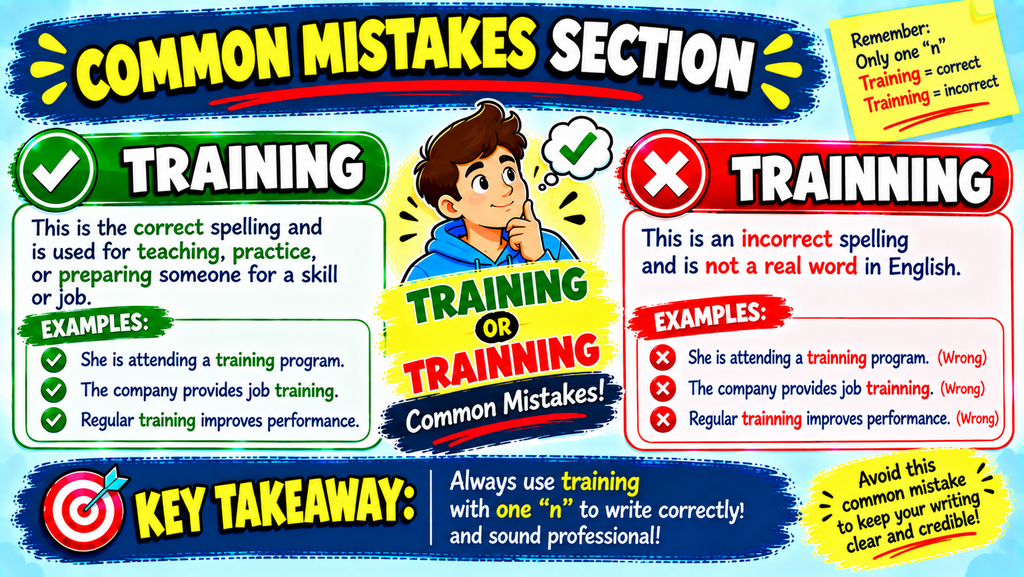
- Writing “trainning” instead of “training”
- Writing “trainned” instead of “trained”
- Confusing this with words like “planning” or “running” that do double
- Assuming all “-ing” words follow the same doubling pattern
Why Do People Write “Trainning”?
Most people over-apply the doubling rule because they’ve memorized it from common short-vowel words like “running” and “swimming” without learning the vowel-digraph exception. Autocorrect doesn’t always catch it either, since “trainning” can slip through in fast typing. ⌨️
Similar Grammar Confusions
| Word | Common Misspelling | Why It Happens |
|---|---|---|
| Training | Trainning | Vowel digraph “ai” misapplies doubling rule |
| Occurring | Occuring | Stress and consonant rule confusion |
| Beginning | Begining | Missed doubling on stressed syllable |
| Reading | Readding | Vowel digraph “ea” incorrectly doubled |
| Traveling | Travelling (UK) / Traveling (US) | Regional spelling variation, not an error |
Usage in Different Contexts
1. Everyday Conversation
“I’m training for a 10K next month” is a natural, common way to talk about personal fitness goals. 🏃
2. Professional Writing
Terms like “employee training,” “training program,” and “training manual” appear constantly in workplace documents, so accuracy here really counts.
3. Creative Writing
Writers might use “training” to describe a character’s backstory or development, such as “years of rigorous training shaped her discipline.”
4. Social Media / Texting
Even in casual captions like “training day 💪 #fitness,” the correct spelling remains “training” — informal tone never changes spelling rules.
Why It Matters (Important Section)
Spelling “training” correctly isn’t just a small grammar detail — it reflects attention to detail in any written communication. 🎯
Key Reasons:
- Prevents embarrassing errors in resumes and cover letters
- Keeps business emails and reports looking professional
- Builds trust with readers, clients, and employers
- Helps ESL learners understand a core English spelling pattern
Special Exception Section
Some words that look similar to “train” do double their consonant, which adds to the confusion. For example, “pin” becomes “pinning” because it has a true single short vowel. The key exception to remember: any word ending in a vowel team or digraph (ai, ee, oa, ea, oi) — like “train,” “read,” or “boat” — does not double, even if it otherwise looks like a short one-syllable word. ⚠️
Quick Recap Checklist
- ✅ Correct spelling: training (one “n”)
- ✅ Applies to both noun and verb forms
- ✅ “Train” has a vowel digraph, so no doubling
- ❌ Never write “trainning,” “trainned,” or “trainn”
Practice Examples
- She is ___ for her certification exam. (training)
- The gym offers personal ___ sessions. (training)
- He ___ his dog every weekend. (trains)
- They completed the ___ program last month. (training)
Frequently Asked Questions: Training or Trainning
Is “trainning” ever correct?
No, “trainning” is always a misspelling in standard English, in every context. ❌
Why doesn’t “train” double its consonant like “run” does?
Because “train” ends in a vowel digraph (“ai”), which doesn’t meet the single-vowel condition needed for doubling.
Is “training” a noun or a verb?
It can be both a noun meaning instruction or skill-building, and a verb form describing an ongoing action.
What’s the correct past tense of “train”?
The correct past tense is “trained,” with a single “n” “trainned” is incorrect.
Does British English spell “training” differently?
No, “training” is spelled the same way in both British and American English.
Why do people commonly misspell this word?
They often over-apply the short-vowel doubling rule without accounting for vowel digraphs like “ai.”
Is “trainer” spelled with one “n” too?
Yes, “trainer” also uses a single “n,” following the same spelling logic as “training.”
Conclusion
The rule behind “training” versus “trainning” comes down to a simple vowel pattern: because “train” contains the vowel digraph “ai,” it never doubles its final consonant before adding “-ing.” 🌟 Keep this exception in mind next time you’re writing a resume, an email, or a social caption, and you’ll spell it correctly every time — no autocorrect required.
