

Introduction
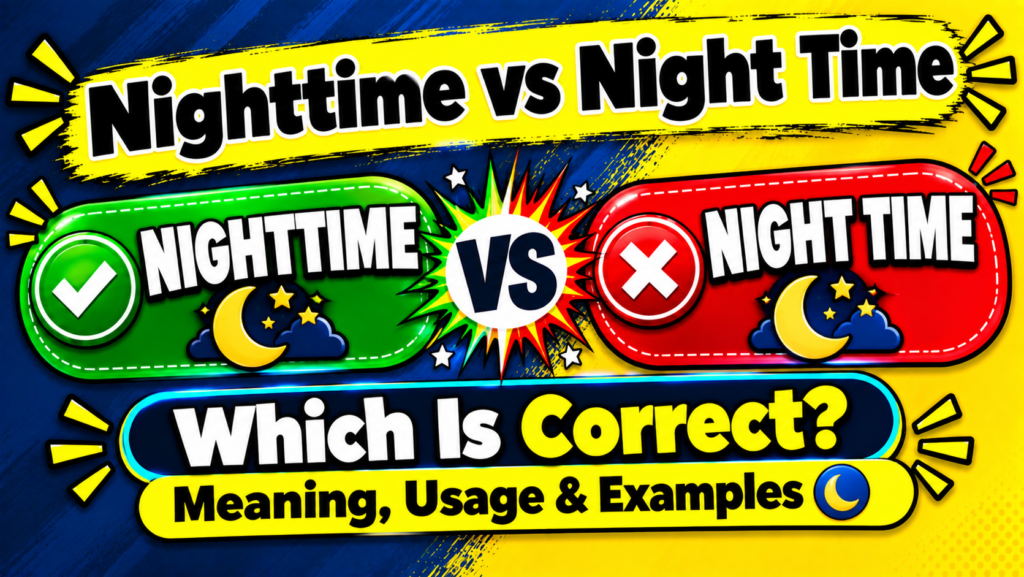
If you’ve ever paused mid-sentence wondering whether to write “nighttime” or “night time,” you’re not alone. 📝 This is one of the most common compound-word mix-ups in English, and getting it right instantly makes your writing look more polished. Below, you’ll find a clear, no-fluff breakdown of the correct usage, common mistakes, and easy memory tricks to lock it in for good.
Quick Answer: Nighttime vs Night Time
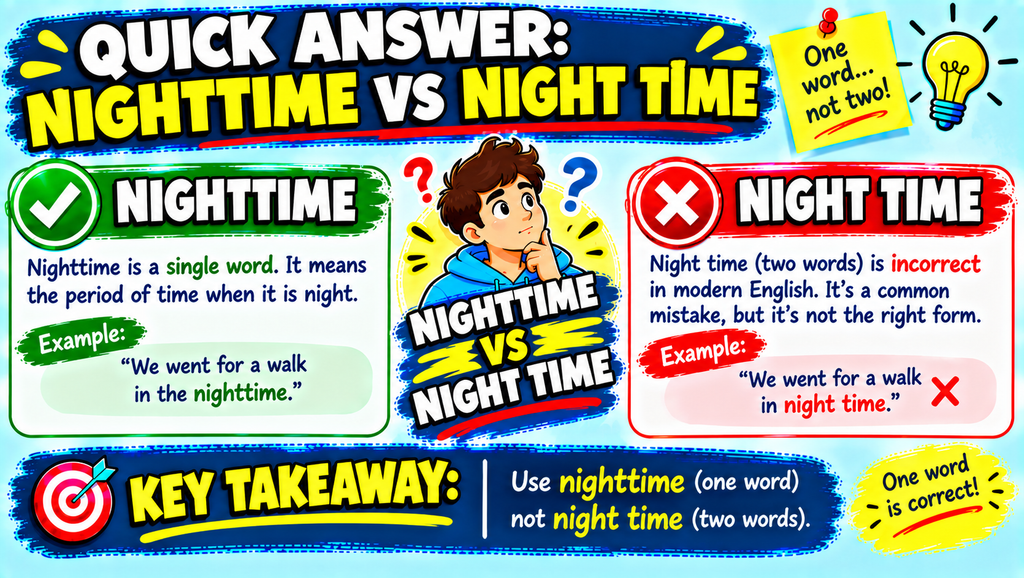
“Nighttime” (one word) is the standard, dictionary-correct form used as both a noun and an adjective. ✅ “Night time” (two words) is generally considered nonstandard, though it sometimes appears informally when “night” and “time” are used as separate, literal words.
| Form | Status | Common Use |
|---|---|---|
| Nighttime | ✅ Correct (standard) | Noun & adjective |
| Night-time | ✅ Correct (British variant) | Noun & adjective |
| Night time | ❌ Nonstandard | Informal/casual writing only |
Understanding the Basics of Nighttime vs Night Time
Core Difference
“Nighttime” is a closed compound word night and time fused into a single unit with its own dictionary entry. 📖 “Night time,” written as two separate words, isn’t recognized as a standard compound by major dictionaries like Merriam-Webster.
Correct Meanings & Uses
What Does “Nighttime” Mean?
“Nighttime” refers to the period between sunset and sunrise when it’s dark outside. 🌌 It works as a noun (a thing) and as an adjective (describing another noun).
Examples:
- The city looks completely different at nighttime.
- She has a nighttime skincare routine.
- Nighttime temperatures dropped sharply this week.
Sentence Breakdown: In “nighttime skincare routine,” nighttime functions as an adjective modifying “routine” just like “daytime job” or “bedtime story.”
Is “Night Time” Ever Correct?
Technically, “night time” can appear when you’re literally combining the word “night” with the word “time” in a loose, descriptive sense but style guides don’t treat it as the standard compound. 🚫
Example: “What time did you say day time or night time?” (informal, spoken emphasis) is different from the correct compound usage: “I prefer working at nighttime.”
Test Tip: If you can replace the phrase with “daytime” and it still makes sense, use “nighttime” (one word). ✅
Case Study: Real-Life Usage
Major style guides, including AP Style and Merriam-Webster, list “nighttime” as one word for both noun and adjective forms. 📊 Publishers and editors overwhelmingly favor the closed form because it matches how the word is actually pronounced as a single unit, not two separate beats.
Why the Second Version Works Better
“Nighttime” reads faster, looks cleaner in headlines, and avoids ambiguity which is exactly why professional editors default to it. ⚡
Grammar Rules Explanation
Why “Nighttime” Is Correct
English regularly fuses two nouns into one closed compound once the combination becomes common enough “daytime,” “lifetime,” and “bedtime” all followed this same path. 🔗 “Night” + “time” followed suit centuries ago.
Why “Night Time” Sounds Natural to Some People
Because we pronounce it with a slight pause, many writers assume it should be two words. 🗣️ This is a case where pronunciation and spelling logic don’t perfectly line up.
Common Mistakes Section
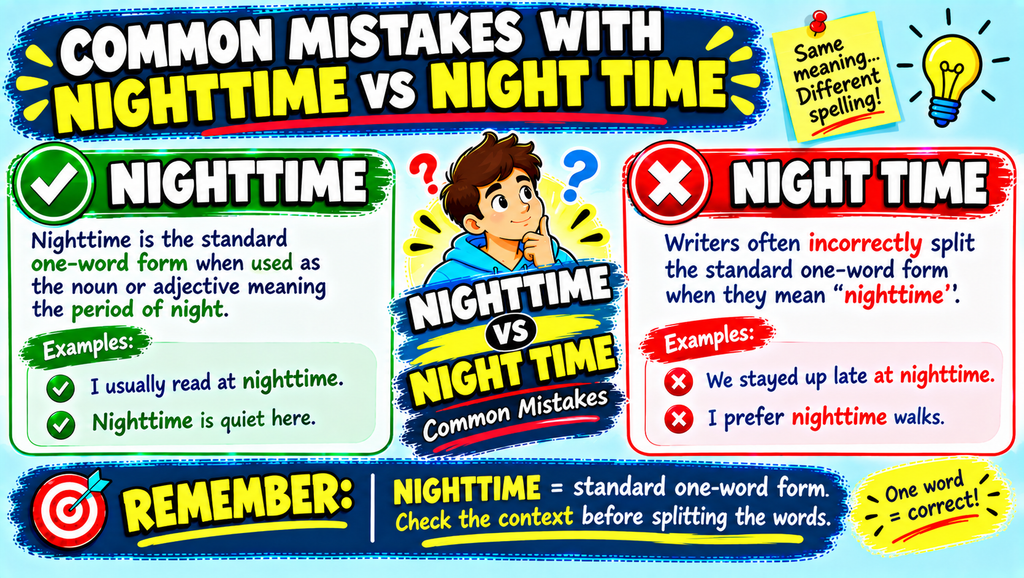
Why Do People Confuse Nighttime vs Night Time?
1. Fast Typing — Typing quickly often splits compound words without thinking. ⌨️
2. Autocorrect Issues — Some autocorrect tools don’t flag “night time” as an error. 📱
3. Lack of Grammar Knowledge — Many similar English compounds follow inconsistent rules, causing confusion. 🤔
Similar Grammar Confusions Table
| Correct (Closed) | Incorrect/Different Meaning (Open) |
|---|---|
| Daytime | Day time |
| Anytime (adverb: “call anytime”) | Any time (noun phrase: “I don’t have any time”) |
| Everyday (adjective: “everyday shoes”) | Every day (adverb: “I run every day”) |
| Bedtime | Bed time |
| Sometime (adverb) | Some time (noun phrase) |
Usage in Different Contexts
Everyday Conversation
In casual speech, “nighttime” flows naturally into sentences without a second thought. 💬
Example: “I get so hungry at nighttime.”
Professional Writing
Business and academic writing should always default to “nighttime” for consistency and credibility. 💼
Example: “The report highlights a rise in nighttime energy consumption.”
Creative Writing
Writers sometimes stylistically separate the words for rhythm or emphasis, though this remains a creative choice, not a grammar rule. ✍️
Example: “Night. Time. Stretching endlessly before her.”
Social Media & Texting
Informal platforms are far more forgiving, and “night time” often slips through unnoticed. 📲
Example: “Can’t sleep, it’s 2am night time thoughts again 😅”
Why It Matters
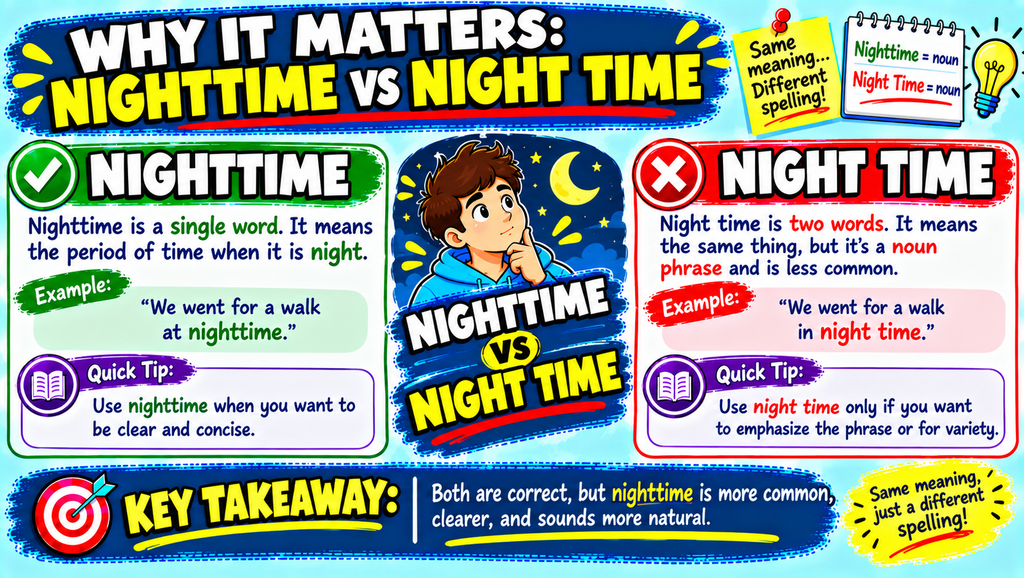
Benefits of Using the Correct Form
- Clarity in Communication — readers instantly understand your meaning. 🎯
- Professionalism — correct compounds signal careful writing. 🏆
- Writing Accuracy — matches dictionary and style-guide standards. ✔️
- Better Digital Communication — improves readability on screens and in SEO content. 💻
Special Exception Section
1. Older Publications
Some 19th- and early 20th-century texts used “night-time” with a hyphen, which still appears occasionally in British English today. 📜
2. Creative Styling
Poets and novelists may split the word intentionally for pacing or emphasis this is a stylistic device, not a grammatical rule. 🎨
Quick Recap Checklist
- ✅ Use “nighttime” as one word for standard writing
- ✅ “Night-time” (hyphenated) is acceptable in British English
- ❌ Avoid “night time” as two words in formal contexts
- ✅ Test with “daytime” as a comparison anchor
Practice Examples ✍️
- I love reading before ______ (nighttime/night time).
- The ______ (nighttime/night time) sky was full of stars.
- Owls are ______ (nighttime/night time) hunters.
- She works the ______ (nighttime/night time) shift at the hospital.
(Answer: “nighttime” fits correctly in all four.)
Deep Dive: Compound Words in English
What Is a Compound Word?
A compound word forms when two or more words combine to create a new meaning. 🧩 English compounds fall into three categories.
Types of Compound Words
| Type | Example | Description |
|---|---|---|
| Closed Compounds | Nighttime, daytime, notebook | Written as one word |
| Open Compounds | Ice cream, high school | Written as two separate words |
| Hyphenated Compounds | Mother-in-law, well-known | Joined with a hyphen |
Nighttime in American vs British English
American English strongly favors the closed form “nighttime,” while British English sometimes retains the hyphenated “night-time.” 🇺🇸🇬🇧 Neither variety treats the fully open “night time” as standard.
Examples
American English: “Nighttime driving requires extra caution.”
British English: “Night-time driving requires extra caution.”
Examples of Nighttime in Sentences
As a Noun
- Nighttime brings a welcome quiet to the neighborhood.
- We arrived long after nighttime had settled in.
As an Adjective
- The clinic offers a nighttime appointment slot.
- His nighttime habits changed after starting the new job.
Incorrect Usage Examples
- ❌ “The night time hours are the quietest.” → ✅ “The nighttime hours are the quietest.”
- ❌ “She prefers night time walks.” → ✅ “She prefers nighttime walks.”
Memory Tricks to Remember the Correct Form
Trick #1: Think of “Daytime” — if “day” and “time” fuse into one word, so should “night” and “time.” ☀️🌙
Trick #2: Use Dictionary Logic — when in doubt, a quick dictionary check confirms “nighttime” as one word. 📚
Trick #3: Visual Connection — picture the words physically merging, like two puzzle pieces locking together. 🧩
Expert Writing Advice ✍️
Avoid Mixing Forms
Stay consistent throughout a single piece of writing don’t switch between “nighttime” and “night time” in the same document. 🔄
Cultural and Literary Use
Writers occasionally separate the words deliberately for dramatic pacing in fiction or poetry. 🎭
Example in Fiction: “Night. Time itself seemed to hold its breath.” a stylistic split used purely for rhythm, not standard grammar.
Final Comparison Table
| Feature | Nighttime | Night-time | Night Time |
|---|---|---|---|
| Word Type | Closed compound | Hyphenated compound | Open (nonstandard) |
| Region | American English | British English | Informal only |
| Grammatically Standard | ✅ Yes | ✅ Yes | ❌ No |
| Common in Formal Writing | ✅ Yes | ✅ Yes | ❌ No |
Frequently asked questions: Nighttime vs Night Time
Is “nighttime” one word or two?
“Nighttime” is correctly written as one word in standard English. ✅
Is “night-time” with a hyphen correct?
Yes, “night-time” is an accepted hyphenated variant, especially in British English. 🇬🇧
Can “night time” ever be grammatically correct?
It’s not the standard compound form, though it sometimes appears informally in casual or literal phrasing. 🚫
What’s the difference between “night” and “nighttime”?
“Night” refers to a specific evening or period, while “nighttime” refers to the general period of darkness. 🌙
Does AP Style use “nighttime” or “night time”?
AP Style and most major style guides use the closed form, “nighttime.” 📰
Is “nighttime” a noun, an adjective, or both?
“Nighttime” functions as both a noun (“during nighttime”) and an adjective (“nighttime routine”). 🔤
Conclusion
“Nighttime” is the grammatically correct, dictionary-standard form for both American and general use, while “night-time” remains a valid hyphenated alternative in British English. 🌙 “Night time,” written as two separate words, should generally be avoided in formal writing. Keep the comparison to “daytime” in mind, and you’ll never second-guess this one again. ✅
