

“Complete” and “completed” look almost identical, but mixing them up is one of the most common grammar slip-ups in English. 📝 One word describes a state, the other describes an action that already happened and once you see the pattern, you’ll never confuse them again.
This guide breaks down the meaning, grammar rules, and real examples so you can use both words correctly in writing and speech.
Quick Answer: Complete vs Completed 🎯
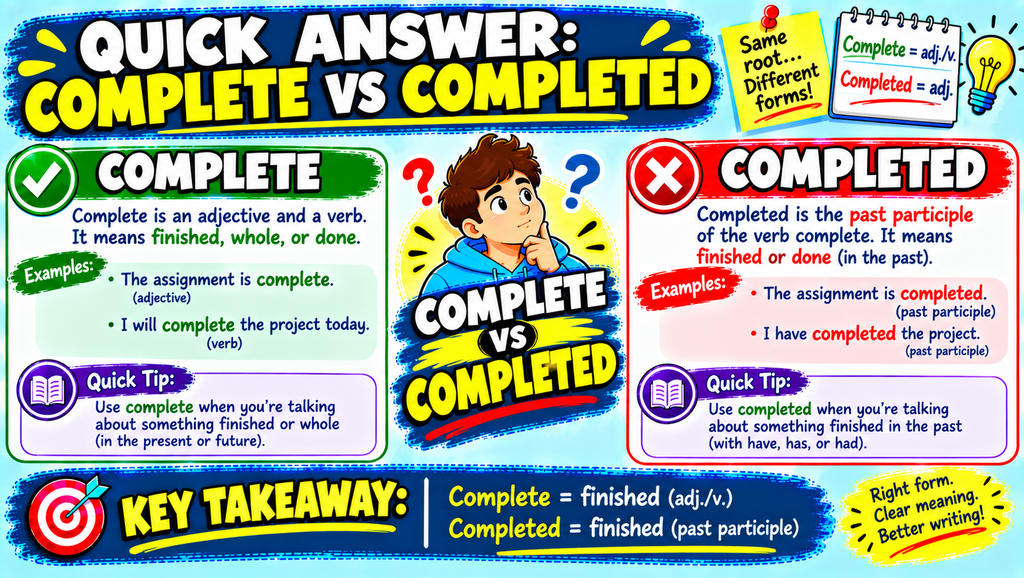
Here’s the short version, perfect if you just need a fast fix:
- Complete is usually an adjective meaning whole, finished, or having all necessary parts (“The set is complete”). It can also be a verb in its base form (“Please complete the form”).
- Completed is the past tense or past participle of the verb “complete,” used to show that an action has already been finished (“She completed the form” or “The form has been completed”).
| Word | Part of Speech | Meaning | Example |
|---|---|---|---|
| Complete | Adjective / Verb (base) | Whole, finished, or “to finish” | The kit is complete. |
| Completed | Past tense / Past participle | An action that has already ended | He completed the kit. |
Understanding the Basics of Complete vs Completed
Core Difference
The real difference isn’t spelling it’s grammar function. “Complete” describes a condition or gives an instruction, while “completed” reports a finished event. ✅
Simple Breakdown
- Complete = State or Condition something is whole, finished, or entire right now.
- Completed = Finished Action something was done, usually with a helping verb like has, have, had, is, or was.
Using “Complete” as an Adjective
When “complete” describes a noun or follows a linking verb (is, was, seems, feels), it’s an adjective meaning “whole” or “finished.”
Examples:
- The puzzle is complete.
- This is a complete guide to grammar.
- Her outfit felt complete with the new shoes.
Sentence Breakdown: In “The puzzle is complete,” is is a linking verb, and complete describes the puzzle’s current condition not an action.
Test Tip: If you can swap the word for “whole” or “finished” without changing the meaning, it’s the adjective “complete.” 💡
Using “Complete” as a Verb
“Complete” is also the base form of a verb, used with “to,” “will,” or present-tense subjects.
Examples:
- I need to complete this report today.
- They will complete the project by Friday.
- Please complete all required fields.
Sentence Breakdown: In “to complete this report,” the word functions as an action something not yet done.
Test Tip: If “will” or “to” comes right before it, you’re looking at the verb form “complete,” not the adjective.
Using “Completed” as a Past Tense Verb
When an action has already finished, “completed” shows simple past tense.
Examples:
- She completed her degree last year.
- The team completed the audit in March.
- We completed the survey yesterday.
Sentence Breakdown: “Completed” here replaces “finished” and points to an action that’s already over.
Test Tip: Ask “did it happen already?” If yes, “completed” is usually correct. ✅
Using “Completed” as a Past Participle
“Completed” also pairs with helping verbs (has, have, had, is, was, will be) to form perfect or passive tenses.
Examples:
- The application has been completed.
- Training will have been completed by June.
- The form was completed incorrectly.
Test Tip: If you see has/have/had or a form of “be” right before it, “completed” is the correct choice.
Case Study: Real-Life Usage Example
Incorrect Email:
“Hi team, the onboarding form is not completed yet please complete it as soon as possible so the file can be complete.”
Correct Email:
“Hi team, the onboarding form has not been completed yet please complete it as soon as possible so the file is complete.”
Another Example
Incorrect: The report was complete by the analyst on Monday.
Correct: The report was completed by the analyst on Monday.
Why the Difference Matters
Swapping these words doesn’t always break communication, but it does make writing look careless. In professional emails, resumes, or reports, precision signals credibility. 📌
Grammar Rules Explanation
| Rule | Explanation | Example |
|---|---|---|
| 1. Use “complete” after linking verbs | Describes a state, not an action | The kitchen renovation is complete. |
| 2. Use “completed” for past actions | Shows the action already happened | We completed the renovation in May. |
| 3. Use “completed” with helping verbs | Forms perfect/passive tense | The renovation has been completed. |
| 4. “Complete” can be verb or adjective | Context decides the role | Complete the form (verb) vs. a complete form (adjective) |
Common Mistakes With Complete vs Completed
Why Mistakes Happen
- Fast Typing: People type quickly and skip the “-ed” ending.
- Autocorrect: Some keyboards “fix” completed to complete, or vice versa.
- Lack of Grammar Knowledge: Many learners assume the two words are interchangeable synonyms.
Common Incorrect Sentences
- ❌ “The project is completed” (when describing an ongoing state should be “complete”)
- ❌ “I complete the task yesterday” (past action needs “completed”)
- ❌ “Have you complete the form?” (helping verb needs “completed”)
Similar Grammar Confusions
This complete/completed mix-up is closely related to other common pairs like finish vs finished or close vs closed same rule, same fix. 🔑
Usage in Different Contexts
| Context | Preferred Style | Example |
|---|---|---|
| Everyday Conversation | Often uses “complete” for state | “Dinner is complete!” |
| Professional Writing | Frequently uses “completed” for reports/status | “The audit was completed on time.” |
| Creative Writing | Either, depending on tone | “Her transformation felt complete.” |
| Social Media/Texting | Casual, sometimes shortened | “Just completed my first 5K! 🏃” |
Everyday Conversation
- “Is your homework complete?”
- “I completed my chores already.”
Professional Writing
- “All action items have been completed.”
- “Kindly complete the attached document.”
Creative Writing
- “The story felt complete without a sequel.”
Social Media and Texting
Informal: “Finally completed the marathon!! 🎉”
More Formal: “I have successfully completed the marathon.”
Why It Matters
Clarity in Communication
Using the right word avoids confusing your reader about whether something is still true or already finished.
Professionalism
Correct grammar builds trust in emails, resumes, and reports. 🧠
Writing Accuracy in Digital Communication
As more communication happens over chat and email, small grammar slips get noticed faster than ever.
Special Exceptions and Edge Cases
Example: “The list is completed” is grammatically possible but less common.
Correct but Less Natural: “The list is completed.”
More Natural: “The list is complete.”
Rare Technical Usage
In sports (like a completed pass in football) or legal/technical writing, “completed” can function almost like an adjective describing a result.
Complete vs Completed in Passive Voice
Examples:
- The task is complete. (state, no actor mentioned)
- The task was completed by the intern. (passive voice, action + actor)
Active Voice vs Passive Voice
Active voice uses “complete” as an action verb (“She completes the form”), while passive voice almost always pairs “completed” with a form of “be” (“The form is completed by her”).
Sentence Pattern Guide
Use “Complete” When:
- Describing a finished state (“The set is complete”)
- Giving an instruction (“Complete the survey”)
- Referring to something whole or entire (“A complete collection”)
Use “Completed” When:
- Describing a past action (“He completed the race”)
- Using helping verbs like has/have/had/was (“It has been completed”)
Quick Recap Checklist
- ✅ Complete = adjective (state) or base verb (instruction)
- ✅ Completed = past tense or past participle (finished action)
- ✅ Check for helping verbs they usually signal “completed”
- ✅ Check for linking verbs they usually signal “complete”
Practice Examples
- The training program (complete/completed) last week. → completed
- Please make sure your application is (complete/completed) before submitting. → complete
- She has (complete/completed) three certifications so far. → completed
Advanced Grammar Insights
Predicate Adjectives
“Complete” often works as a predicate adjective after “be” verbs, describing the subject’s condition rather than an action performed on it.
Past Participles
“Completed” as a past participle can appear in perfect tenses (has completed) or passive constructions (was completed) both signal that the action is finished.
Common Patterns Native Speakers Use
Most Natural Expressions
- “Task complete!” (casual, state)
- “I’ve completed the task.” (natural past action)
Native Speakers Prefer:
Short adjective phrases like “all set” or “done” alongside “complete,” while reserving “completed” for more formal or written contexts.
Memory Tricks to Remember the Difference
Trick 1: Think About Time
Complete = right now. Completed = already happened.
Trick 2: Look for Helping Verbs
Has, have, had, is, was, will be + completed.
Trick 3: Replace the Word
Try swapping in “whole” (for complete) or “finished” (for completed) to test which fits. 💡
Mini Quiz
- The form (complete/completed) yesterday.
- Is your project (complete/completed) yet?
- They have (complete/completed) the training.
- A (complete/completed) set of tools was delivered.
(Answers: 1. completed, 2. complete, 3. completed, 4. complete)
Frequently asked questions Complete vs Completed
Is “complete” a synonym of “completed”?
Not exactly “complete” often describes a state, while “completed” describes a finished action, though they overlap in some contexts.
Can “complete” be used as a verb?
Yes, “complete” is the base form of the verb, as in “Please complete the survey.”
Which is correct: “task is complete” or “task is completed”?
Both are grammatically fine, but “task is complete” is more natural for describing a current state.
Is “completed” always passive?
No it can be part of active perfect tense (“I have completed it”) or passive voice (“It was completed”).
What is the past participle of “complete”?
The past participle is “completed,” used with has/have/had or forms of “be.”
Why do people confuse complete and completed?
Because both relate to “finishing,” but they differ by part of speech and tense, which is easy to overlook in fast writing.
Conclusion
“Complete” and “completed” both point to the idea of finishing something, but grammar decides which one fits. 🔑 Use “complete” for a state, condition, or instruction, and “completed” for a past action or with helping verbs. Once you apply this simple test — checking for helping verbs and linking verbs — you’ll pick the right word every time. ✅
