

If you’ve ever paused mid-sentence wondering whether to say “I like to listen to music” or “I like to listen to the music,” you’re not alone. This is one of the most common article mix-ups in English, especially for ESL learners. ✅
The good news? Both phrases are correct they just mean slightly different things depending on context. Let’s break it down clearly, with real examples, common mistakes, and a quick grammar cheat sheet you can actually remember.
Quick Answer: Listen to Music vs Listen to the Music
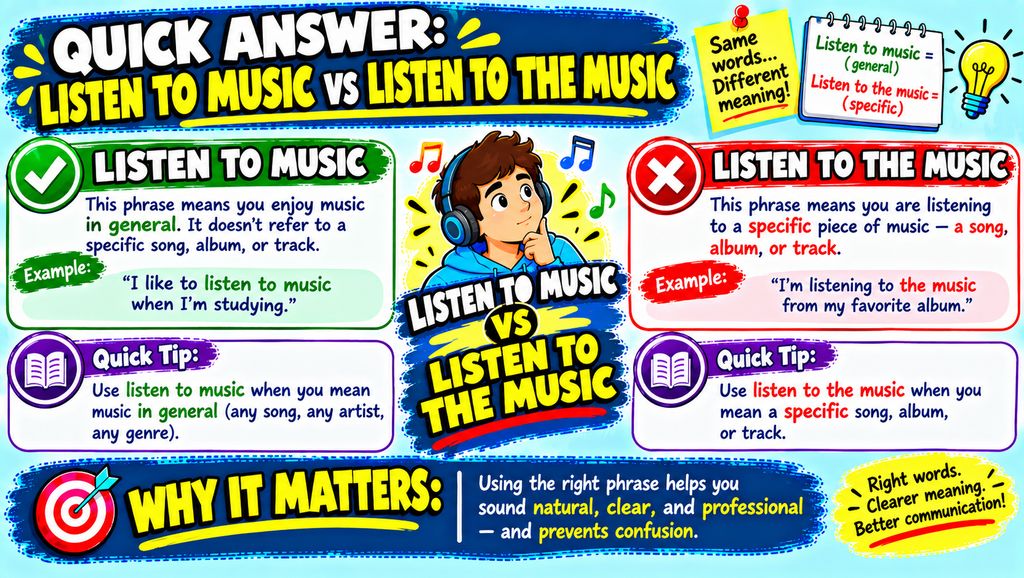
Here’s the short version before we dig deeper 👇
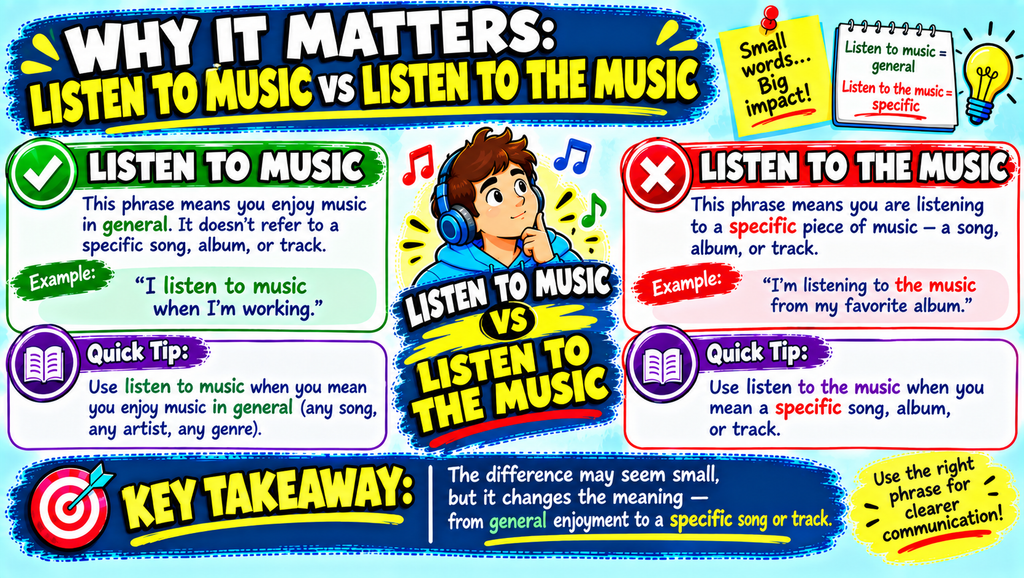
- “Listen to music” = general reference. No specific song, genre, or artist in mind (e.g., “I listen to music every morning.”)
- “Listen to the music” = specific reference. You mean a particular song, playlist, or sound that’s already known or currently playing (e.g., “Listen to the music playing in the café.”)
Neither version is “wrong” the article (“the” or nothing) simply changes the meaning from general to specific. 🎯
Understanding the Basics: Listen to Music vs Listen to the Music
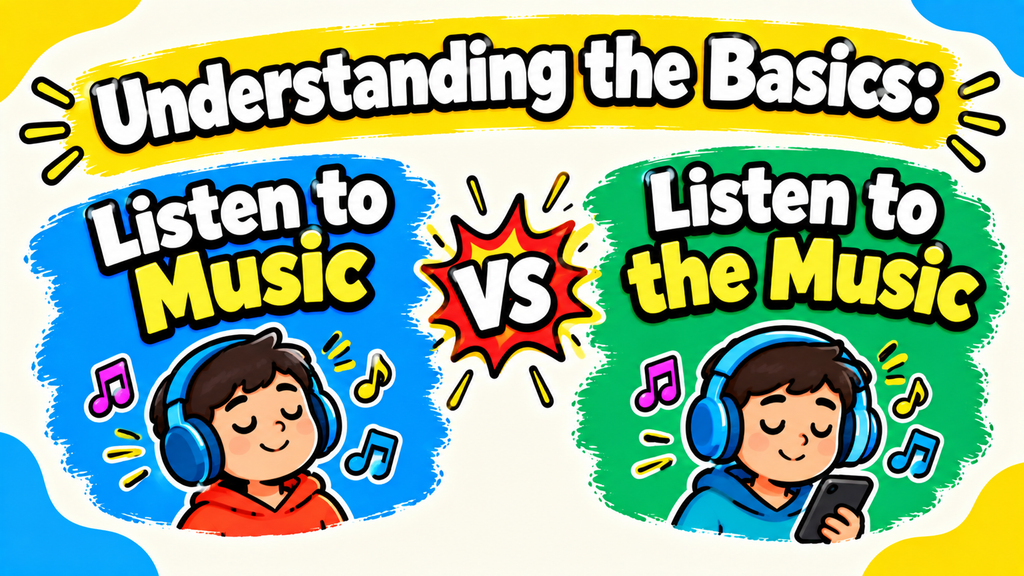
English uses three types of articles: a/an, the, and the zero article (no article at all). “Music” is an uncountable noun, so it never takes “a” or “an” — but it can appear with or without “the,” depending on whether you’re being general or specific.
- No article → general idea (“I love music.”)
- “The” → specific, known reference (“I love the music from that film.”)
This same pattern shows up with other uncountable nouns too, like “coffee,” “water,” and “information.” 💡
Comparison Table
| Phrase | Article Type | Meaning | Example Sentence |
|---|---|---|---|
| Listen to music | Zero article | General activity or habit | She listens to music while studying. |
| Listen to the music | Definite article | Specific, known, or currently playing music | Listen to the music — it’s from our wedding! |
Correct Meanings & Uses
Using “Listen to Music”
This version talks about music as a broad concept — not one particular song or album, but the general act of listening.
Sentence Breakdown:
“I listen to music” → listen (verb) + to (required preposition) + music (general, uncountable noun, no article).
Test Tip: If you can replace “music” with “movies,” “books,” or “sports” and the sentence still makes sense as a general statement, you’re using the zero article correctly. Example: “I listen to music” ↔ “I watch movies.” ✅
Using “Listen to the Music”
This version points to specific music something already mentioned, playing right now, or obvious from context.
Sentence Breakdown:
“Listen to the music” → listen + to + the (points to something specific) + music (a known or identifiable piece).
Test Tip: Ask yourself, “Which music?” If you can answer with something specific (this song, that playlist, the soundtrack), “the” belongs there. Example: “Listen to the music” → the music playing right now on the radio. 🎧
Additional Examples
Listen to Music (general):
- He listens to music on his commute every day.
- Do you listen to music while working out?
- I don’t listen to music much these days.
Listen to the Music (specific):
- Turn up the volume and listen to the music!
- I could listen to the music from that concert forever.
- Please listen to the music before giving feedback on the mix.
Case Study Section
Imagine two coworkers chatting during lunch:
Anna: “I usually listen to music when I need to focus.”
Ben: “Same actually, listen to the music playing right now. It’s the same artist you mentioned!”
Anna’s sentence is general just a habit. Ben’s sentence points to a specific song playing at that moment. Same verb, same object, completely different meaning all because of one small word: “the.” 📌
Grammar Rules Explanation
A few core rules make this easy to remember:
- “Listen” always needs “to” before an object “listen music” is incorrect; it must be “listen to music.”
- Zero article is used for general, uncountable statements (“music,” “art,” “love” in general).
- Definite article (“the”) is used when both speaker and listener know exactly which music is meant because it was mentioned earlier, it’s currently playing, or it’s the only option in context.
Common Mistakes
Fast Typing
Writers often drop “to” entirely when typing quickly “I listen music” instead of “I listen to music.” Spell-check won’t always catch this since it’s a grammar issue, not a spelling one. ⌨️
Autocorrect
Autocorrect tools sometimes insert or remove “the” based on surrounding words, accidentally changing a general statement into a specific one (or vice versa) without the writer noticing.
Lack of Knowledge
Many non-native speakers translate directly from their first language, where articles work differently or don’t exist at all leading to missing or misplaced “the.”
Similar Grammar Confusions
This general-vs-specific article pattern shows up in plenty of other common phrases:
- Watch TV vs. Watch the TV
- Play guitar vs. Play the guitar
- Go to school vs. Go to the school
- Listen to radio vs. Listen to the radio
Usage in Different Contexts
Everyday Conversation
Casual speech leans heavily on “listen to music” for general habits (“I listen to music to relax”), while “the music” pops up when pointing something out in the moment (“Listen to the music isn’t it beautiful?”).
Professional Writing
In reports, reviews, or formal writing, precision matters. A music critic would write “the music” when reviewing a specific album, but “music” in general when discussing industry trends.
Creative Writing ✍️
Writers often use “the music” poetically to create imagery “the music” of rain, wind, or a lover’s voice giving abstract things a specific, felt presence.
Social Media and Texting
Captions often drop articles for brevity (“Listening to music 🎶”) which is grammatically fine in casual, informal settings, though it’s technically the zero-article general form.
Why It Matters
Clarity in Communication
Choosing the right article prevents confusion about whether you mean music in general or one specific track small word, big difference in meaning.
Professionalism
In resumes, emails, or academic writing, correct article usage signals strong command of English and attention to detail.
Writing Accuracy in Digital Communication
With so much writing happening over text and social media, small article errors can make messages sound less polished, even if the meaning is technically clear.
Special Exception
One notable exception: song and movie titles don’t always follow standard grammar logic. For example, “Listen to the Music” is the title of a well-known 1972 song by The Doobie Brothers — in titles, “the” is often used for stylistic or artistic effect rather than strict grammatical necessity. 🎶
Quick Recap Checklist
- ✅ Use “listen to music” for general habits or preferences.
- ✅ Use “listen to the music” for specific, known, or currently playing music.
- ✅ Always include “to” after “listen” when there’s an object.
- ❌ Never say “listen music” — it’s always “listen to music.”
Practice Examples
Try filling in the blank with “the” or nothing (zero article):
- I love ___ music from the 90s. (the — specific era)
- She listens to ___ music every night before bed. (zero article — general habit)
- Can you hear ___ music coming from next door? (the — specific, audible now)
- He doesn’t listen to ___ music much anymore. (zero article — general)
Frequently asked questions
Is “listen to the music” grammatically correct?
Yes it’s correct when referring to specific, known, or currently playing music.
Can I say “listen music” without “to”?
No, “listen” always requires “to” before its object; “listen music” is incorrect.
What’s the difference between “hear music” and “listen to music”?
“Hear” is passive and unintentional, while “listen to” involves active, deliberate attention.
When do I use “the” before “music”?
Use “the” when the music is specific, previously mentioned, or obvious from context.
Is “Listen to the Music” a song title?
Yes, it’s a famous 1972 song by The Doobie Brothers.
Which phrase should I use in formal writing?
Use whichever matches your meaning “music” for general statements, “the music” for a specific piece being discussed.
Conclusion
Both “listen to music” and “listen to the music” are grammatically correct the only real difference is whether you’re speaking generally or specifically. Once you remember that “the” signals something known or particular, choosing the right version becomes second nature. Keep this guide handy, and you’ll never second-guess this common English mix-up again. 🎧
