

Ever filled out a school form that asked for your “mother tongue,” then a job application that asked for your “native language”? 🤔 It feels like the same question asked twice. 📝 Often it is, but not always. ✅
This guide explains mother tongue vs native language in plain English. 🗣️ You’ll get clear meanings, a comparison table, real-life examples, common mistakes, and a short practice quiz. 🎯 Let’s settle it. 🌍
Quick Answer: Mother Tongue vs Native Language
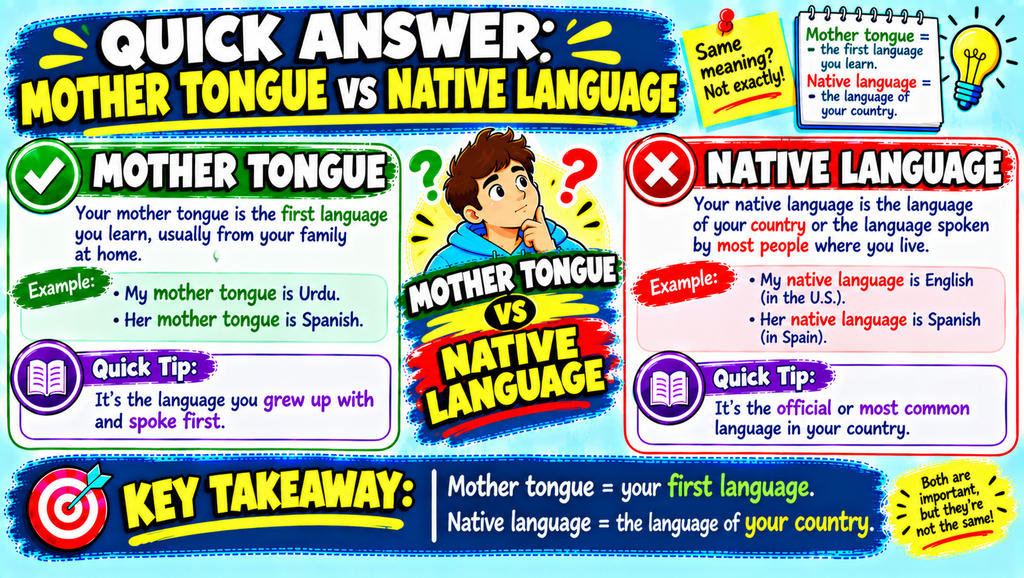
Mother tongue is the first language you learn at home as a child, and it carries family and cultural roots. 🏡 Native language is the language you picked up naturally in childhood and know best, usually the one you use every day. 💬 They are often the same language, but they can differ for bilingual families and people who move countries. ✈️
Understanding the Basics: Mother Tongue vs Native Language
Most dictionaries treat the two terms as near-synonyms. 📖 In everyday English, though, writers and teachers often draw a soft line between them. ✏️ That line comes down to two ideas:
- Origin: Which language came from your family and home? 👨👩👧
- Use: Which language do you actually live and think in? 🧠
A third term, first language (L1), sits close to both. 🤝 It simply means the first language you were exposed to. 🍼 Linguists also mention your dominant language, which is the one you use most right now. ⚖️
Comparison Table
| Feature | Mother Tongue | Native Language |
|---|---|---|
| Core meaning | First language learned at home | Language acquired naturally in childhood and known best |
| Main focus | Family, heritage, emotion | Fluency, natural acquisition, daily use |
| Learned from | Parents or caregivers | Home, community, or surroundings |
| Emotional weight | High | Moderate |
| Tone | Warm, cultural, literary | Neutral, formal, practical |
| Stability | Fixed by early home life | Your strongest language may shift over time |
| Example | Tamil spoken at home | English used at school and work |
Correct Meanings & Uses
What Does “Mother Tongue” Mean?
Mother tongue means the first language a child learns at home, usually from parents or caregivers. 👶 The phrase comes from the idea of learning speech from your mother. 🤱 Today it covers any caregiver, and it often carries warmth, memory, and identity. ❤️
Example:
- “Her mother tongue is Tamil, but she studies in English.” 📚
- “He still counts in his mother tongue.” 🔢
Test Tip: Ask yourself, “Which language did my family speak to me as a baby?” 🍼 That answer is your mother tongue. ✅
What Does “Native Language” Mean?
Native language means a language you acquired naturally in childhood, through immersion rather than lessons. 🌱 It is usually the language you handle with the most ease. 💪 Because of that, it sounds more neutral and formal than “mother tongue.” 🎓
Example:
- “English is my native language, so I write my reports without help.” 💻
- “The survey was offered in each participant’s native language.” 📋
Test Tip: Ask yourself, “In which language do I think, joke, and argue without effort?” 😄 That is your strongest candidate. 🧠
When They Are the Same
If you grew up in a home and country that share one language, both terms point to it. 🏠 A child raised in Japan by Japanese-speaking parents has Japanese as both. 🇯🇵 Most monolingual families fall into this group. ✅
Case Study Section
These are illustrative examples, not real people. 📌
Case 1: Amara, Igbo at Home and English Everywhere Else
Amara’s parents speak Igbo at home in London. 🏡 School, friends, and work all happen in English. 🏫 Igbo is her mother tongue. 💛 English is the language she handles best, so many people would call it her native language. 🗣️ Both labels fit, for different reasons. ⚖️
Case 2: Lucas, Two Languages from Day One
Lucas’s father speaks German and his mother speaks Portuguese. 👨👩👦 He heard both from birth. 🍼 He has two mother tongues and two native languages. 🌐 Bilingual families are the classic exception to the “one language” idea. 🔄
Grammar Rules Explanation
- Both are noun phrases. “Mother tongue” is a compound noun, and “native language” is an adjective plus a noun. 🧱
- Keep “mother tongue” as two words. Avoid “mothertongue.” ✍️
- Use a possessive or an article. Say “my mother tongue” or “a native language.” 👍
- Use “in” before the language. For example, “She writes poetry in her mother tongue.” 📜
- Pluralize the noun. It’s “mother tongues” and “native languages.” 🔤
- Use “native speaker” for people. The language is “native,” and the person is a “native speaker.” 🗣️
Common Mistakes
Fast typing
Typos are the top offender. ⌨️ You’ll often see “mother tounge,” “mothertongue,” and “natve language.” 😬 Reread the term before you hit send. 👀
Autocorrect
Autocorrect can change “native” to “naive” or swap “tongue” for a different word. 📱 Proofread every form, CV, and caption. ✔️
Lack of knowledge
- Assuming the two terms always mean the same thing. ❌
- Thinking “native” means “born in this country.” 🌎
- Believing the mother tongue must be your mother’s language only. 👩
- Writing “I am native of French” instead of “I am a native speaker of French.” 🇫🇷
Similar Grammar Confusions Table
| Confusing Pair | Key Difference | Example |
|---|---|---|
| Mother tongue vs first language | Mother tongue stresses home and heritage. First language simply means first learned. | “Korean is my first language.” |
| Native language vs native speaker | One is the language, the other is the person. | “She is a native speaker of Hindi.” |
| Native language vs national language | A national language is chosen by a country. | “Filipino is the national language of the Philippines.” |
| Mother tongue vs heritage language | A heritage language is a family language you may speak only partly. | “Spanish is her heritage language.” |
| Second vs foreign language | A second language is used around you. A foreign language is learned where it isn’t spoken. | “A student in Brazil learning Japanese studies a foreign language.” |
Usage in Different Contexts
Everyday Conversation
In casual talk, people swap the two terms freely. 🗨️ “What’s your mother tongue?” and “What’s your native language?” usually get the same answer. 😊 Mother tongue can sound a bit more personal. 💞
Professional Writing
On a CV or official form, “native language” or “first language” is usually the safest pick. 📄 “Mother tongue” is also common in education and government paperwork in many countries. 🏛️ Match the wording the form uses. 🔎
Creative Writing ✍️
Writers choose “mother tongue” for warmth, nostalgia, and identity. 🕯️ For example: “The lullaby returned in her mother tongue.” 🎶 “Native language” suits clearer, more factual passages. 📚
Social Media and Texting
Short posts favor short phrases, so “mother tongue” or “L1” often shows up in bios. 📲 UNESCO designated 21 February as International Mother Language Day, so posts using the term spike around that date. 🎉 Keep your spelling clean, since typos spread fast online. 🚀 epfl
Why It Matters (Important)
Clarity in communication
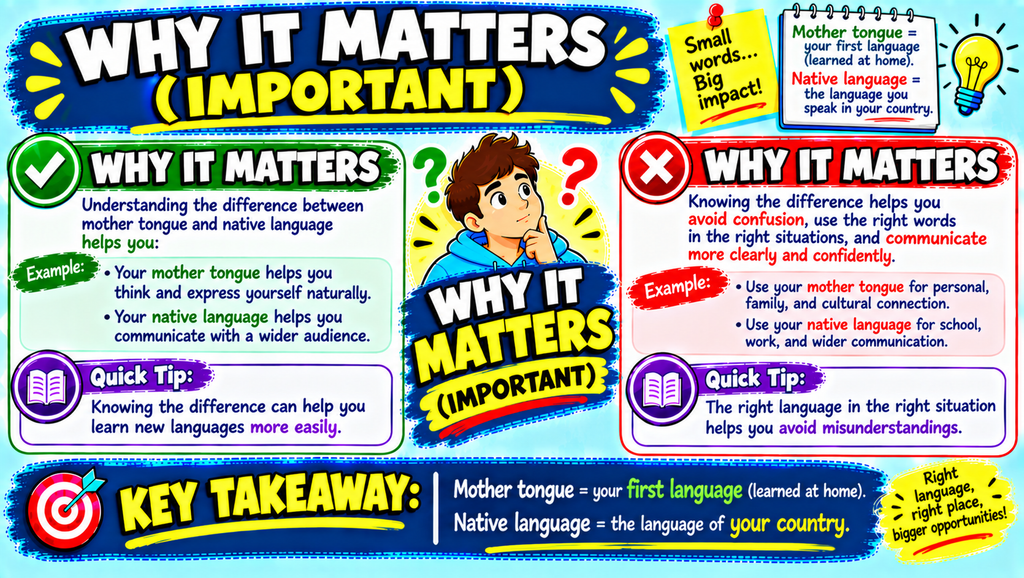
The right term avoids confusion on forms, in classrooms, and in interviews. 🎯 Teachers use this information to support multilingual learners. 🍎
Professionalism
Accurate wording shows care. 💼 It matters most in CVs, translation work, and academic writing. 🎓
Writing accuracy in digital communication
Search engines, autocorrect, and translation tools all respond to precise wording. 🔍 Correct terms and spelling help your writing get found and understood. 💻
Special Exception
In some places, “mother tongue” refers to the language of your ethnic community, not your personal first language. 🌏 Singapore, for example, uses the term for the language tied to your ethnic group, however well you speak it. 🇸🇬 Statistics Canada defines it as the first language learned at home in childhood and still understood at the time of the census. 🍁 Always check the local definition before answering an official form. 📝 WikipediaWikipedia
Quick Recap Checklist
- ✅ Mother tongue = the first language learned at home.
- ✅ Native language = the language acquired naturally in childhood and known best.
- ✅ They are often the same, but they can differ.
- ✅ Bilingual people can have more than one of each.
- ✅ “First language” is a neutral, safe alternative.
- ✅ Check the local definition on official forms.
- ✅ Proofread for typos and autocorrect errors.
Practice Examples
Fill in the blank with “mother tongue” or “native language,” or fix the error. ✏️
- “Every evening, Grandma sang lullabies in her ____.” 🎶
- “The translator works only into her ____ for the best accuracy.” 🧑💼
- Fix it: “He is a native of French.” 🇫🇷
- Fix it: “My mothertounge is Urdu.” 🔤
- True or false: “You can only have one mother tongue.” 🤔
Answers: 1) mother tongue; 2) native language (1 and 2 could swap in casual use, but these fit best); 3) “He is a native speaker of French”; 4) “My mother tongue is Urdu”; 5) False, bilingual homes can have two. ✅
Frequently asked questions: Mother Tongue vs Native Language
What is the main difference between mother tongue and native language?
Mother tongue stresses the first language learned at home and its cultural roots. 🏡 Native language stresses natural acquisition and strong fluency. 💬
Are mother tongue and native language always the same?
No. They often match, but they can differ in immigrant or multilingual families. 🌐
Can you have more than one mother tongue?
Yes. Children raised with two languages from birth can have two mother tongues. 👶
Is first language the same as mother tongue?
Usually, yes. “First language” is the neutral term for the first language you learned. 🍼
Can your native language change over time?
The language you learned as a child stays the same, but your strongest language can shift with where you live and work. 🔄
Which term should I use on a CV or form?
Use the exact wording the form asks for. 📄 If you have a choice, “native language” or “first language” is the safest. ✅
Is mother tongue always my mother’s language?
Not necessarily. It means the language of your early home life, whoever spoke it to you. 👪
Conclusion
Mother tongue and native language overlap a lot, but they aren’t perfect twins. 🌍 Mother tongue points to where your language story began. 🏡 Native language points to the language you know and use best. 🗣️ When you’re unsure, choose “first language” or copy the wording on the form. ✅ Now you can use each term with confidence. 🎉
