

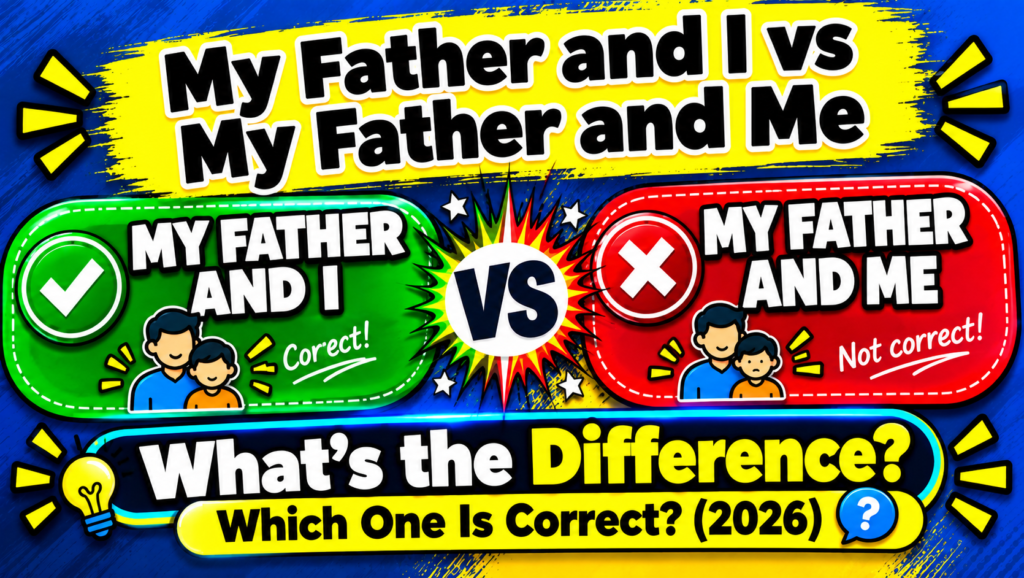
Have you ever paused mid-sentence and wondered, “Is it my father and I or my father and me?” 🤔 You’re not alone. 😊 This small choice trips up students, writers, and confident speakers alike. 📝 In this guide, you’ll learn the simple rule, a two-second test, and plenty of real examples. ✅ By the end, you’ll choose the right phrase every time. 🎯
Quick Answer: My Father and I vs My Father and Me
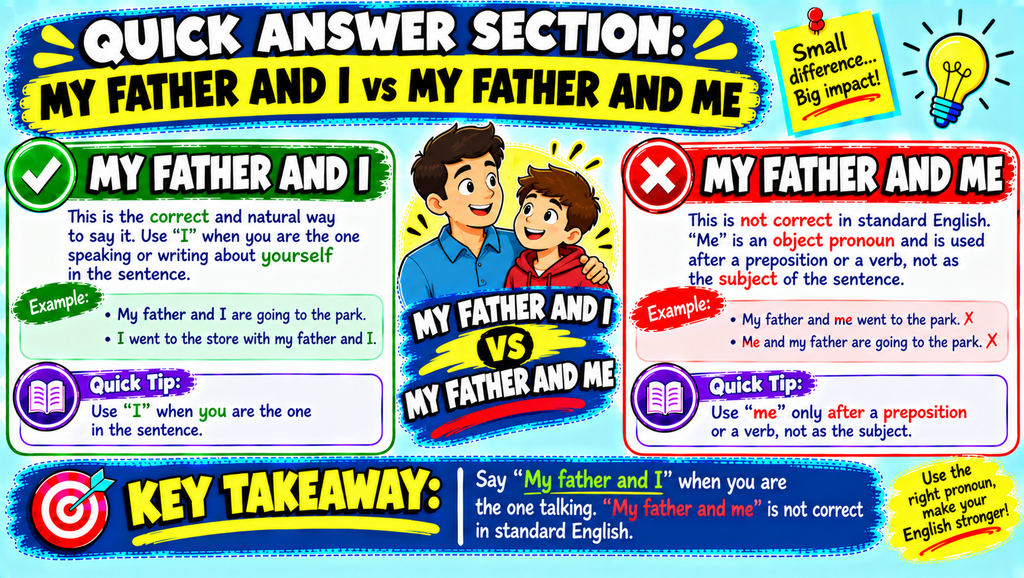
Use “my father and I” when the phrase is the subject, meaning the people doing the action. 🏃
Use “my father and me” when the phrase is the object, meaning the people receiving the action or following a preposition. 🎁
- ✅ My father and I went fishing. 🎣
- ✅ The guide took my father and me out on the lake. 🚤
Fast test: Drop “my father and.” If “I went fishing” sounds right, use I. If “the guide took me” sounds right, use me. 💡
Understanding the Basics: My Father and I vs My Father and Me
Both phrases are correct English. 👍 The difference is the job the phrase does in the sentence. 🔍
“I” is a subject pronoun. 🙋 “Me” is an object pronoun. 🎯 When you add “my father” to the mix, you create a compound subject or a compound object. 👨👦 The pronoun rule stays exactly the same. 🔒
Here’s the confusing part. 😵 Many of us were corrected as kids for saying “Me and Dad went out.” 🙅 So we learned to avoid “me” altogether. 😬 That fear leads to a common overcorrection, where people say “for my father and I” in places where “me” is correct. ❌
Comparison Table
| Feature | My Father and I | My Father and Me |
|---|---|---|
| Pronoun type | Subject pronoun | Object pronoun |
| Role in sentence | Does the action | Receives the action |
| Position | Before the verb | After a verb or preposition |
| Example | My father and I cook dinner. ✅ | Mom thanked my father and me. ✅ |
| Wrong use | Mom thanked my father and I. ❌ | My father and me cook dinner. ❌ |
| Quick test | “I cook dinner” works | “Mom thanked me” works |
Correct Meanings & Uses
Using “My Father and I”
Choose this form when the phrase sits before a verb and acts as the subject. 🧠 Think of it as the “doer” of the sentence. 💪
- My father and I love old movies. 🎬
- My father and I are planning a road trip. 🚗
- Last summer, my father and I built a treehouse. 🌳
- Did my father and I miss the bus? 🚌
Test Tip: Remove “my father and” and say the sentence alone. 🧪 “I love old movies” is correct, so “my father and I” is correct too. ✅
Using “My Father and Me”
Choose this form when the phrase receives the action or follows a preposition such as to, for, with, from, between, or about. 📌
- The teacher praised my father and me. 👏
- She sent a postcard to my father and me. 💌
- This trip means a lot to my father and me. ❤️
- There’s no secret between my father and me. 🤫
Test Tip: Remove “my father and” again. 🧪 “The teacher praised me” is correct, so “my father and me” is correct too. ✅
Case Study Section
Here’s a short, illustrative scenario. 📖
Daniel is writing a speech for his father’s retirement party. 🎉 His first draft reads: “My father and me built this business from the ground up. Thank you to everyone who supported my father and I.” 😬
Both sentences contain an error. ⚠️ Let’s fix them with the drop-the-dad test. 🔧
- Sentence one: “Me built this business” sounds wrong, so the subject needs I. Corrected: “My father and I built this business.” ✅
- Sentence two: “Supported I” sounds wrong, so the object needs me. Corrected: “…supported my father and me.” ✅
The takeaway? 🎓 The first sentence was a “me instead of I” error. The second was an “I instead of me” overcorrection. 🔄 One short test fixed both. ⚡
Grammar Rules Explanation
English changes a pronoun’s form based on its job in the sentence. 🧩 This is called case. 📚
| Subject Pronouns | Object Pronouns |
|---|---|
| I | me |
| he | him |
| she | her |
| we | us |
| they | them |
Follow these five rules and you’ll rarely slip: 🛡️
- Subject = “I.” If the phrase comes before the verb and does the action, use my father and I. 🏃
- Direct object = “me.” If the action lands on the phrase, use my father and me. 🎯
- Indirect object = “me.” Use it when something is given or sent to the people. 🎁
- After a preposition = “me.” Words like between, with, for, and to always take the object form. 📍
- Mention the other person first. Saying “my father and I” is more polite than “I and my father.” 🙂
That last rule is about courtesy, not grammar. 🤝 It’s a convention, so breaking it won’t make a sentence ungrammatical. 👌
Common Mistakes
Fast typing
When you type quickly, your fingers follow speech habits. ⌨️ You might write “me and my dad” without noticing. 💨 A quick proofread catches most of these slips. 👀
Autocorrect
Autocorrect and grammar tools don’t always understand context. 🤖 They may leave “between my father and I” untouched. 😅 Trust the drop-the-dad test over a squiggly line. ✔️
Lack of grammar knowledge
Many people never learned why the rule works. 🤷 They only memorized “never say ‘me and.'” 📝 Once you understand subject versus object, the rule makes sense. 💡
Copying speech patterns
We hear “my father and I” in songs, speeches, and TV, even in places where it’s wrong. 📺 Because it sounds formal, people assume it’s always better. 🎩 That’s the overcorrection trap. 🪤
Similar Grammar Confusions
The same rule applies to many other phrases. 🔁
| Confusing Pair | Correct Choice | Why |
|---|---|---|
| My mother and I / my mother and me | My mother and I went shopping. 🛍️ | Subject |
| Between you and I / between you and me | Between you and me. 🤐 | After a preposition |
| He and I / him and me | He and I won. 🏆 | Subject |
| Give it to my sister and I / me | Give it to my sister and me. 🎁 | Object |
| My father and myself | Use only when “I” or “me” already appears earlier. 🪞 | Reflexive pronoun |
A quick warning about “myself.” ⚠️ Writers often use it to dodge the I-versus-me decision. 🙈 “Please contact my father or myself” is a common slip, and “my father or me” is the better choice. ✅
Usage in Different Contexts
Everyday Conversation
In casual speech, people often say “Me and my dad went out.” 💬 Listeners understand it, but it’s nonstandard. 😌 If you want to sound polished, say “My dad and I went out.” ✨
Professional Writing
Emails, reports, and cover letters call for standard grammar. 💼 Write “My father and I founded the company” and “The award was given to my father and me.” 🏅 Small errors can weaken an otherwise strong message. 📉
Creative Writing
Dialogue can bend the rules to sound real. 🎭 A teenage character might say “Me and Dad are fine.” 🗣️ Keep your narration correct and let the characters speak naturally. 📚
Social Media and Texting
Captions are short, so people often skip the rule. 📱 For a photo, “Me and my father at the lake” is casual and fine. 😎 For a formal post, such as a tribute, use “My father and I at the lake.” 🏞️
Why It Matters
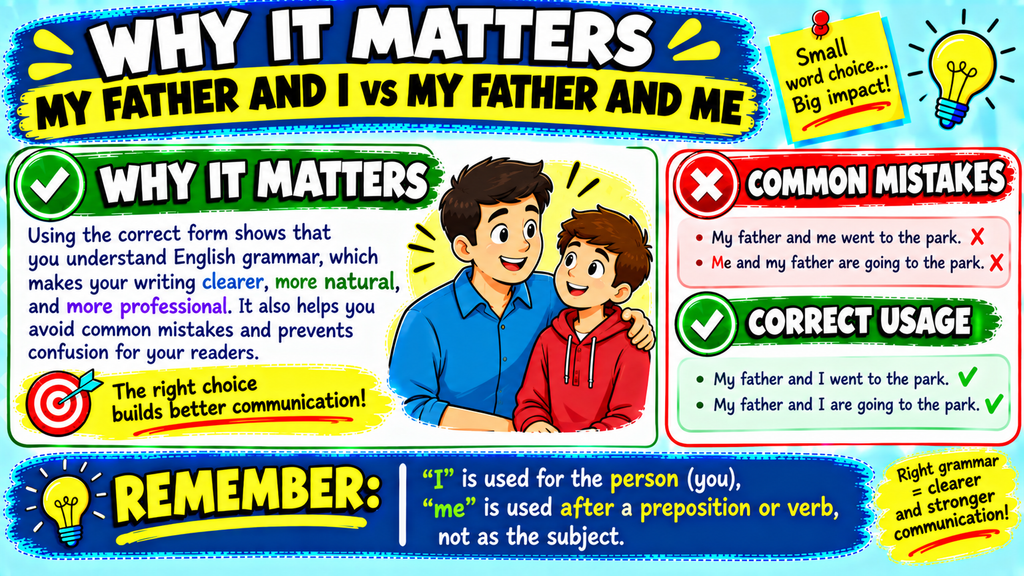
Clarity in communication
Correct pronouns keep your meaning clean and easy to follow. 🔎 Readers don’t stumble over awkward phrasing. 🙌
Professionalism
Correct grammar signals care and credibility. 🏢 It helps in job applications, school essays, and business emails. 📧
Writing accuracy
Choosing the right case shows you understand how sentences work. 🧠 That skill carries over to every other pronoun. 🔗
Digital communication quality
Online posts last a long time and spread fast. 🌐 Clean grammar helps your content look trustworthy and professional. 👍
Special Exception
Most cases follow the simple rule above. 📏 A few situations need extra care. 🧐
- After “be” verbs: Traditional grammar says “The winners were my father and I.” 🏅 In everyday speech, many people say “It was my father and me,” and it’s widely accepted. 💬
- Comparisons with “than” or “as”: “My brother is taller than I” is formal, because it means “than I am.” 📏 “Taller than me” is common in casual speech. 😊
- Photo captions and informal labels: Order may follow the left-to-right position in the picture. 📸 Strict grammar still prefers “my father and me” for an object. 🖼️
When in doubt, pick the standard form for formal writing. 🎓
Quick Recap Checklist
- ☑️ Is the phrase doing the action? Use my father and I. 🏃
- ☑️ Is it receiving the action? Use my father and me. 🎁
- ☑️ Does a preposition come right before it? Use me. 📍
- ☑️ Drop “my father and” to test the pronoun alone. ✂️
- ☑️ Avoid “myself” unless “I” or “me” appears earlier. 🚫
- ☑️ Put the other person first for politeness. 🙂
More Examples for Better Understanding
| Sentence | Correct? | Reason |
|---|---|---|
| My father and I watched the match. ⚽ | ✅ | Subject |
| My father and me watched the match. | ❌ | “Me watched” is wrong |
| The coach called my father and me. 📞 | ✅ | Direct object |
| The coach called my father and I. | ❌ | “Called I” is wrong |
| Dinner was cooked by my father and me. 🍝 | ✅ | After preposition “by” |
| Come with my father and me. 🚶 | ✅ | After preposition “with” |
| Are my father and I invited? 💌 | ✅ | Subject of “are” |
| He told my father and me a secret. 🤫 | ✅ | Indirect object |
Memory Trick
Use the “Drop the Dad” trick. 🧠 Cross out “my father and” and read what’s left aloud. 🔊
Here’s a second hook: “I does it. Me gets it.” 🎯 If the pronoun is doing something, use I. If something is happening to it, use me. 🔄
Frequently asked question: My Father and I vs My Father and Me
Is it “my father and I” or “my father and me”?
Both are correct, depending on the sentence. Use “I” for subjects and “me” for objects. ✅
Why do people say “my father and me” as a subject?
It’s a common habit in casual speech. Standard grammar still calls for “my father and I” before a verb. 💬
Is “me and my father” correct?
It’s fine in casual speech and captions, but it’s nonstandard as a subject. In formal writing, say “my father and I.” 📝
Is “between my father and I” correct?
No. “Between” is a preposition, so it needs the object form: “between my father and me.” ❌➡️✅
Can I say “my father and myself”?
Only if “I” or “me” already appears earlier in the sentence. Otherwise, choose “I” or “me.” 🪞
Which is correct in a photo caption?
“A photo of my father and me” is the standard form. “Me and my father” is acceptable only in casual posts. 📸
Does the rule change for “my dad” or “my mother”?
No. The same subject-versus-object rule works for any person you pair with yourself. 👨👩👧
Is it rude to put myself first?
It isn’t ungrammatical, but putting the other person first is the polite convention. 🙂
Conclusion
The difference between my father and I and my father and me comes down to one question: is the phrase doing the action or receiving it? 🎯 Use I for subjects and me for objects and prepositions. ✅ When you’re unsure, drop “my father and” and trust your ear. 👂 With the simple test and the memory tricks above, you’ll write with more confidence in emails, essays, captions, and conversation. 🚀
