

Agreed vs agree 🤝: which one should you use? 🤔 Both words come from the same verb, but they work in different situations. 📝 This guide explains the meaning, usage, and examples in plain English. ✅ You’ll also get a quick test you can use in any email, essay, or text message. ⚡
Quick Answer: Agreed vs Agree
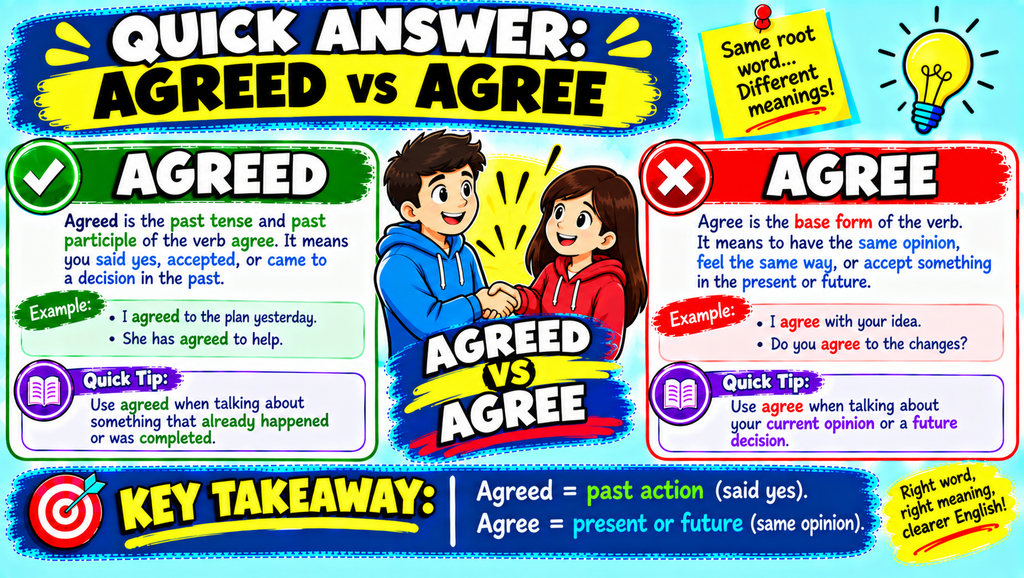
“Agree” is the present-tense verb. 🕐 Use it for opinions you hold now: “I agree with you.” 💬
“Agreed” is the past tense of the verb. ⏪ It’s also an adjective (“the agreed price”) and a one-word reply (“Agreed!”). 👍
- ✅ I agree with your plan. 📋
- ✅ We agreed on the plan yesterday. 📅
- ✅ Agreed. Let’s start Monday. 🚀
Fast test: Is the action happening now or in general? Use agree. Did it already happen, or are you describing a decision? Use agreed. 💡
Understanding the Basics: Agreed vs Agree
“Agree” means to share an opinion, accept a suggestion, or reach a decision with someone. 🧠 It’s the base form of the verb. 🔤
“Agreed” has three jobs. 🧩 It’s the past tense, the past participle, and a handy adjective. 🛠️ It can also work as an interjection when you reply to someone. 🗣️
Agreed vs Agree: Comparison Table
| Feature | Agree | Agreed |
|---|---|---|
| Part of speech | Verb (present, base form) | Verb (past), adjective, interjection |
| Time | Now or in general | Past or completed |
| He/She/It form | agrees | agreed |
| Typical pattern | I agree with you | We agreed to meet |
| Standalone use | Rare (“Agree?” in casual chat) | Common (“Agreed.”) |
| Example | I agree completely. ✅ | The agreed deadline is Friday. ✅ |
Correct Meanings & Uses
Using “Agree”
Use agree when you state a current opinion or make a general statement. 🎯 It also follows helper words like will, can, must, and to. 🔧
- I agree with the new policy. 📜
- Most experts agree that sleep matters. 😴
- She agrees with her manager. 👩💼
- Do you agree with this idea? 🤔
- I will agree to the terms if the price drops. 💰
Test Tip: Add “right now” to the end of your sentence. 🧪 If it still makes sense, agree is probably correct. ✅
Using “Agreed”
Use agreed when the decision is already made or the action is in the past. 🕰️ It also works before a noun, as an adjective. 🏷️
- We agreed to split the cost. 🍕
- They have agreed on a date. 📆
- The agreed budget is $5,000. 💵
- The terms were agreed last week. 🗓️
Test Tip: Add “yesterday” or “last week.” 🧪 If the sentence still works, use agreed. ✅
“Agreed” as a Standalone Expression
“Agreed” can stand alone as a complete reply. 💬 It means “I agree” or “I’m in.” 🙌
- “We should leave early.” “Agreed.” 🚪
- “This is the best option.” “Agreed!” 🌟
It sounds quick and confident. ⚡ In formal emails, add a short phrase like “Agreed, I’ll send the file today” so it doesn’t feel abrupt. 📧
Case Study Section
Here’s a short, illustrative scenario. 📖
Priya works in marketing. 💼 She writes this reply to a client: “As we agree last week, I agreed with the new timeline. Please confirm if you agreed.” 😬
Three problems appear in two sentences. ⚠️ Let’s fix them with the time test. 🔧
- “As we agree last week” points to the past, so it needs agreed. Corrected: “As we agreed last week.” ✅
- “I agreed with the new timeline” describes her opinion now. Corrected: “I agree with the new timeline.” ✅
- “Please confirm if you agreed” asks about a current stance. Corrected: “Please confirm if you agree.” ✅
The takeaway? 🎓 One tense mix-up can make a professional email feel careless. 📉 A quick time check fixes it in seconds. ⏱️
Grammar Rules Explanation
Here are five simple rules for choosing between agree and agreed. 📚
- Present tense = agree or agrees. Use agree with I, you, we, and they. Use agrees with he, she, and it. 🕐
- Past tense = agreed. Use it for every subject: I agreed, she agreed, they agreed. ⏪
- After “have,” “has,” or “had” = agreed. We have agreed. She had agreed. ✅
- After “to” or a modal verb = agree. I want to agree. He will agree. 🔧
- Match the preposition to the meaning. 📍
| Pattern | Use it for | Example |
|---|---|---|
| agree with | A person or opinion | I agree with Maya. 👩 |
| agree to | A plan or request | He agreed to the plan. 📋 |
| agree on | Terms or a decision | We agreed on a price. 💵 |
| agree about | A topic | They agree about music. 🎵 |
Common Mistakes
Fast typing
When you type quickly, the final d often disappears. ⌨️ You end up with “We agree yesterday” instead of “We agreed yesterday.” 😅 A fast proofread catches most of these slips. 👀
Autocorrect issues
Autocorrect may swap agree and agreed without warning. 🤖 It can also leave “I am agree” untouched if it doesn’t flag the phrase. 😬 Read your message once before hitting send. ✔️
Lack of grammar knowledge
Many learners aren’t sure when agree turns into agreed. 🤷 Word-for-word translation from other languages can also produce “I am agree.” 🌍 Remember that English uses plain “I agree,” with no “am.” 💡
Similar Grammar Confusions Table
| Confusing Pair | The Difference | Example |
|---|---|---|
| Agree vs approve | Agree shares an opinion. Approve gives official permission. | I agree with the idea, but the board must approve it. 🏛️ |
| Agreed vs agreeable | Agreed means settled. Agreeable means pleasant or willing. | The agreed time suits everyone. 😊 |
| Agree vs accept | Agree means to share a view. Accept means to receive or take. | She accepted the offer. 🎁 |
| Agree to vs agree with | To goes with plans. With goes with people. | I agree with you, not with the plan. 🙅 |
| Agree vs disagree | They’re opposites. | I agree, but he disagrees. ↔️ |
Usage in Different Contexts
Everyday Conversation
In daily chats, “Agreed!” works as a quick, friendly answer. 💬 “I agree” feels a little more thoughtful. 🙂 Both sound natural with friends and family. 👨👩👧
Professional Writing
Emails, contracts, and reports call for precise wording. 💼 Write “As agreed, the invoice is due Friday” and “I agree with your proposal.” 📄 Use agreed for settled terms and agree for your current position. ⚖️
Creative Writing ✍️
In fiction, agreed shows up often as a dialogue tag. 📚 Try “Fine,” she agreed. 🗣️ Avoid repeating it too often, because variety keeps your dialogue fresh. 🌈
Social Media and Texting
Short replies rule online. 📱 Phrases like “Agreed 👍” and “100% agree” are common and clear. 😎 Keep one-word replies for casual spaces, not formal posts. 🎯
Why It Matters
Clarity in communication
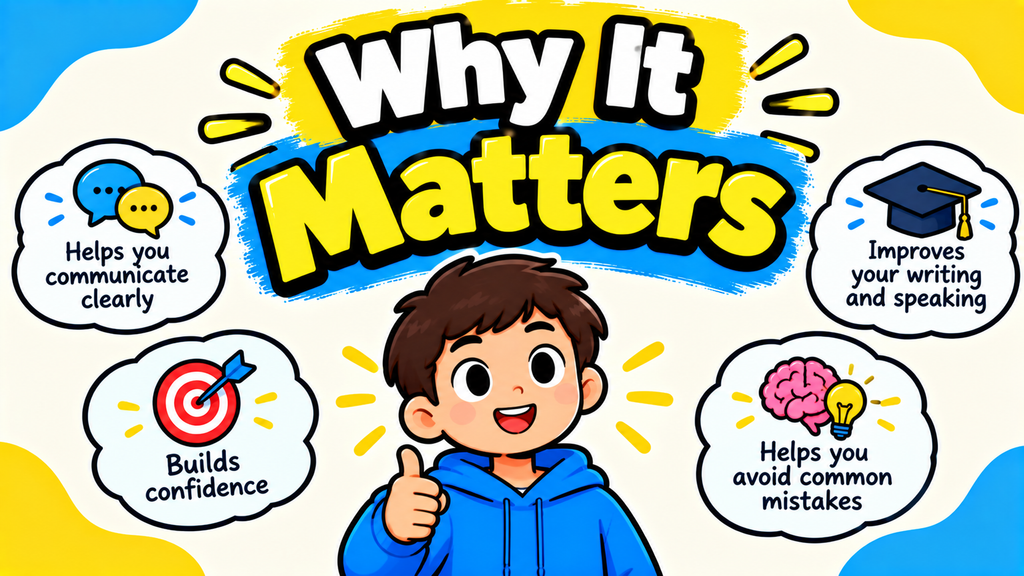
The right form tells readers when a decision happened. 🔎 “I agreed” and “I agree” can mean different things to a client. 🤝
Professionalism
Clean grammar builds trust in emails and applications. 🏢 A tense error in a contract-related message can look careless. 📉
Writing accuracy in digital communication
Online messages spread quickly and stick around. 🌐 Accurate wording keeps your tone credible across email, chat, and social media. ✅
Special Exception
Most sentences follow the rules above. 📏 A few cases deserve extra attention. 🧐
- “Agreed” before a noun: It works as an adjective: the agreed price, the agreed schedule. 🏷️
- “It is agreed that…”: This is a formal, passive pattern often found in contracts. ⚖️
- British English: “Agree” can take a direct object, as in agree a price or agree a deal. 🇬🇧
- “As agreed”: This common business phrase refers back to an earlier decision. 📧
- “I am agreed”: It’s technically possible, but it sounds stiff. Say “I agree.” ❌➡️✅
When in doubt, choose the simpler form. 🎓
Quick Recap Checklist
- ☑️ Talking about now? Use agree. 🕐
- ☑️ Talking about the past? Use agreed. ⏪
- ☑️ After have, has, or had? Use agreed. ✅
- ☑️ After to or will? Use agree. 🔧
- ☑️ He, she, or it in the present? Use agrees. 👤
- ☑️ Before a noun? Agreed works as an adjective. 🏷️
- ☑️ Never write “I am agree.” 🚫
Frequently asked questions About Agreed vs Agree
Is it “agreed” or “agree”?
Use “agree” for present opinions and “agreed” for past actions or settled decisions. ✅
Is “agreed” the past tense of “agree”?
Yes. “Agreed” is both the simple past tense and the past participle. ⏪
Is “I am agree” correct?
No. Say “I agree.” The extra “am” is a common error. ❌
Can “agreed” be a sentence on its own?
Yes. A one-word reply like “Agreed.” is a complete, natural sentence. 💬
Should I say “agree with” or “agree to”?
Use “with” for people and opinions, and “to” for plans, offers, or requests. 📍
Is “agreed upon” correct?
Yes. “Agreed upon” is acceptable, though “agreed” alone is often shorter and cleaner. ✂️
Which form do I use with “he” and “she”?
In the present tense, use “agrees.” In the past tense, use “agreed.” 👤
Is “agreed” formal or informal?
It works in both. Add a short follow-up phrase in formal emails so it doesn’t feel curt. 📧
Conclusion
The agreed vs agree question comes down to timing and function. ⏱️ Use agree for what you think now and agreed for what’s already decided. ✅ Remember the helper words, the preposition pairings, and the special cases like “the agreed price” and “As agreed.” 🧠 With the quick tests above, you’ll pick the right word in every email, essay, and chat. 🚀
