

You are typing a message and suddenly stop. 🤔 Is it “anyone has” or “anyone have”? 😅 Both look natural, and you have probably seen both online. 👀
Here is the good news. 🎉 The rule is short, and once you see it, you will not second-guess yourself again. ✅ This guide covers the correct form, the one big exception, and simple tricks for choosing the right verb every time. 💡
Quick Answer: Anyone Has or Anyone Have?
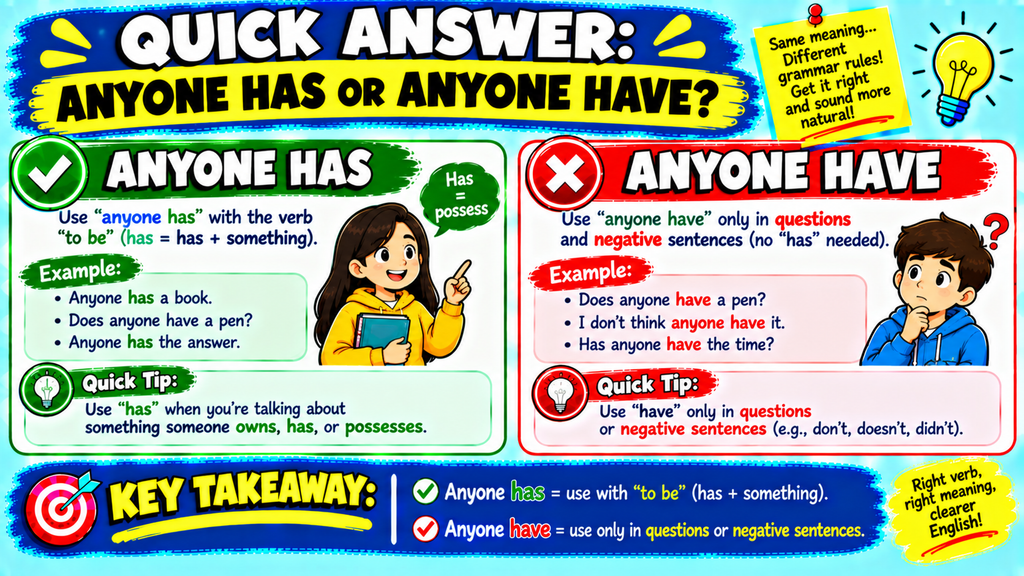
Use “anyone has” in statements. ✅ Use “anyone have” only after a helping verb like does, did, can, or will. 👍 In casual speech, people also drop “does” and say, “Anyone have a pen?” 🖊️
| Situation | Correct Form | Example |
|---|---|---|
| Statement | anyone has | Anyone has the right to ask. ✅ |
| After a helping verb | anyone have | Does anyone have the right to ask? ✅ |
| Casual speech (shortened) | anyone have | Anyone have a charger? 🔌 |
| Statement with “have” | ❌ | Anyone have the right to ask. ❌ |
Understanding the Basics: Anyone Has or Anyone Have
Anyone is an indefinite pronoun that means “any person at all.” 🙋 It can point to a crowd, but grammar treats it as one single subject. 🧠 A singular subject needs a singular verb. ✅
For the verb to have, the singular present form is has. 📘 Here is how it works with different subjects:
| Subject | Verb Form |
|---|---|
| I / You / We / They | have |
| He / She / It | has |
| Anyone / Anybody | has |
So where does “have” come from? 🤷 It appears when a helping verb such as does comes first. ⬇️ That helping verb takes the singular ending, and the main verb goes back to its plain base form. 🔁
Correct Meanings and Uses
Using “Anyone Has” in Statements
Choose “anyone has” when anyone is the subject and no helping verb comes before it. ✅ This covers three common patterns: 📌
- Possession: Anyone has the right to disagree politely. 🗣️
- Present perfect: I doubt anyone has finished the report yet. 📄
- Relative clauses: Anyone who has a question can ask now. ✋
Questions with the present perfect also use “has.” ✅ For example, “Has anyone seen my keys?” 🔑
Test Tip: Swap anyone with he or she. 🔄 If “he or she has” sounds right, then “anyone has” is correct. ✅
Using “Anyone Have” After Helping Verbs
After do, does, did, can, could, will, would, should, may, might, and must, the main verb stays in its base form. 🧩 That is why “have” is correct here. ✅
- Does anyone have a spare pen? 🖊️
- Did anyone have trouble logging in? 💻
- Will anyone have time to help on Friday? 📅
- Should anyone have concerns, please reach out. 📧
Test Tip: Look at the word right before anyone. 👀 If it is a helping verb, use “have.” ✅
Case Study: Workplace Email Example
Here is an illustrative scenario. 💼 Maya, a project manager, drafts a quick email to her team: 📨
“Anyone have the final budget file? Anyone who have already reviewed it, please reply.”
This short message has two problems. ⚠️ The first sentence is casual shorthand with “does” missing. 😬 The second sentence is plain wrong, because “who” refers to anyone, which is singular. ❌
Maya fixes it like this: 🛠️
“Does anyone have the final budget file? Anyone who has already reviewed it, please reply.”
The email now reads cleaner and more professional. ✨ Her team also gets the message without a second glance. 👏
Grammar Rules Explanation
Keep these five rules in your pocket: 🎒
- “Anyone” is singular. It takes singular verbs like is, was, and has. ✅
- Statements use “has.” For example, “Anyone has access to the form.” 📝
- Helping verbs trigger “have.” The helping verb carries the singular ending, so “have” stays plain. 🔁
- Present perfect questions use “has.” For example, “Has anyone replied?” 📬
- Relative clauses use “has.” For example, “Anyone who has tried it knows.” 🙌
Common Mistakes
Most errors come from the same few traps. ⚠️
| Incorrect ❌ | Correct ✅ | Why |
|---|---|---|
| Anyone have the right to vote. | Anyone has the right to vote. | Statement, singular subject |
| Does anyone has a pen? | Does anyone have a pen? | “Does” already carries the -s |
| Has anyone have seen it? | Has anyone seen it? | Two verbs doing one job |
| Anyone who have tried it knows. | Anyone who has tried it knows. | “Who” matches “anyone” |
| Anyone are welcome. | Anyone is welcome. | Singular needs “is” |
Similar Grammar Confusions Table
The same logic works for other indefinite pronouns. 🔍
| Pronoun | Statement | Question with “Does” | Perfect Question |
|---|---|---|---|
| Anyone | Anyone has time. | Does anyone have time? | Has anyone called? |
| Anybody | Anybody has a chance. | Does anybody have a chance? | Has anybody left? |
| Everyone | Everyone has a role. | Does everyone have a role? | Has everyone arrived? |
| Everybody | Everybody has a seat. | Does everybody have a seat? | Has everybody eaten? |
| Someone | Someone has my book. | Does someone have my book? | Has someone replied? |
Usage in Different Contexts
Everyday Conversation
Spoken English is relaxed. 😎 People say, “Anyone have a spare charger?” without thinking twice. 🔌 It sounds natural because everyone understands the missing “does.” 👂
Professional Writing
In emails, reports, and cover letters, use the full form. 💼 “Does anyone have questions?” looks polished, while the shortened version can seem careless. 📋
Creative Writing
Dialogue can bend the rules because real people talk that way. 🎭 Narration, however, should follow standard grammar. 📖 Let your characters be casual, but keep your narrator precise. ✍️
Social Media and Texting
Posts and group chats favor speed. ⚡ “Anyone have recs for a good laptop?” works fine here. 💻 Just switch to the full version when the audience gets more formal. 🎯
Why It Matters
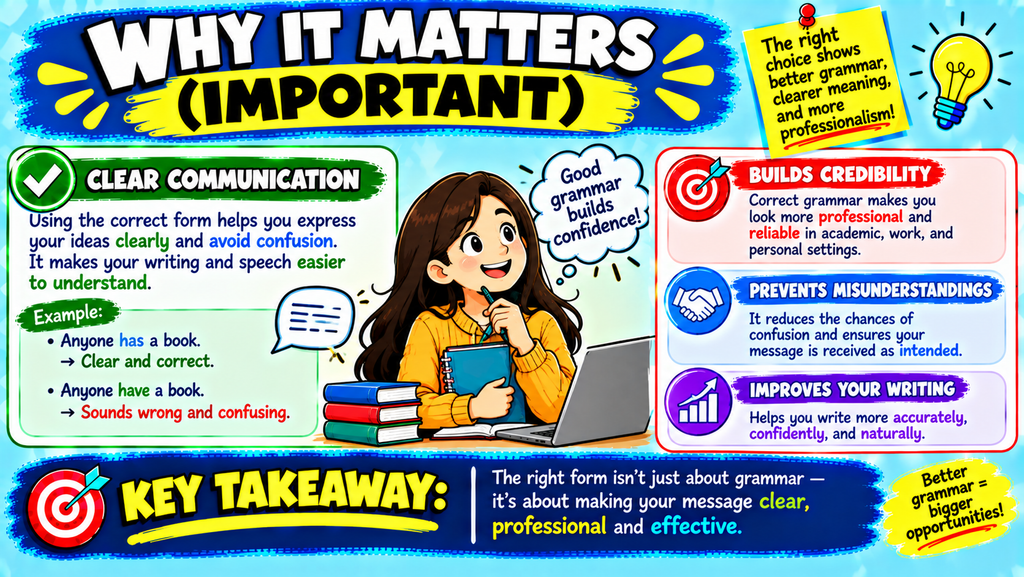
Clarity
Correct verbs make your message easy to follow. 🔍 Readers should focus on your idea, not your grammar. 💬
Professionalism
Small slips can shape first impressions. 👔 Clean subject-verb agreement signals care and credibility. 🏆
Writing Accuracy
Exams, job applications, and published content all reward accuracy. 📚 One consistent rule saves you from constant guessing. ✅
Confidence
When you know why a phrase is correct, you write faster. 🚀 You also stop doubting yourself at the keyboard. 😌
Special Exception
There is one exception worth knowing. 💡 In informal speech, people often delete the first word of a question. ✂️ That is why “Anyone have a pen?” is really shorthand for “Does anyone have a pen?” 🖊️
Trying to “fix” it into “Anyone has a pen?” usually sounds odd. 🤨 So in casual talk, “anyone have” is fine. 👍 In formal writing, restore the helping verb. ✅
Quick Recap Checklist
- ✅ Anyone is singular.
- ✅ Statements take has.
- ✅ After does, did, can, will, use have.
- ✅ “Anyone who has” is always correct.
- ✅ “Has anyone + past participle” works for perfect questions.
- ✅ Casual “Anyone have…?” is fine in speech, not in formal writing.
Extra Examples for Better Understanding
With “has”:
- Anyone has the freedom to join the club. 🎉
- Has anyone checked the schedule? 🗓️
- Anyone who has visited Tbilisi remembers the old town. 🏙️
- I wonder if anyone has noticed the typo. 🧐
With “have”:
- Does anyone have a minute to talk? ⏰
- Did anyone have a good weekend? 🌞
- Can anyone have a look at this draft? 📝
- Anyone have a good book to recommend? 📚 (casual)
Memory Trick
Think of “any ONE.” 1️⃣ One person means one s, so you write has. ✅
For questions, remember this: only one verb gets the -s. 🔑 In “Does anyone have…?” the s lives in does, so have stays plain. 🎯
Frequently asked questions: Anyone Has or Anyone Have
Is it “anyone has” or “anyone have”?
Use “anyone has” in statements and “anyone have” after helping verbs like does or can. ✅
Is “anyone have” ever correct?
Yes, it is correct after helping verbs and in casual speech where “does” is dropped. 👍
Is “does anyone has” correct?
No, the correct form is “does anyone have.” ❌ The word does already carries the singular ending. ✅
Is “anyone” singular or plural?
It is singular, even though it can refer to many people. 🧠
Can I write “anyone have a pen?” in an email?
It is fine in a quick, casual message. 💬 For professional emails, write “Does anyone have a pen?” ✅
Is it “anyone who has” or “anyone who have”?
The correct form is “anyone who has,” because “who” refers to the singular anyone. ✅
Can I use “has anyone” in a question?
Yes, with a past participle, as in “Has anyone seen my keys?” 🔑
Conclusion
The anyone has or anyone have debate comes down to one idea. 🎯 Anyone is singular, so statements use has, and helping verbs lead to have. ✅ Casual speech may skip “does,” but formal writing should not. 📝
Keep the “any ONE” trick and the “only one -s” trick handy. 🧰 With them, you can write with confidence in emails, essays, and chats. 🚀
