

Do you write “no difference” or “no different”? 🤔 The two phrases look almost identical, but they work in completely different ways. 😅 One names an absence of change, and the other describes how alike two things are. 🔍 This guide covers the meaning, the grammar rule, and the easy tricks that stop you from mixing them up. 🚀
Quick Answer: No Difference vs No Different
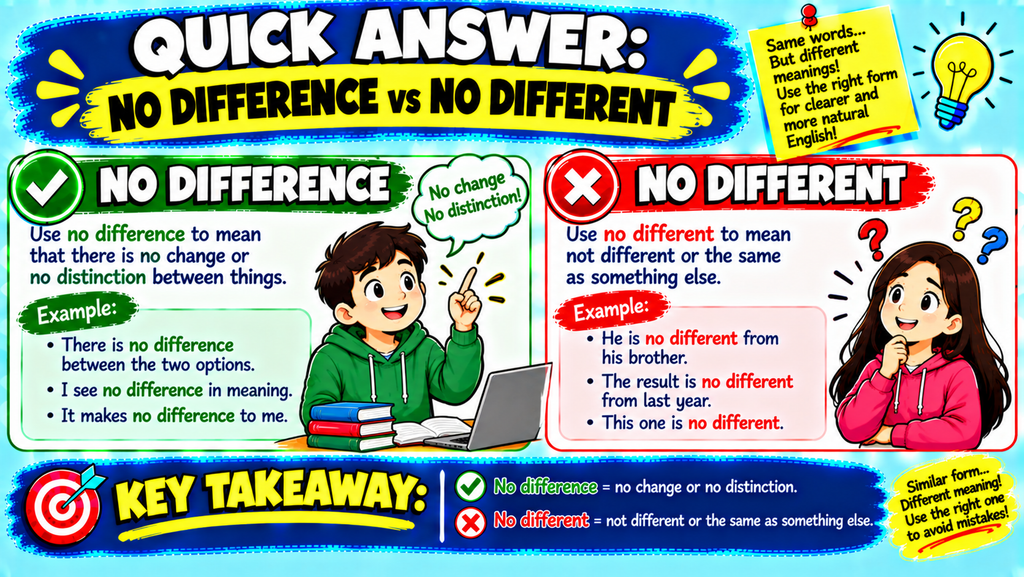
“No difference” is correct when you need a noun, as in “There is no difference between the two.” ✅ “No different” is correct when you need an adjective, as in “This plan is no different from the old one.” ✅ Use “difference” after verbs like make and see. 🎯 Use “different” after be, look, seem, or feel. 👀
Understanding the Basics of No Difference vs No Different
The word “no” does two jobs in English. 🧠 Before a noun, it means “not any,” so “no difference” means “not any difference.” 📌 Before an adjective, it works like “not at all,” so “no different” means “not at all different.” 💡
Here is a handy memory trick. 🧩 “No different” behaves just like “no better,” “no worse,” and “no easier.” ✨ If those fit your sentence, “no different” will fit too. 👍
Comparison Table: No Difference vs No Different
| Feature | No Difference | No Different |
|---|---|---|
| Grammar role | Noun phrase (no + noun) | Adverb + adjective |
| Core meaning | Zero change or distinction | Not at all different; the same |
| Common verbs | make, see, notice, there is | be, look, seem, feel |
| Common partners | in, between, to | from, than |
| Correct example | It makes no difference. ✅ | It is no different from before. ✅ |
| Common mistake | It makes no different. ❌ | The two plans are no difference. ❌ |
Correct Meanings & Uses
What Does “No Difference” Mean?
“No difference” means nothing changes, or nothing separates two things. 🔎 In other words, the gap is zero. 0️⃣ Dictionaries such as Merriam-Webster list “make no difference” as an idiom meaning to cause no change or to be unimportant. 📖
Examples
- It makes no difference which day you choose. 📅
- I can see no difference in taste. 🍰
- The rain made no difference to our plans. 🌧️
- The study found no significant difference between the two groups. 🧪
Sentence breakdown: In “It makes no difference,” it is the subject, makes is the verb, and no difference is the object. 🧱 The noun “difference” is the thing being “made.” ✅
Test tip: Try swapping in “a difference.” 🔁 If “It makes a difference” sounds natural, then “It makes no difference” is the right negative form. ✅
What Does “No Different” Mean?
“No different” means “not at all different,” or simply “the same.” 🟰 It describes a person, thing, or situation, so it usually follows a linking verb. 🔗
Examples
- Your idea is no different from mine. 💡
- The new menu is no different than the old one. 🍽️
- This update feels no different. 📱
- She looks no different after ten years. 😮
Test tip: Replace the phrase with “the same.” 🔁 If “Your idea is the same as mine” works, then “no different” works too. ✅
Why “No Different” Often Sounds Wrong
“No different” sounds wrong when the sentence needs a noun. ❌ Phrases like “there is,” “it makes,” and “I see” all ask for a noun, and “different” is not one. 🚫 That is why “There is no different” and “It makes no different” feel off. 😬 The fix is simple: swap in “difference.” 🔧
Case Study: Real-Life Examples
Workplace Email Example
- ❌ “Hi Sam, there is no different between version A and version B.”
- ✅ “Hi Sam, there is no difference between version A and version B.”
- ✅ “Hi Sam, version A is no different from version B.”
Both fixes work, but the first sentence needed the noun. 📧
Conversation Example
Incorrect
- “Should we meet at 5 or 6?”
- “It makes no different to me.” ❌
Correct
- “Should we meet at 5 or 6?”
- “It makes no difference to me.” ✅
Grammar Rules Explained
Rule 1: “Difference” Is a Noun
A noun names a thing or an idea. 📚 “Difference” names the state of being unlike. 🧾 You can place “a,” “the,” “any,” or “no” before it. ✅
- Spot the difference. 🕵️
- There is a big difference in price. 💰
- What is the difference between a lake and a pond? 🏞️
Rule 2: “Different” Is an Adjective
An adjective describes a noun or follows a linking verb such as be or seem. 🏷️ It is often followed by “from,” “than,” or “to.” 🔗
- This road is different from the old one. 🛣️
- Life here is different now. 🌍
- She took a different route. 🧭
What the Style Guides Say
Collocation dictionaries pair “difference” with “in,” “between,” and “of,” as in “difference in temperature” or “difference of opinion.” 🌡️ For “different,” “from” is the safest choice in formal writing. 🎓 “Than” is common in American speech, especially before a clause, as in “Life is different than it was ten years ago.” 🇺🇸 “To” turns up more often in British English. 🇬🇧
Common Mistakes with No Difference vs No Different
- ❌ It makes no different. → ✅ It makes no difference.
- ❌ There is no different between them. → ✅ There is no difference between them.
- ❌ I noticed no different in speed. → ✅ I noticed no difference in speed.
- ❌ The two plans are no difference. → ✅ The two plans are no different.
Notice that the error can go both ways. 🔄
Why These Mistakes Happen
- Fast typing: The two words differ by only a few letters. ⌨️
- Autocorrect: It can swap one word for the other without warning. 📱
- Lack of grammar knowledge: Many writers never learned the noun-versus-adjective rule. 🤷
- Similar-sounding words: In quick speech, the endings blur together. 🗣️
Similar Grammar Confusions
| Pair | Parts of Speech | Example |
|---|---|---|
| Difference / Different | noun / adjective | no difference vs. no different |
| Success / Successful | noun / adjective | no success vs. not successful |
| Advice / Advise | noun / verb | good advice vs. to advise |
| Choice / Choose | noun / verb | a smart choice vs. to choose |
Usage in Different Contexts
Everyday Conversation
“It makes no difference to me” is a polite way to say you have no preference. 😊 “It’s no different” works for casual comparisons, like “Honestly, this one’s no different from the last.” 🗨️
Professional Writing
Reports and research papers often use “no significant difference” when results match. 📊 For example: “We found no significant difference in sales between the two regions.” 📈 Keep the noun form here, because the sentence needs an object. 🧠
Creative Writing ✍️
Writers use “no different” to show sameness with feeling. 🎭 For example: “The town looked no different, but she felt like a stranger.” 🌆
Social Media & Texting
- ❌ Common incorrect post: “Honestly it makes no different lol” 😬
- ✅ Correct version: “Honestly it makes no difference lol” 😄
Why It Matters

- Clarity: The right word keeps your meaning crystal clear. 🔍
- Professionalism: Small slips in emails and reports can hurt your credibility. 💼
- Better writing accuracy: Knowing parts of speech improves every sentence you write. ✍️
- Stronger digital communication: Clean captions, posts, and messages get taken more seriously. 📲
Special Case: When “No Different” Is Correct
Many people think “no different” is always wrong. 🙅 It is not. ✅ It is perfectly correct when it describes something and follows a verb like be. 🎯 For example, “Her new car is no different from her old one.” 🚗
Important distinction: “No difference” answers the question “How much change?” 📏 “No different” answers the question “What is it like?” 🧐
Quick Recap Checklist
- ✅ Need a noun after makes, see, or there is? Use no difference.
- ✅ Describing something after is, looks, or feels? Use no different.
- ✅ Followed by “in” or “between”? Use no difference.
- ✅ Followed by “from” or “than”? Use no different.
Which One Should You Use?
Ask one question: does the sentence need a thing or a description? 🤔 A thing gets “difference.” 📦 A description gets “different.” 🎨
Practice Examples
Example 1
- ❌ It makes no different which one you pick.
- ✅ It makes no difference which one you pick. 👍
Example 2
- ❌ The twins are no difference from each other.
- ✅ The twins are no different from each other. 👯
Example 3
- ❌ I noticed no different in speed.
- ✅ I noticed no difference in speed. 🏎️
Advanced Explanation for English Learners
All these words share one root. 🌱 They trace back to the Latin verb differre, which means to carry apart. 📜
Word Family Example
| Word | Part of Speech | Example Sentence |
|---|---|---|
| differ | verb | Our opinions differ. |
| difference | noun | There is no difference. |
| different | adjective | This is no different. |
| differently | adverb | She thinks differently. |
| differentiate | verb | Can you differentiate the two? |
| indifferent | adjective | He felt indifferent about the result. |
Common Sentence Patterns
Pattern 1: There Is No Difference
Structure: There + is + no difference + in/between + noun 🧱
- There is no difference in price. 💵
- There is no difference between the two photos. 🖼️
Pattern 2: Is Different From
Structure: Subject + be + different + from/than/to + noun 🧱
- My phone is different from yours. 📱
- The result was different than we expected. 🎲
Pattern 3: Is No Different From
Structure: Subject + be + no different + from/than + noun 🧱
- Today is no different from yesterday. 📆
- This brand is no different than the rest. 🏷️
Mini Quiz Time
Choose “difference” or “different” for each blank. ✏️
- It makes no ______ which road we take. 🛣️
- This version is no ______ from the last one. 💻
- I see no ______ between the two photos. 📷
Answers: 1. difference, 2. different, 3. difference. 🎉
Frequently asked questions About No Difference vs No Different
Is “no different” grammatically correct?
Yes, when it describes something after a verb like be, as in “This is no different from that.” ✅ It cannot replace the noun “difference.” 🚫
Can I say “it makes no different”?
No. The verb “makes” needs a noun, so say “it makes no difference.” ✅
What does “no difference” mean?
It means there is no change, gap, or distinction between things. 🔎
Is “no different than” correct?
Yes, it is common in American English, especially before a clause. 🇺🇸 In formal writing, “no different from” is the safer choice. 🎓
Is “no differences” correct?
Yes, use the plural when you compare several points, as in “There are no differences between the drafts.” 📝
Can “different” be used as a noun?
No. In standard English, “different” is an adjective, and the noun is “difference.” 📚
What is the difference between “not different” and “no different”?
They mean nearly the same thing, but “no different” sounds slightly stronger, like “not at all different.” 💪
Conclusion
The rule is short and easy to remember. 🧠 Use “no difference” when you need a noun, and use “no different” when you need an adjective. ✅ If you can say “a difference,” pick the noun. 🔁 If you can say “the same,” pick the adjective. 🟰 Keep these two tests in mind, and you will never mix up these phrases again. 🚀
