

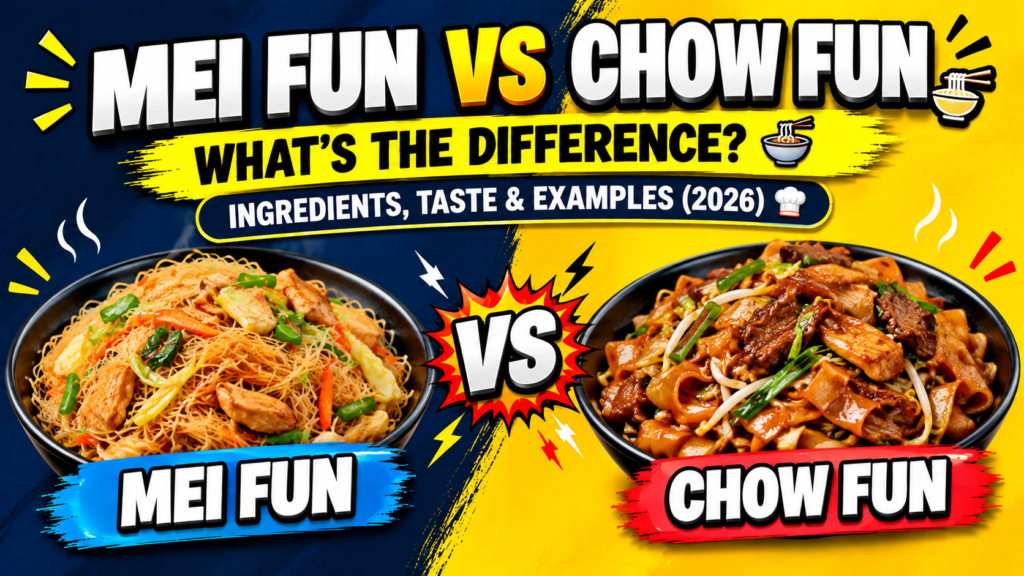
Standing at a Chinese takeout counter and wondering whether to order mei fun or chow fun? 🤔 The names sound alike and both are rice noodles, so the mix-up is very common. 🍚 This guide explains the difference between mei fun and chow fun, from noodle width and texture to taste, origins, nutrition, and popular dishes. 📖 By the end, you will know exactly which one to order, buy, or cook. ✅
Quick Answer: Mei Fun vs Chow Fun
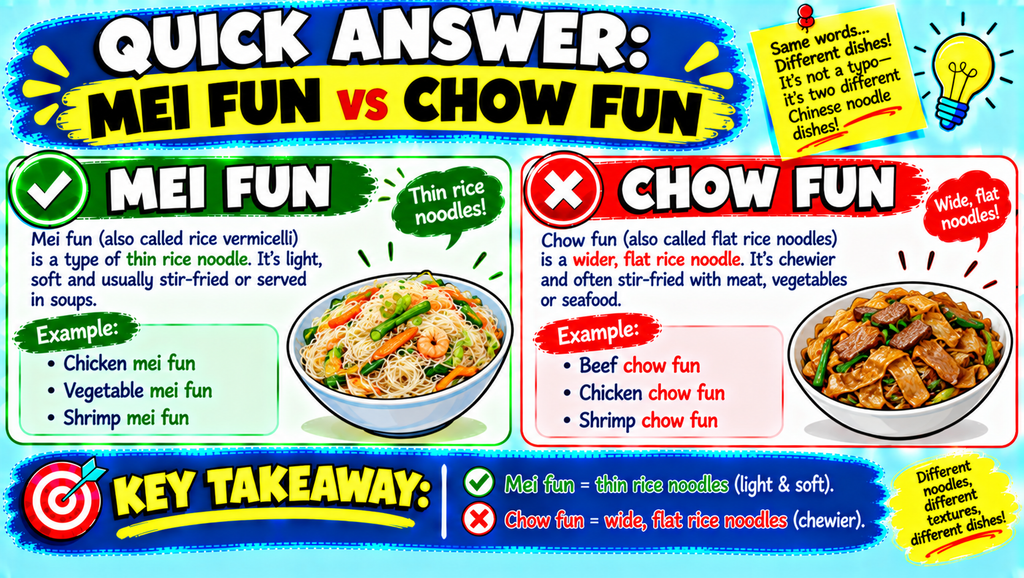
Mei fun is a thin rice vermicelli noodle, while chow fun is a wide, flat rice noodle. 🍜 Mei fun is soft and delicate, and chow fun is chewy and silky. 😋 Neither is the same as chow mein or lo mein, which use wheat egg noodles. 🌾
| Feature | Mei Fun | Chow Fun |
|---|---|---|
| Noodle type | Thin rice vermicelli (rice sticks) | Wide, flat rice noodles (ho fun) |
| Width | About 1–2 mm | Roughly ¼ inch or wider |
| Shape | Round, thread-like, sold in bundles | Flat ribbons or cut sheets |
| Texture | Soft, light, slightly wiry | Chewy, silky, slightly bouncy |
| Flavor | Mild with a hint of sweetness | Mild rice flavor, picks up soy and wok char |
| Best cooking method | Soak, then toss quickly | High-heat wok stir-fry |
| Classic dish | Singapore mei fun | Beef chow fun |
| Gluten | Naturally gluten-free (check labels) | Naturally gluten-free (check labels) |
Understanding the Basics of Mei Fun vs Chow Fun
In Cantonese, “fun” means rice noodle, so it has nothing to do with the English word. 😄 “Mei” points to rice, and “chow” means stir-fried. 🍳 Once you know that, the names start to make sense. 💡
Core Difference
The core difference is thickness, and everything else follows from it. 📏 Width changes the chew, the cooking method, how much sauce the noodle absorbs, and the dishes it suits. 🍽️
- Mei fun is thin, soft, and quick to absorb liquid. 🧵
- Chow fun is wide, chewy, and sturdy enough for a hard sear. 🔥
- Mei fun suits soups, salads, and spring rolls. 🥗
- Chow fun suits wok-fried dishes with beef, seafood, or vegetables. 🥩
Correct Meanings and Uses
Both terms can describe the noodle itself and the dish made with it. 🥢 Here is how to use each one correctly. ✔️
What Is Mei Fun?
Mei fun (also spelled mai fun or maifun) is thin rice vermicelli, usually sold dry in bundles. 🍚 You soak it in hot water until soft, then stir-fry it, add it to soup, or toss it into a salad. 🥗
Example: “We ordered Singapore mei fun with shrimp and char siu.” 🦐
Test Tip: If the noodles look like fine threads, it is mei fun. 🔍
What Is Chow Fun?
Chow fun is a wide rice noodle, also called ho fun, hor fun, or shahe fen. 🍜 It is sold fresh or dried, and it shines in stir-fries, though it also turns up in soups. 🍲
Example: “Beef chow fun is my favorite takeout dish.” 🥩
Test Tip: If the noodle is a flat ribbon you could fold in half, it is chow fun. 🔍
Noodle Characteristics Compared
Mei Fun Noodles
- They are round and very thin, about 1–2 mm across. 🧵
- The texture is soft and light, and the flavor is neutral with a faint sweetness. 😌
- They soak up curry, white pepper, and broth quickly. 🍛
- They never get truly crispy, even when fried. 🍳
- Over-soaking turns them mushy, so watch the clock. ⏱️
Chow Fun Noodles
- They are wide, flat, and pleasantly chewy. 🎀
- The mild rice flavor lets soy sauce and wok char take center stage. 🔥
- They can tear if overcooked or stirred too roughly. ⚠️
- Fresh noodles are best used the same day, because chilling makes them stiff. 🧊
Case Study: Ordering at a Chinese Restaurant
Conversation
Customer: “Hi, I’ll have the beef mei fun, please.” 🙋
Server: “Our mei fun uses thin vermicelli. 🍜 Did you want the wide, flat noodles instead?” 🤔
Customer: “Yes, the wide, chewy ones with bean sprouts.” 😋
Server: “That is beef chow fun, and I’ll put it in for you.” 👍
Why?
The customer pictured wide noodles but used the wrong name. 🙈 Beef chow fun is the dish built on wide rice noodles, beef, and bean sprouts. 🥩 Mei fun would have arrived as soft, thin vermicelli instead. 🧵 One quick check saved the meal. ✅
Grammar Rules Explanation
Both names work as nouns for the noodle and for the finished dish. 📝 A few simple rules keep your writing clean. 🧼
- Use lowercase in running text, such as “I ate chow fun,” and capitalize only in titles or at the start of a sentence. 🔤
- Treat both like other noodle names: “The mei fun was soft” or “These chow fun noodles are wide.” 🍜
- Spellings like mai fun, maifun, ho fun, and hor fun are romanizations of the same noodles. 🌏
- “Chow” means stir-fried, so “chow mei fun” simply means stir-fried thin rice noodles. 🍳
Why Accuracy Matters
Swapping the names changes the dish. 🔄 Singapore mei fun made with wide noodles is no longer Singapore mei fun. 🙅
Historical Origins of Mei Fun and Chow Fun
Origin of Mei Fun
Thin rice noodles have no single documented birthplace. 🗺️ They are a staple across southern China and Southeast Asia, from Hong Kong to Thailand, Vietnam, and Singapore. 🌏 Singapore mei fun itself is a Cantonese creation from Hong Kong, despite the name. 🇭🇰
Origin of Chow Fun
Wide rice noodles are believed to come from the town of Shahe, now part of Guangzhou in Guangdong province. 🏙️ The exact origin of beef chow fun is unknown, though a few legends exist. 📜 Cantonese emigration carried the dish overseas, which is why it is a staple on North American menus today. ✈️
Common Mistakes People Make
- Calling thin vermicelli “chow fun.” ❌
- Ordering “mei fun” when you want wide noodles. ❌
- Assuming chow fun and chow mein are the same thing. ❌
- Swapping one noodle for the other in a recipe without adjusting the method. ❌
Why the Mistake Happens
Both names end in “fun,” both noodles are made from rice, and both appear in stir-fried dishes. 🔁 Menus add to the confusion by using inconsistent spellings and shortcuts. 📋
Similar Confusions Table
| Pair | Key Difference |
|---|---|
| Mei fun vs chow fun | Thin rice vermicelli vs wide rice noodles |
| Chow fun vs chow mein | Rice noodles vs wheat egg noodles |
| Mei fun vs lo mein | Rice vermicelli vs saucier wheat egg noodles |
| Chow fun vs ho fun | Same noodle, different name (dish vs noodle) |
Causes of Mistakes
- Similar-sounding names. 👂
- Different romanizations of the same words. 🔤
- Shared ingredients like beef, shrimp, and vegetables. 🍤
- Menus with no photos or descriptions. 📷
Popular Variations
Singapore Mei Fun
This curry-flavored stir-fry combines vermicelli with char siu, shrimp, and plenty of vegetables. 🍛 Despite the name, it came from Hong Kong rather than Singapore. 🇭🇰
Vegetable Mei Fun
This lighter dish tosses vermicelli with cabbage, carrots, mushrooms, and scallions. 🥕 It cooks fast and works well as a meatless meal. 🌱
Beef Chow Fun
This Cantonese classic stir-fries sliced beef, bean sprouts, and wide noodles over very high heat. 🥩 Cooks chase “wok hei,” the smoky “breath of the wok,” for the best flavor. 🔥
Seafood Chow Fun
Shrimp, squid, or fish pair nicely with wide noodles and a lighter sauce. 🦑 The gentle seasoning lets the seafood stay in the spotlight. ✨
Usage in Different Contexts
Everyday Conversation
Say “chow fun” when you want wide, chewy noodles and “mei fun” when you want thin, soft ones. 🗣️ If you are unsure, describe the noodle to your server. 🙋
Professional Writing
In menus, recipes, and food blogs, define the noodle on first mention and stay consistent with spelling. 🧾 Adding the width or an alias like ho fun helps readers and search engines alike. 🔎
Creative Writing
Use “fine, wiry threads” for mei fun and “silky ribbons with charred edges” for chow fun. ✍️ Sensory details show the difference better than labels do. 👃
Social Media and Texting
Match your hashtag to your photo, such as #chowfun for wide noodles and #meifun for vermicelli. 📱 Food fans notice, and accurate captions earn trust. 🤝
Nutritional Differences
| Factor | Mei Fun | Chow Fun |
|---|---|---|
| Main ingredient | Rice flour | Rice flour |
| Gluten | None naturally | None naturally |
| Carbs per 100 g | About 25 g | About 26 g |
| Fat (plain noodles) | Very low | Very low |
| Biggest variable | Oil, sauce, add-ins | Oil, sauce, add-ins |
Plain, the two noodles are nearly identical nutritionally. ⚖️ What really changes the numbers is the oil, sauce, and protein in the finished dish. 🍳 Check packaging for added ingredients, and remember that soy sauce often contains wheat. 🔍
Why It Matters
Clarity in Communication
Using the right name gets you the dish you imagined. 🎯
Professionalism
Accurate food terms make menus, blogs, and recipes look credible. 💼
Better Dining Experiences
Knowing the noodle helps you order confidently and enjoy the texture you expect. 😊
Writing Accuracy
Correct terms keep recipes reliable and prevent readers from buying the wrong noodle. 🛒
Special Exceptions
Restaurant Variations
Some restaurants use “mei fun” loosely or list dishes as “chow mei fun.” 📋 When in doubt, read the menu description or ask what noodle is used. 🙋
Regional Differences
Chow fun is the Cantonese name, while Mandarin speakers say “chao fen” for the stir-fry. 🗣️ Malaysia and Singapore use names like hor fun and kway teow, and Hawaii has its own Hawaiian-style chow fun. 🌺 Outside southern China, wide rice noodles are less common on menus. 🗺️
Quick Recap Checklist
- Thin like threads means mei fun. 🧵
- Wide like ribbons means chow fun. 🎀
- Soups, salads, and spring rolls favor mei fun. 🥗
- High-heat stir-fries favor chow fun. 🔥
- Both are rice noodles, so neither is chow mein. 🍚
- Both taste mild, so the sauce drives the flavor. 🥢
Which One Should You Use?
Choose mei fun for light, quick, absorbent dishes like Singapore noodles or vegetable stir-fries. 🍛 Choose chow fun for hearty, chewy, wok-seared dishes like beef chow fun. 🥩
Practice Examples
Example 1
“I want wide, chewy noodles with beef and bean sprouts, so I’ll order beef ___ fun.” 🥩 Answer: chow, because wide rice noodles are chow fun. ✅
Example 2
“Singapore ___ fun is made with thin rice vermicelli.” 🍛 Answer: mei. ✅
Example 3
“Which noodle works better inside spring rolls?” 🥟 Answer: Mei fun, because chow fun is too wide and thick for rolling. ✅
Frequently Asked Questions About Mei Fun vs Chow Fun
What is the main difference between mei fun and chow fun?
Mei fun is thin rice vermicelli, and chow fun is a wide, flat rice noodle. 🍜 Thickness drives the texture and the dishes they suit. 📏
Is mei fun the same as rice vermicelli?
Yes, mei fun is thin rice vermicelli, also called rice sticks. 🍚 Spellings like mai fun and maifun refer to the same noodle. ✅
Is chow fun the same as ho fun?
Ho fun is the noodle, and chow fun is the stir-fried dish or the name many North American menus use. 🥢 People often use the two terms interchangeably. 🔄
Can I substitute chow fun for mei fun?
You can, but the texture and the dish will change. ⚠️ Singapore mei fun made with wide noodles is a different dish. 🙅
Are mei fun and chow fun gluten-free?
Both are rice-based, so the noodles are naturally gluten-free. 🌾 Check packaging and sauces, since soy sauce often contains wheat. 🔍
Which is healthier, mei fun or chow fun?
Plain, they are nutritionally very close. ⚖️ The oil, sauce, and add-ins matter far more than the noodle. 🥦
Is chow fun the same as chow mein?
No, chow fun uses rice noodles, while chow mein uses wheat egg noodles. 🍝 They also taste and feel different. 😋
Is Singapore mei fun actually from Singapore?
No, it is generally described as a Cantonese dish from Hong Kong. 🇭🇰 The name refers to the style, not the birthplace. 📛
Conclusion
The mei fun vs chow fun question comes down to one thing: noodle width. 📏 Mei fun gives you thin, soft vermicelli for light stir-fries, soups, and spring rolls. 🍜 Chow fun gives you wide, chewy ribbons made for smoky, high-heat wok cooking. 🔥 Remember the thread-versus-ribbon trick, and you will order and cook with confidence every time. 🎉 Share this guide with a fellow noodle lover who still mixes them up. 💬
