

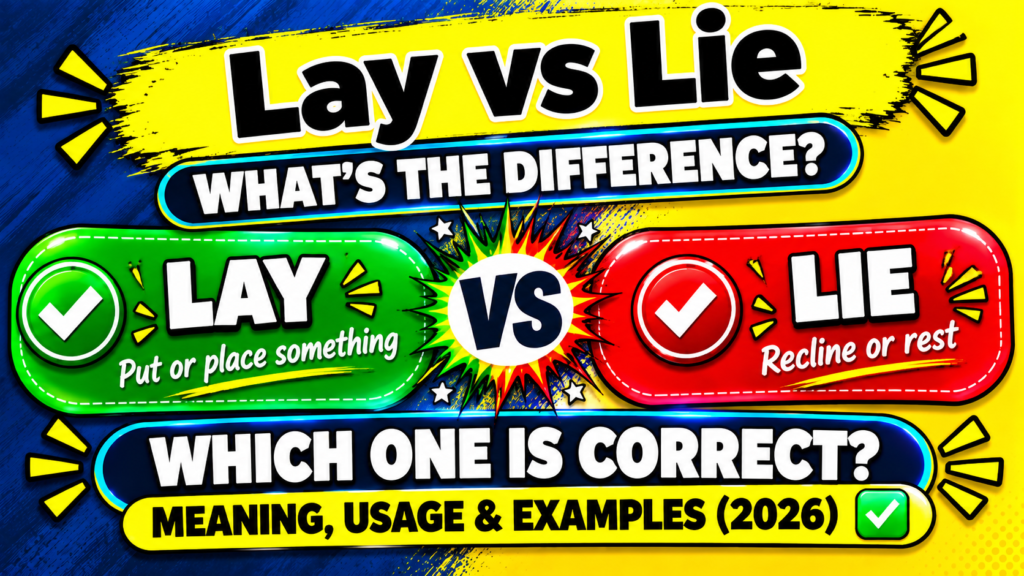
Lay vs lie: which one is correct? 🤔 These two tiny verbs confuse students, writers, and even native speakers every single day. 😅 The short answer is simple: lay means to place something, while lie means to recline or to tell an untruth. ✅ This lay vs lie guide gives you the rules, the tricky past tenses, clear examples, and a quick quiz so you can stop guessing. 🎯
Understanding Lay or Lie in Simple English
The whole confusion comes down to one grammar idea: the direct object. 🧠 A direct object is the thing that receives the action. 📦 Lay always needs one, and lie never has one. 🔑
You lay a book on the table, but you simply lie on the sofa. 🛋️ The trouble starts because the past tense of lie is lay, which looks just like the present tense of the other verb. 😵
Lay or Lie: Simple Definition
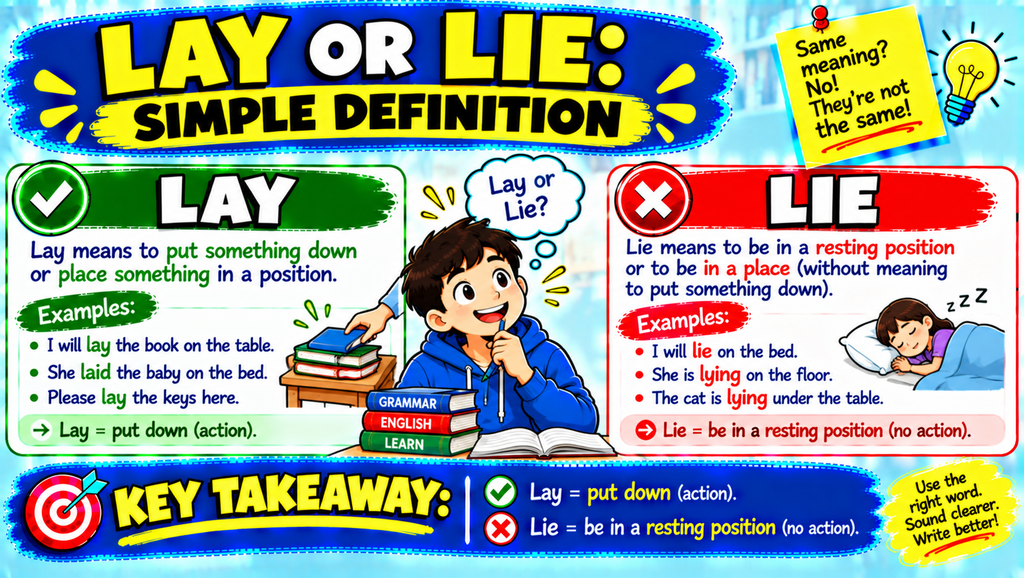
Lay means to put or place something down, and it needs a direct object. 📦 Lie means to recline or rest flat, and it never takes an object. 😴 A second meaning of lie is to say something untrue. 🤥 The past tense of lay is laid, the past tense of lie (recline) is lay, and the past tense of lie (untruth) is lied. 💡
- Please lay the keys on the counter. 🔑
- I need to lie down for ten minutes. 😴
- He lied about his age. 🤥
What Does Lay Mean?
Lay is a transitive verb that means to put, place, or set something down with care. 📦 It also covers a bird producing eggs and preparing a table for a meal. 🥚
- Lay your coat on the bed. 🧥
- Hens lay eggs every morning. 🐔
- She laid the baby in the crib. 👶
What Does Lie Mean?
Lie is an intransitive verb, so it never takes an object. 🚫 It has two separate meanings, and each one has its own past tense. 🔀
- To recline: The cat likes to lie in the sun. ☀️ (lie, lay, lain)
- To say something false: Don’t lie to me. 🙅 (lie, lied, lied)
Lay vs Lie: Core Difference
This table shows every form side by side. 📊
| Verb | Meaning | Present | Past | Past participle | -ing form | Needs an object? |
|---|---|---|---|---|---|---|
| Lay | to place | lay | laid | laid | laying | Yes |
| Lie | to recline | lie | lay | lain | lying | No |
| Lie | to tell an untruth | lie | lied | lied | lying | No |
Notice the trap: lay is both the present tense of one verb and the past tense of the other. 🪤 That overlap causes most of the mistakes. 💥
Is Lay or Lie Formal or Informal?
Both verbs are standard English, so neither one is slang. 📰 What changes is how strictly people follow the rules. 📏
In casual speech, many people say “I’m going to lay down,” and you will hear it everywhere. 🗣️ In essays, exams, and business emails, stick with lie down when you mean to recline. 🎓 Editors still treat the mix-up as an error. 🚩
Idioms are looser. 🎭 Lie low is the traditional form, but lay low is very common in casual speech. ✅
How to Use Lay Correctly
Follow these steps every time: 👇
- Find the object. Ask “lay what?” and if you get an answer, lay is right. Lay the folder on my desk. 📁
- Present tense: I lay my phone down every night. 📱
- Past tense: She laid the cards on the table yesterday. 🃏
- Past participle: They have laid new tiles in the kitchen. 🧱
- -ing form: He is laying a new carpet. 🏠
How to Use Lie Correctly
Lie has no object, so nothing follows it directly. 🚫 Use these forms for reclining: 👇
- Present: I lie on the couch after work. 🛋️
- Past: Yesterday I lay on the couch for an hour. ⏳
- Past participle: I have lain here since noon. 🕛
- -ing form: The dog is lying by the door. 🐕
Never write “lieing.” ❌ The correct spelling is lying. ✅
Lie + Preposition Structure
Lie usually comes with a preposition or adverb that shows where or to whom. 📍 Common patterns are lie on, lie in, lie down, lie around, lie ahead, lie to (a person), and lie about (a topic). 🧩
- She lies on the grass and reads. 📖
- Don’t lie to me. 🙅
- He lied about the price. 💸
Lie Down vs Lay Down: Important Difference
The tired-person example shows the difference clearly. 😴
- I’m tired, so I’m going to lie down. (You recline, so there is no object.) 🛏️
- I was tired, so I lay down. (Past tense of lie.) ⏪
- I’ll lay the baby down in the crib. (The baby is the object.) 👶
- I laid the baby down an hour ago. (Past tense of lay.) 🕐
Lie in Questions
Questions follow the same rule. ❓ If you can name an object, switch to lay. 🔄
- Can I lie down for a few minutes? 😌
- Why did you lie to me? 😠
- Where does the problem lie? 🔍
- How long has he lain there? ⌛
Common Situations Where Lay or Lie Is Used
| Situation | Word | Example |
|---|---|---|
| Resting in bed | lie | I like to lie in bed on Sundays. 🛌 |
| Putting an item down | lay | Lay the towel on the chair. 🏖️ |
| Birds producing eggs | lay | The duck laid three eggs. 🦆 |
| Preparing a table (British) | lay | She laid the table for six. 🍽️ |
| Telling a falsehood | lie | He lied to the police. 🚔 |
| Where something is located | lie | The village lies at the foot of a hill. ⛰️ |
| Making plans | lay | Let’s lay out a clear plan. 🗺️ |
Advanced Usage of Lie
Lie with Nouns
Lie is also a noun that means an untruth. 🤥 It is countable, so you can tell a lie or many lies. 🔢
- It was a harmless white lie. 🤍
- Nobody believed his lie. 🙄
- The lie detector test was inconclusive. 🕵️
Lie with Time Expressions
Time words help you choose the right tense. ⏰
| Time expression | Lie (recline) | Lay (place) |
|---|---|---|
| Every night | I lie down at ten. | I lay my keys on the shelf. |
| Yesterday | I lay down at ten. | I laid my keys on the shelf. |
| Since morning | She has lain awake. | She has laid out the plans. |
| Right now | I am lying down. | I am laying my keys down. |
Lie in Formal Writing
Formal writing uses lie a lot to mean “to be located” or “to rest with.” 📚 It also expects the full forms lie, lay, lain without shortcuts. 🎓
- The answer lies in the data. 📊
- Responsibility lies with the board. 🏢
- Further challenges lie ahead. 🛣️
- The documents lay on his desk all week. 🗂️
Synonyms and Opposite of Lie
| Meaning | Synonyms | Opposites |
|---|---|---|
| Lie (recline) | recline, rest, stretch out, lounge | stand, rise, sit up, get up |
| Lie (untruth) | fib, falsehood, untruth, fabrication | truth, honesty, fact |
| Lay (place) | put, place, set, rest, deposit | pick up, lift, remove |
Lay vs Lie: Right vs Wrong
| Wrong ❌ | Right ✅ | Why |
|---|---|---|
| I’m going to lay down for a nap. | I’m going to lie down for a nap. | No object, so use lie |
| Yesterday I laid in bed all day. | Yesterday I lay in bed all day. | Past tense of lie is lay |
| She has laid awake all night. | She has lain awake all night. | Past participle of lie is lain |
| Lie the book on the desk. | Lay the book on the desk. | Book is the object |
| The cat is laying in the sun. | The cat is lying in the sun. | Resting, with no object |
| The hen lied an egg. | The hen laid an egg. | Laid is the past tense of lay |
Common Mistakes People Make
- Using “lay” for reclining in the present tense. Say lie down, not lay down. 🛏️
- Mixing up the past tenses. The past of lie is lay, and the past of lay is laid. 🔀
- Using “laid” for “lain.” After has or have, reclining takes lain. ⏳
- Writing “laying” for resting. Use lying when nobody is placing anything. 🛋️
- Spelling it “lieing.” The right spelling is lying. ✍️
- Forgetting that the untruth verb is regular. It is lie, lied, lied, not lay. 🤥
Memory Trick: Never Confuse Lay or Lie Again
- Lay = place. Both words have an a. 📦
- Lie = recline. Both words have an i. 😴
- Ask “lay what?” If an object answers, use lay. 🔑
- Try the swap test. Replace the verb with place, and if it fits, use lay. 🔄
- Think of animals and people. Hens lay eggs, but people lie down. 🐔
Quick Practice Section
Fill in the blank with the correct form: 📝
- Please ___ your phone on the desk. 📱
- I want to ___ down for an hour. 😴
- Yesterday, he ___ on the sofa all afternoon. 🛋️
- She has ___ the table for dinner. 🍽️
- The dog is ___ by the door. 🐕
- They ___ the new carpet last week. 🏠
- He ___ about his age. 🤥
Answers
- lay (the phone is the object) ✅
- lie (no object) ✅
- lay (past tense of lie) ✅
- laid (past participle of lay) ✅
- lying (resting, no object) ✅
- laid (past tense of lay) ✅
- lied (past tense of lie, untruth) ✅
Lay or Lie with Specific Phrases
| Phrase | Verb | Note |
|---|---|---|
| lie down | lie | No object |
| lay something down | lay | Needs an object |
| lie low | lie | Traditional form; lay low is common in casual speech |
| laid low | lay | Passive form, as in laid low by the flu |
| lie in wait | lie | Fixed phrase |
| lay off (workers) | lay | The firm laid off 50 workers. |
| lay the groundwork | lay | Common in business writing |
| lay of the land | lay | American form; lie of the land is common in British English |
| lay an egg | lay | Birds and also jokes that fail |
Frequently asked questions
What is the main difference between lay and lie?
Lay means to place something and needs an object, while lie means to recline or tell an untruth and takes no object. ✅
What is the past tense of lie?
For reclining it is lay (Yesterday I lay down), and for telling an untruth it is lied. ⏪
Is it lie down or lay down?
Use lie down for yourself and lay down only when you place something, like lay the baby down. 👶
Is it laying or lying in bed?
It is lying in bed, because nobody is placing an object. 🛏️
Is it lie low or lay low?
Lie low is the traditional and formal choice, though lay low is widely used in casual speech. 🤫
What is the past participle of lie?
It is lain for reclining (has lain) and lied for telling an untruth (has lied). 🔁
Do chickens lay or lie?
Chickens lay eggs, because the eggs are the object. 🐔
Conclusion
The lay vs lie choice gets easy once you check for a direct object. 🔍 Use lay when you place something, and use lie when you recline or tell an untruth. ✅ Remember the past tenses, because lay is the past of lie and laid is the past of lay. ⏪ Bookmark this guide, and share it with a friend who still says “I’m going to lay down.” 🔖
