

Accept vs except: which one do you need? The two words sound almost identical, so it’s easy to type the wrong one when you’re writing fast. Here’s the short answer: accept means to receive or agree to something, while except means to leave something out. ✅
This guide to accept vs except covers the meaning of each word, how to use them in real sentences, the rare verb form of except, and simple memory tricks that make the choice automatic.
Understanding Accept or Except in Simple English
Accept and except belong to the group of commonly confused words known as near homophones. In everyday speech, the first vowel is so soft that the two words blend together.
Their meanings, though, pull in opposite directions. One welcomes something in. The other pushes something out. 💡
Spellcheck won’t save you here, either. Both words are spelled correctly, so a wrong pick slides right past the red squiggly line.
Accept or Except: Simple Definition
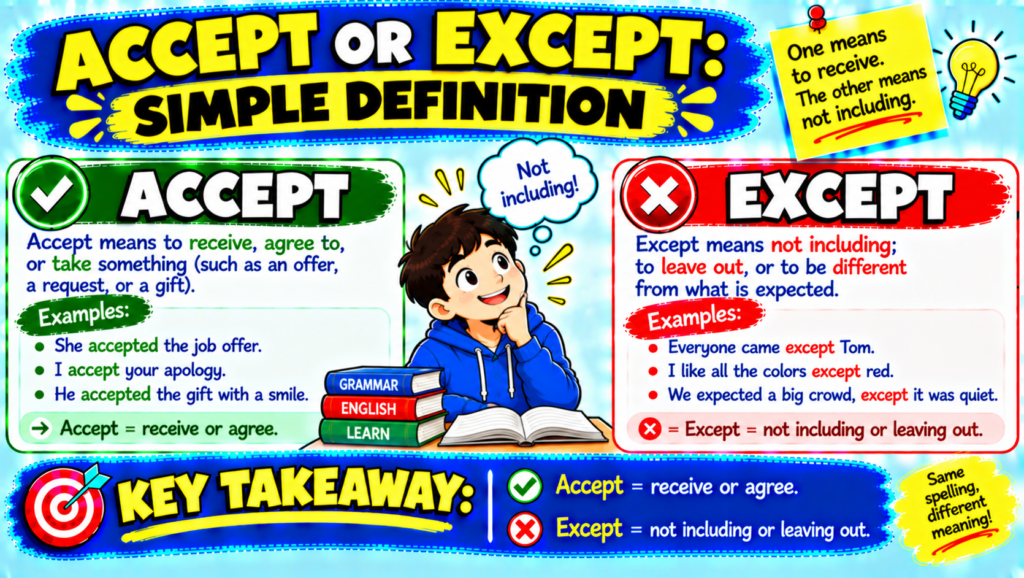
- Accept (verb): to receive, agree to, or approve of something.
- Except (preposition or conjunction): excluding, other than, or but not.
Quick test: if you can swap the word for “receive” or “agree to,” use accept. If you can swap it for “excluding,” use except. ✅
What Does Accept Mean?
Accept is always a verb. It has a few closely related meanings:
- To take something offered: She accepted the gift with a smile.
- To say yes: He accepted the job offer on Friday.
- To believe something is true: Most doctors accept the new guidelines.
- To put up with something: We had to accept the delay.
- To take as payment: This café accepts cards only.
Related forms include accepts, accepted, accepting, and the noun acceptance.
Whatever the meaning, accept always involves someone taking something in, whether it’s an object, an idea, or a situation.
What Does Except Mean?
Except is mostly a preposition, and it marks the person or thing that’s left out.
- As a preposition: The pharmacy opens daily except Sunday.
- As a conjunction: I’d join you, except I have to work late.
- In the phrase “except for”: Except for the price, the hotel was perfect.
Its noun cousin is exception, which means something that doesn’t follow the rule. ✅
Accept or Except: The Core Difference
| Feature | Accept | Except |
|---|---|---|
| Part of speech | Verb | Preposition or conjunction (verb in rare cases) |
| Core meaning | Receive, agree, approve | Exclude, leave out, other than |
| Swap-in test | “receive” or “agree to” | “excluding” or “but not” |
| Memory hook | A for agree | Ex for exclude |
| Example | I accept your offer. | Everyone except Sam came. |
| Related noun | Acceptance | Exception |
The pattern is simple: accept brings something in, and except keeps something out. 💡
Is Accept or Except Formal or Informal?
Neither. Both words are standard English and fit anywhere, from a text message to a legal contract.
The only formal twist is the verb form of except, which shows up mostly in legal and official writing. We’ll get to that below.
How to Use Accept Correctly
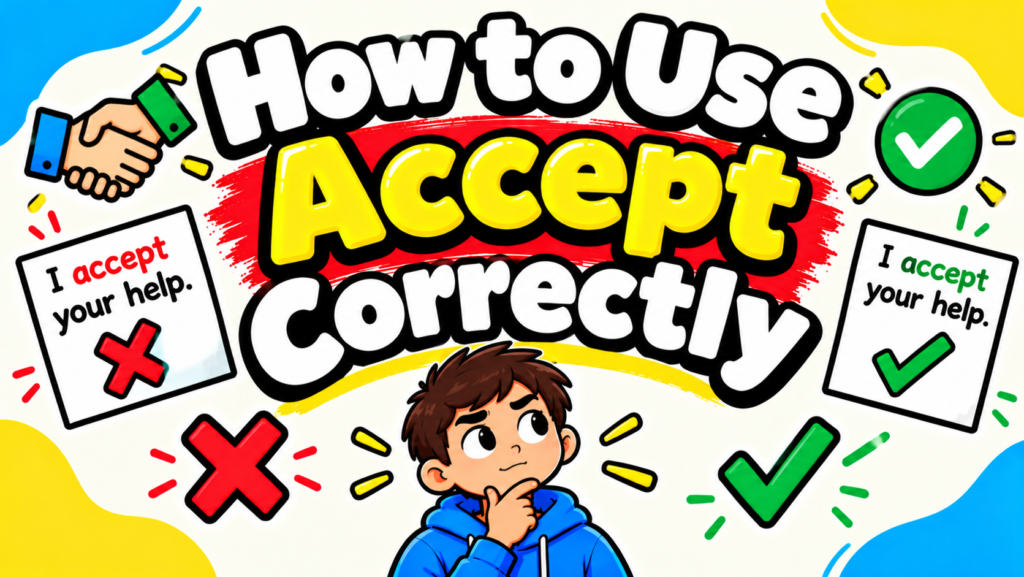
Use accept when someone is receiving, approving, or agreeing to something. You’ll usually find it in this pattern: subject + accept + thing.
- Please accept my apology.
- The shop doesn’t accept checks.
- She decided to accept responsibility.
- Do you accept the terms and conditions?
- They accepted my invitation.
If the action is receiving or agreeing, accept is your word. ✅
How to Use Except Correctly
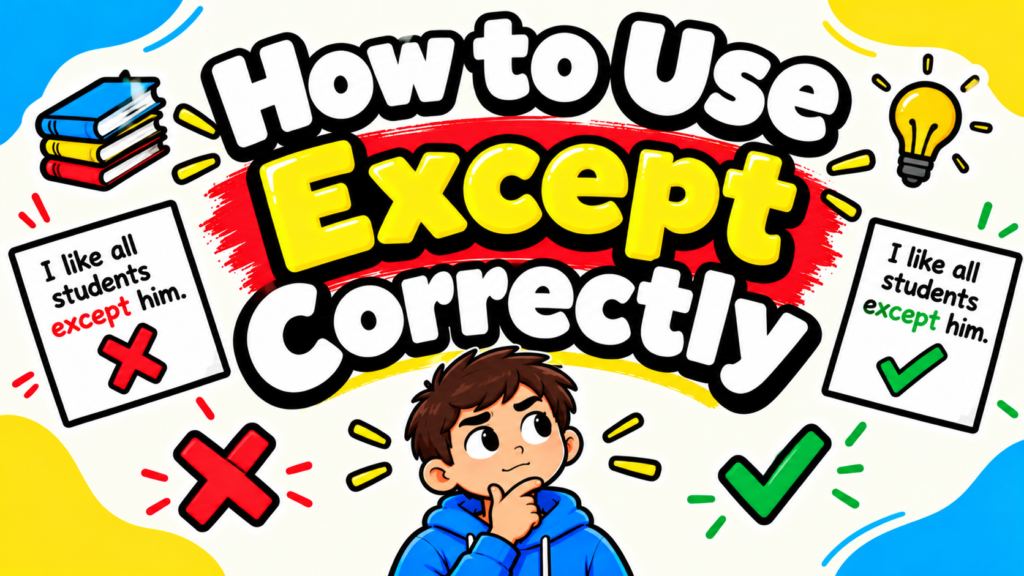
Use except to name what’s being excluded. It sits right before the person or thing that’s left out.
- Everyone except Maria arrived on time.
- I like all fruit except mango.
- The gym is open daily except holidays.
Two handy patterns to know:
- Except for often opens a sentence: Except for the noise, it was a great stay.
- Except that introduces a catch or a reason: I’d say yes, except that I’m already booked.
Common Situations Where Accept or Except Is Used
| Situation | Accept | Except |
|---|---|---|
| Work | I’ll accept the meeting invite. | I’m free every day except Thursday. |
| Shopping | We accept all major cards. | Everything is half price except gift cards. |
| Websites | Click Accept to continue. | All fields are required except phone number. |
| School | She accepted the scholarship. | Every student except seniors must attend. |
| Relationships | Please accept my apology. | I forgive everything except lying. |
Except as a Verb: The Rare Usage Most Guides Miss
Here’s the twist many articles skip. Except can also be a verb. It means to leave out or exclude, and in legal writing it can mean to object to something.
You’ll mostly spot it in the past tense:
- Children under five are excepted from the fee.
- Present company excepted, everyone here has been late at least once.
It’s rare, formal, and easy to misread. In everyday writing, “exclude” or “leave out” is clearer. 💡
The legal sense, “to take exception to,” is very specialized. If you’re not drafting a contract, you can safely ignore it.
Accept or Except: Right vs Wrong Examples
| ❌ Wrong | ✅ Right | Why |
|---|---|---|
| Please except my apology. | Please accept my apology. | You’re receiving an apology. |
| Everyone accept Maria came. | Everyone except Maria came. | Maria is being left out. |
| I except your offer. | I accept your offer. | You’re agreeing, so you need the verb. |
| We’re open daily accept holidays. | We’re open daily except holidays. | Holidays are excluded. |
| She was excepted to the university. | She was accepted to the university. | Admission means being received. |
Common Mistakes People Make with Accept or Except
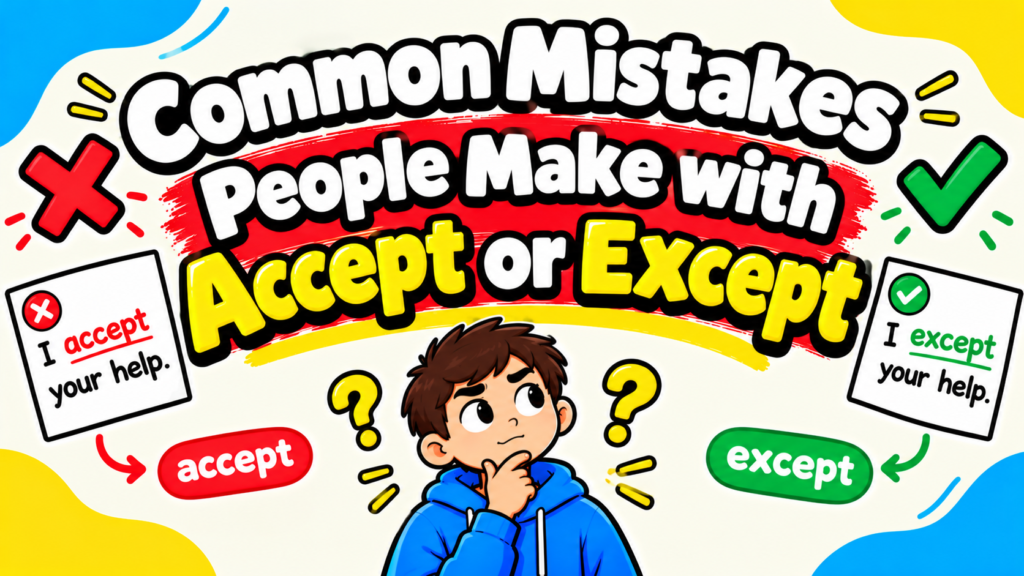
- Typing on autopilot. Because both words are real, spellcheck stays quiet.
- Using accept to mean “excluding.” “All accept one” should be “all except one.”
- Mixing in expect. Expect means to anticipate: I expect rain tomorrow. That’s a third word altogether.
- Using except as a verb in casual writing. It’s correct but rare, so it can confuse readers.
- Skipping the proofread. A quick read-aloud with the swap-in test catches most slips.
Memory Trick: Never Confuse Accept or Except Again
Try these three shortcuts:
- The “A” trick. Accept starts with A, like agree, award, and allow.
- The “X” trick. Except has an X, like a cross-out mark that removes something.
- The swap test. Replace the word with “excluding.” If the sentence still works, use except. If not, use accept.
Here’s the step-by-step version for any sentence:
- Say the sentence with “receive” or “agree to” in its place. Does it work? Use accept.
- Say it with “excluding” in its place. Does it work? Use except.
- If neither fits, check whether you meant expect.
Accept or Except in Formal vs Informal Writing
The spelling rules don’t change with tone, but your phrasing options do.
| Style | Accept | Except |
|---|---|---|
| Formal (essays, contracts, reports) | Please accept the terms outlined below. | All members are eligible, with the exception of trustees. |
| Informal (texts, chats) | Sure, I’ll accept. | Everyone’s coming except Jake. |
In formal writing, you can swap except for “excluding” or “with the exception of.” In casual writing, “but” often does the same job: everyone but Jake.
Accept or Except with Specific Phrases
| Phrase | Correct word | Example |
|---|---|---|
| ___ an apology | accept | I accept your apology. |
| ___ responsibility | accept | He had to accept responsibility. |
| ___ the terms | accept | Please accept the terms to continue. |
| ___ an invitation | accept | They gladly accepted the invitation. |
| ___ for | except | Except for Monday, I’m free. |
| ___ that | except | I’d go, except that it’s raining. |
| everyone ___ me | except | Everyone except me knew. |
| present company ___ | excepted | Present company excepted, of course. |
Frequently Asked Questions
What is the simple rule for accept or except?
Accept means to receive or agree to something. Except means to leave something out. ✅
Is it accept or except an apology?
It’s “accept an apology.” You’re receiving it, not excluding it.
Is it accept or except for one person?
Use except when you’re leaving one person out: “Everyone except Tom came.”
Can except be used as a verb?
Yes, but rarely. It means to exclude, as in “present company excepted,” and it’s mostly formal or legal.
What is the difference between accept and except in grammar?
Accept is a verb. Except is usually a preposition or conjunction.
Is it all accept or all except?
“All except” is the usual phrase, meaning “all but.” “All accept” works only when “all” is the subject: “All accept the offer.”
How do I remember the difference?
Link accept with agree and except with exclude. The X in except works like a cross-out mark. 💡
Which is more commonly confused?
It goes both ways. Most slips happen while typing fast, and spellcheck won’t flag either word.
Which is correct, except or accept the terms?
“Accept the terms” is correct, because you’re agreeing to them.
Can accept and except appear in the same sentence?
Yes: “I accept all offers except the last one.” The first word agrees, the second excludes.
Conclusion
Accept and except sound alike, but they do opposite jobs. Accept takes something in. Except leaves something out.
Next time you’re unsure, run the swap test: “receive” points to accept, and “excluding” points to except. Do it a handful of times and the choice becomes automatic. 🎯
Bookmark this guide for your next proofread, and share it with anyone who still types “please except my apology.”
