

Could of vs could have: which one is correct? 🤔 Only “could have” is right, and “could of” is a spelling mistake that comes from the way we talk. 🗣️ You’ve probably seen it in texts, comments, and even work emails. 📱 This guide explains the grammar, the reason behind the mix-up, and a simple trick to get it right every time. ✅
Understanding Could Of or Could Have in Simple English
“Could have” is the correct phrase, and “could of” is always wrong. ✅ When you speak, “could have” shrinks to “could’ve,” and that sounds almost identical to “could of.” 👂 Your ear hears “of,” but the grammar needs “have.” 📚
| Phrase | Correct? | Example |
|---|---|---|
| Could have | ✅ Yes | I could have called earlier. 📞 |
| Could’ve | ✅ Yes (short form) | I could’ve called earlier. 📞 |
| Could of | ❌ No | I could of called earlier. 🚫 |
Could Of or Could Have: Simple Definition
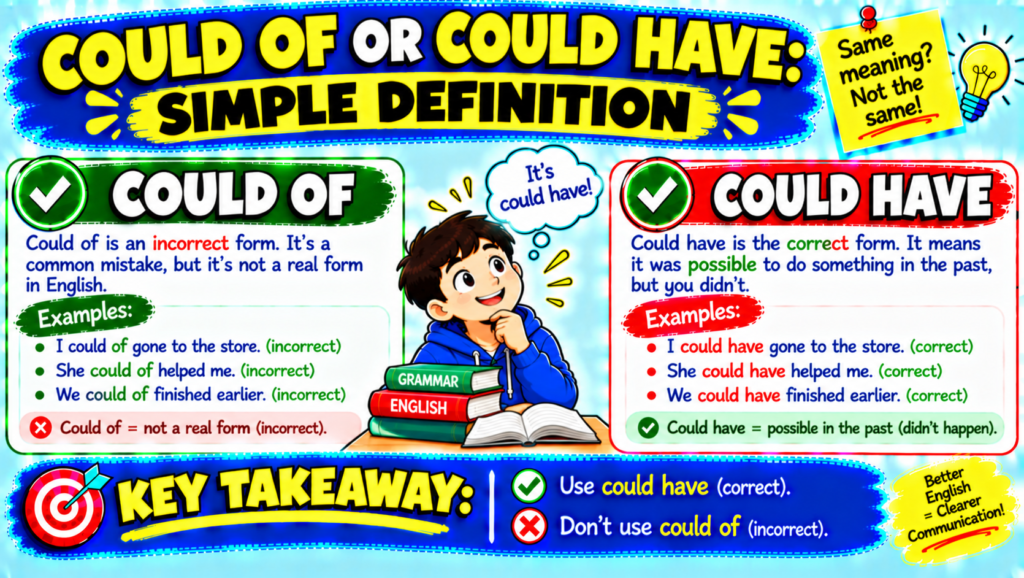
“Could have” is a modal verb phrase. 🧩 “Could” is the modal verb, and “have” is the auxiliary verb that supports it. 🔧 A past participle such as “gone,” “done,” or “seen” comes next. ✍️ Together they describe something that was possible in the past but never happened. ⏳
“Could of” isn’t a real verb phrase at all. 🙅 “Of” is a preposition, and a preposition can’t help a verb form the past. 📖
Why Do People Write Could Of Instead of Could Have?
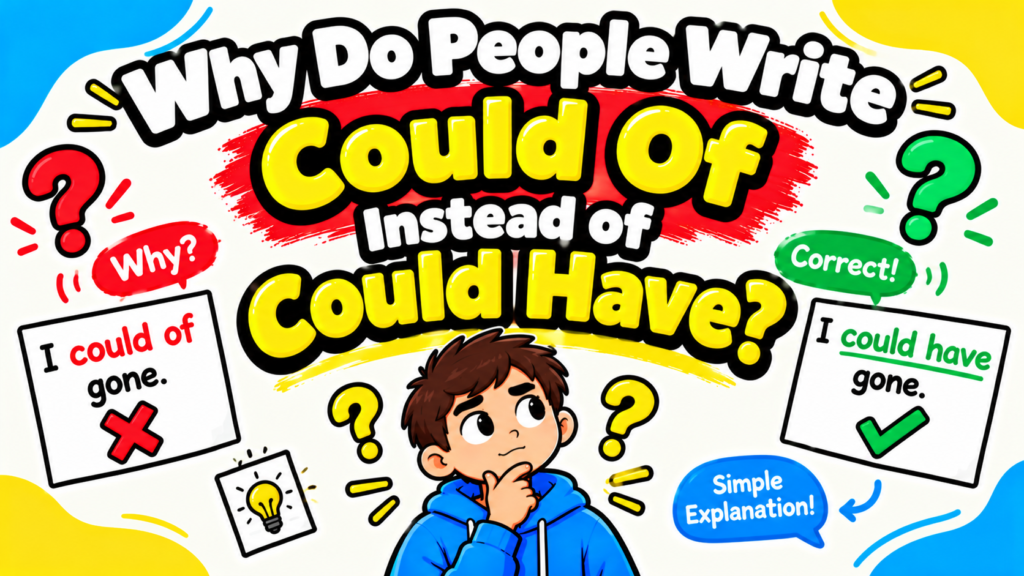
The mix-up starts with pronunciation. 🔊 In fast speech, “have” loses its “h” and shrinks to a quick “uv” sound. 💨 That sound matches the word “of.” 🔁
A few other habits keep the error alive:
- Contractions: “Could’ve” sounds like “could of” when you hear it, not when you see it. 👀
- Typing speed: Writers often type what they hear. ⚡
- Constant exposure: The error shows up in comments, memes, and captions, so it starts to look normal. 🌐
- Speech before spelling: Most people learn to talk long before they study grammar patterns. 🎓
Native speakers make this mistake more often than learners, which surprises many people. 😲
Full Breakdown of Could Have
Here’s the whole structure in one line: could + have + past participle. 🧠 The subject can change, but the pattern stays the same. 🔒
| Subject | Pattern | Example |
|---|---|---|
| I | could have + past participle | I could have finished earlier. ⏱️ |
| She | could have + past participle | She could have joined us. 👋 |
| They | could have + past participle | They could have won the match. 🏆 |
| We | could have + past participle | We could have stayed longer. 🏖️ |
The negative form is “couldn’t have,” as in “She couldn’t have known.” 🙈 In questions, the subject moves in between: “Could you have missed the call?” 📵
Is Could Of or Could Have Formal or Informal?
“Could have” works in both formal and casual writing. ✅ “Could’ve” is relaxed, so it suits chats and friendly emails. 💬 “Could of” fits nowhere, because it’s an error in every setting. 🚫
| Form | Formal writing | Casual writing |
|---|---|---|
| Could have | ✅ Best choice | ✅ Fine |
| Could’ve | ⚠️ Better avoided | ✅ Fine |
| Could of | ❌ Never | ❌ Never |
How to Use Could Have Correctly
Follow these four quick steps:
- Start with your subject. 👤
- Add “could have.” ✍️
- Finish with a past participle, such as “gone” or “taken.” ✅
- Ask yourself if the action was possible but didn’t happen. 🔍
Some clean examples:
- I could have taken the earlier train. 🚆
- You could have asked me for help. 🙋
- They could have fixed the bug sooner. 🐞
Common Situations Where Could Have Is Used
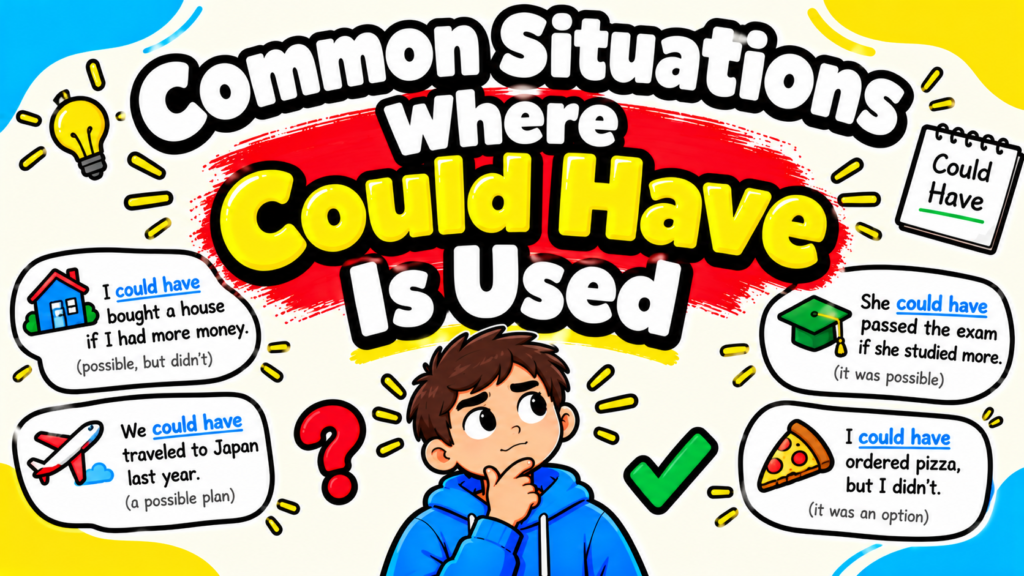
You’ll reach for “could have” in these cases:
- Missed chances: We could have booked the tickets earlier. 🎟️
- Regret: I could have studied harder for that exam. 📚
- Mild criticism: You could have told me about the delay. 😅
- Guesses about the past: He could have taken the wrong road. 🛣️
- Hypotheticals: If I’d known, I could have helped. 🤝
Can Could Of Ever Be Correct?
Almost never. 🚫 There’s one rare case where “could” and “of” sit side by side on purpose. 🧐 It happens when “of” starts its own phrase, as in “We could, of course, take the bus.” 🚌 The commas show that “of course” is a separate unit, so “could” still connects to “take.” ✅
You may also see it in fiction dialogue, where an author spells it that way to show a character’s casual speech. 🎭 Outside those two situations, “could of” is simply a mistake. ❌
Could Have as a Contraction Could’ve
“Could’ve” is the short form of “could have.” ✂️ The apostrophe stands in for the letters “ha.” 🔤 It’s perfect for texts, chats, and conversational blog posts. 💬
- ✅ I could’ve gone with you.
- ❌ I could of gone with you.
- ❌ I could’of gone with you.
Watch the apostrophe placement, because “could’of” is still wrong. 👀
Could Of or Could Have Right vs Wrong
| Wrong | Right |
|---|---|
| I could of known. ❌ | I could have known. ✅ |
| She could of won. ❌ | She could have won. ✅ |
| We could of left. ❌ | We could’ve left. ✅ |
| They could of helped. ❌ | They could have helped. ✅ |
| It could of been worse. ❌ | It could have been worse. ✅ |
Could Of vs Should Of vs Would Of
The same problem happens with every modal verb. 🔁 “Should of,” “would of,” “might of,” and “must of” are all wrong for the same reason. 🚫 The fix is identical each time: swap “of” for “have.” ✅
| Wrong | Correct | Contraction |
|---|---|---|
| could of | could have | could’ve |
| should of | should have | should’ve |
| would of | would have | would’ve |
| might of | might have | might’ve |
| must of | must have | must’ve |
Common Mistakes People Make with Could Of or Could Have
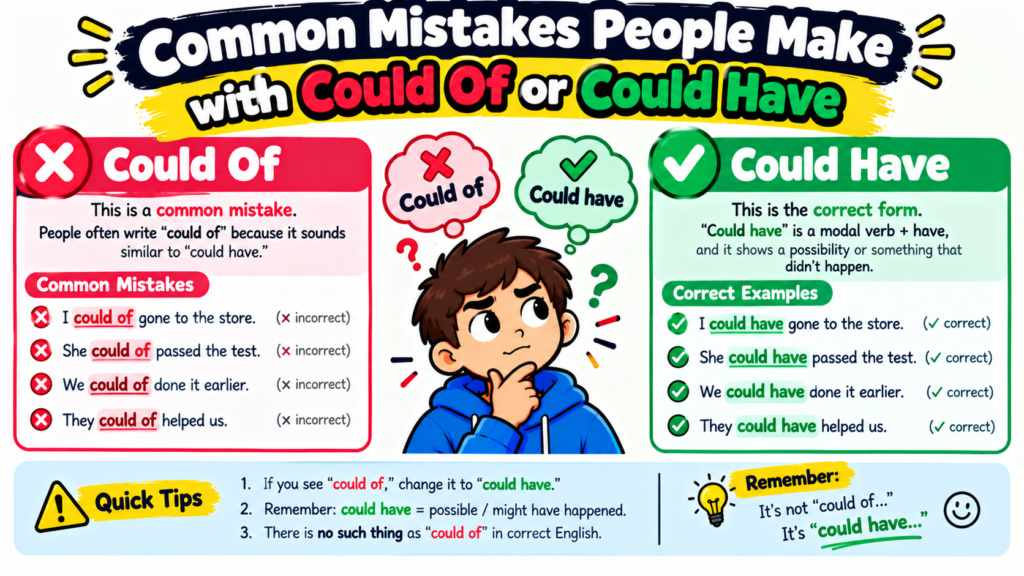
- Writing “could of” instead of “could have.” ❌ Write “We could have left.” ✅
- Adding an apostrophe to “of.” ❌ “Could’of” isn’t a word, so write “could’ve.” ✅
- Adding “of” after the contraction. ❌ “Could’ve of gone” should be “could’ve gone.” ✅
- Using the wrong verb form afterward. ❌ “Could have went” should be “could have gone.” ✅
- Using the base form after “have.” ❌ “Could have help” should be “could have helped.” ✅
Memory Trick Never Write Could Of Again
- Nouns and verbs: “Of” belongs with nouns, while “have” belongs with verbs. 🧠 If a verb comes next, choose “have.” ✅
- The expand test: Spell out the contraction in your head. 🔍 “Could’ve” always opens up to “could have.” 📖
- The “been” test: Words like “been,” “gone,” and “done” never follow “of” in this pattern. 🚦 If you see one, you need “have.” 🔧
- Read it slowly: Say the sentence aloud with a clear “have.” 🗣️ The correct version will sound natural right away. 👍
Could Of or Could Have in Formal vs Informal Writing
Your setting decides which correct form fits best. 🎯
| Where you’re writing | Best choice |
|---|---|
| Academic essays and reports | could have |
| Business emails and cover letters | could have |
| Text messages and chats | could’ve |
| Social media posts | could’ve |
| Fiction dialogue | could’ve (“could of” only to show a deliberate error) |
In short, “could have” is safe everywhere. ✅ “Could’ve” is safe in relaxed writing. 💬 “Could of” is never safe. 🚫
Frequently Asked Questions
Is could of ever correct?
No, not as a replacement for “could have.” ❌ The only exception is when “of” starts its own phrase, as in “We could, of course, wait.” ✅
Why do people write could of instead of could have?
Because “could’ve” sounds almost exactly like “could of” in speech. 👂 People simply write what they hear. ✍️
What is the correct form could of or could have?
“Could have” is the correct form. ✅ “Could of” is a common spelling mistake. ❌
Can I write could’ve instead of could have?
Yes, “could’ve” is the proper short form. ✂️ Use it in casual writing and keep “could have” for formal text. 💼
Is should of also wrong?
Yes, “should of” is wrong for the same reason. ❌ Write “should have” or “should’ve.” ✅
Is would of correct?
No, “would of” is incorrect. 🚫 Use “would have” or “would’ve.” ✅
How do I remember could have vs could of?
Remember that “of” goes with nouns and “have” goes with verbs. 🧠 If a verb follows, pick “have.” ✅
Is could of used in any dialect of English?
You’ll see it in informal writing that copies casual speech, but standard English doesn’t accept it. 🗣️ Always use “could have” in standard writing. 📖
What type of error is could of?
It’s a sound-based spelling error, where writers spell what they hear instead of what the grammar requires. 👂 It’s not a different dialect rule. ❌
Can could of appear in dialogue in fiction writing?
Yes, but only on purpose. 🎭 Authors use it to show a character’s casual or non-standard speech. 💬
Conclusion
When it comes to could of vs could have, the answer is simple. 🎯 “Could have” and its short form “could’ve” are correct, and “could of” never is. ✅ Remember the formula: could + have + past participle. 🧠 If you’re ever unsure, expand the contraction and remember that “of” goes with nouns while “have” goes with verbs. 🔍 Use this guide as your quick reference, and your writing will stay clean and confident. 🌟
