

You’re typing a quick message when your fingers freeze. 😅 Is it “too early” or “to early”? 🤔 Here’s the answer up front: “too early” is the correct spelling in almost every sentence. ✅ “To early” is a common typo that slips into texts, emails, and even published articles. 📩
This guide explains what each phrase means, why people mix them up, and how to get it right every time. 📚 You’ll also get examples, a right-vs-wrong table, and a memory trick that actually sticks. 💡
To Early or Too Early? The Short Answer
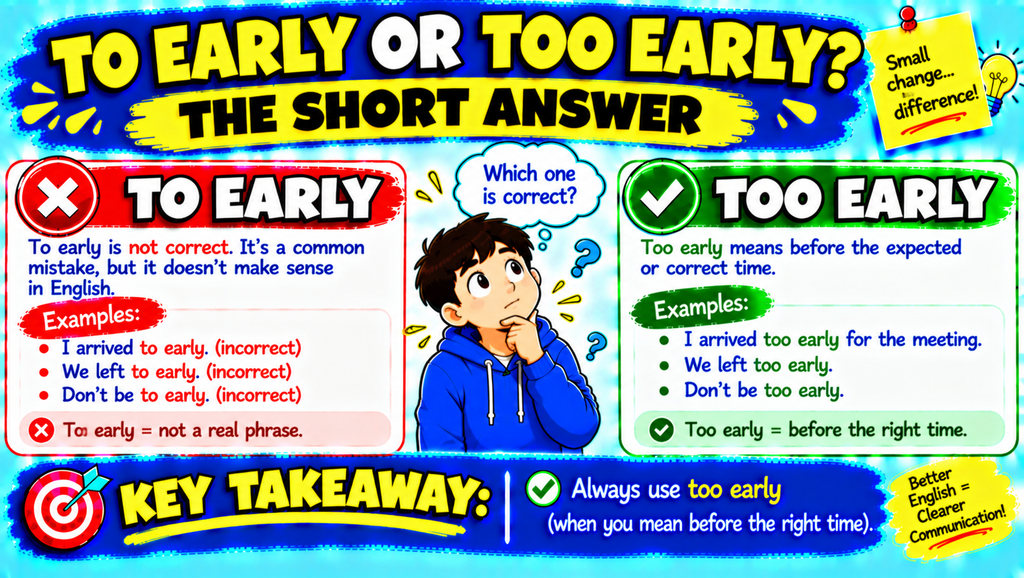
Use “too early” when something happens before the right, expected, or acceptable time. ⏰
Here are three quick examples:
- It’s too early to tell who will win. 🏆
- She arrived too early, so the doors were still locked. 🚪
- Please don’t send the invoice too early. 🧾
“To early” only works in rare cases where “to” and “early” happen to sit side by side as separate words. 🔍 We’ll cover those exceptions below. 👇 In every other case, switch to “too early.” ✔️
What Does “To Early” Mean?
On its own, “to early” isn’t a phrase with a meaning. 🙅 It’s usually a misspelling of “too early.” ✍️
The word to is a preposition (we’re going to the park) or part of an infinitive verb (I want to sleep). 🛏️ Neither job fits when you’re describing excess. ❌
There’s one catch. 🎣 Sometimes “to” and “early” meet by accident because “early” describes a noun that comes next. 🧩 Take this sentence: “Thanks to early detection, the plant survived.” 🌱 Here, “to” belongs to “thanks,” and “early” belongs to “detection.” 🔗
What Does “Too Early” Mean?
“Too early” means before the proper, expected, or ideal time. 🕰️ The word too is an adverb that signals “more than needed” or “excessively.” 📈 So “too early” literally means “earlier than it should be.” ⏪
It works in three common ways:
- Timing: We reached the airport too early. ✈️
- Judgment: It’s too early to make a decision. 🤷
- Emphasis: It’s way too early for this meeting. 😴
Close synonyms include prematurely, ahead of time, too soon, and untimely. 📝
To Early or Too Early: The Core Difference
| Feature | Too Early | To Early |
|---|---|---|
| Spelling | Two o’s | One o |
| Grammar role | Adverb + adjective or adverb | Preposition or infinitive marker + “early” |
| Meaning | Earlier than expected or ideal | No meaning as a phrase |
| Correct? | ✅ Yes, almost always | ❌ Usually a typo |
| “Excessively early” swap test | Works | Fails |
| Example | It’s too early to call. | Welcome to early access. (rare, valid) |
That one-letter gap looks tiny, but it changes the whole sentence. 🔤
Is To Early or Too Early Formal or Informal?
“Too early” is neutral. ⚖️ You can use it in a text to a friend, a business email, or a research paper. 💼
“To early” isn’t informal, it’s simply incorrect. 🚫 In a casual chat, readers may forgive it. 😬 In a resume, report, or client email, it looks careless. 📉
How to Use “To Early” Correctly
Use “to early” only when to is a preposition and early describes the noun right after it. 🧠 Look for these patterns:
- Prepositional phrases: Thanks to early detection, treatment was simple. 🩺
- Time ranges: The café is busy from early morning to early evening. 🌅
- Titles and labels: Welcome to Early Access! 🎮
- Cause phrases: Due to early frost, the harvest shrank. ❄️
Here’s a fast test. 🧪 If a noun follows “early” (detection, morning, access, frost), “to early” may be right. ✅ If “early” ends the clause or is followed by “to,” “for,” or “in,” you need “too.” ❌
How to Use “Too Early” Correctly
These are the patterns you’ll use most:
- Too early + to + verb: It’s too early to celebrate. 🎉
- Too early + for + noun: Isn’t it too early for dessert? 🍰
- Verb + too early: He left the party too early. 🚶
- Too early + in + time frame: It’s too early in the season to judge. 🍂
- Intensifiers: much too early, far too early, way too early, a bit too early. 📏
Skip “very too early.” 🙅 The word “too” already carries the idea of excess, so “very” just adds clutter. 🧹
Common Situations Where To Early or Too Early Is Used

People reach for “too early” in all kinds of everyday moments:
- Daily routines: My alarm rings too early on Mondays. ⏰
- Work: It’s too early to judge the campaign’s results. 📊
- Health: It’s too early to take a pregnancy test. 🧪
- Seasons: Holiday lights in October feel too early. 🎄
- Sports: The fans celebrated too early. ⚽
- Dating: Saying “I love you” on date two might be too early. 💬
- Events: We got to the theater too early. 🎭
Why Spellcheck Often Misses This Mistake
Spellcheck looks at spelling, not meaning. 🔎 That’s the whole problem. Here’s why “to early” slips through:
- Both “to” and “early” are real words, so nothing gets flagged. ✅
- The two spellings sound identical, so reading aloud won’t help. 🔊
- “To” is one of the most common words in English, so fingers type it on autopilot. ⌨️
- Fast typing leaves little time to spot a tiny slip. ⚡
Try this instead. 💡 Press Ctrl+F (or Cmd+F) and search for “to early” in your draft. 🔍 Each hit takes two seconds to check, and you’ll catch the error before anyone else does. 🎯
To Early or Too Early Right vs Wrong Examples
| ❌ Wrong | ✅ Correct |
|---|---|
| It’s to early to call the match. | It’s too early to call the match. |
| We arrived to early for the interview. | We arrived too early for the interview. |
| Is it to early for lunch? | Is it too early for lunch? |
| He quit to early. | He quit too early. |
| Don’t celebrate to early. | Don’t celebrate too early. |
| I woke up to early today. | I woke up too early today. |
One special case stays correct as written: “Thanks to early feedback, we fixed the bug.” 🐛
Common Mistakes People Make with To Early or Too Early
- Typing on autopilot. The brain picks the most familiar “to.” 🧠
- Writing “two early.” “Two” is the number 2, so it never fits here. 2️⃣
- Repeating the slip in similar phrases. “To late,” “to soon,” and “to much” are wrong for the same reason. 🔁
- Saying “too early than expected.” Use “earlier than expected” instead. ⏪
- Mixing up the two senses of “too.” “It’s too early” means excessively early, while “It’s early, too” means also early. 🔀
Memory Trick: Never Confuse To Early or Too Early Again

- Extra O, extra amount. “Too” has an extra “o,” just like it describes an extra amount. ➕
- The swap test. Replace the word with “excessively” or “overly.” If the sentence still works, use “too.” 🔄
- Adjective alert. When the next word is an adjective or adverb (early, late, soon, hot), “too” is the safe pick. 🚨
- Quick rhyme. Too much, too soon, too early: extra “o,” every time. ✨
To Early or Too Early in Formal vs Informal Writing
| Setting | Correct Choice | Example |
|---|---|---|
| Work email | too early | It’s too early to confirm the budget. 💼 |
| Academic paper | too early (or “premature”) | It is too early to draw firm conclusions. 🎓 |
| News writing | too early | Officials say it’s too early to name a cause. 📰 |
| Texts and social media | too early | Too early for Monday vibes. 😴 |
| Any setting | to early (separate words only) | Thanks to early planning, we finished on time. 🗓️ |
In formal writing, you can also swap in premature, prematurely, or ahead of schedule for variety. 🎩
To Early or Too Early with Specific Phrases
| Phrase | Meaning | Example |
|---|---|---|
| too early to tell | Not enough time has passed to know | It’s too early to tell if the plan works. 🔮 |
| too early to say | A slightly more cautious version | It’s too early to say who’s at fault. 🤔 |
| too early to call | The result can’t be decided yet | The race is too early to call. 🏁 |
| too early in the game | Still the beginning of a process | It’s too early in the game to panic. 🎲 |
| way too early | Strong emphasis | It’s way too early for a meeting. 😴 |
| never too early | A good time to start anytime | It’s never too early to save money. 💰 |
| better too early than too late | Early is safer than late | Let’s leave now, better too early than too late. 🚗 |
| thanks to early (separate words) | Valid “to” + “early” pairing | Thanks to early voting, lines were short. 🗳️ |
Frequently asked questions
Is it “too early” or “to early”?
“Too early” is correct. ✅ “To early” is a typo unless “to” and “early” belong to different parts of the sentence, as in “thanks to early detection.” 🩺
What does “too early” mean?
It means before the right, expected, or ideal time. ⏰ Think “prematurely” or “ahead of time.” 📅
Is “to early” ever correct?
Yes, but rarely. 🎯 It works when “to” is a preposition and “early” describes the noun after it, like “from early morning to early evening.” 🌅
What’s the difference between “too early” and “too soon”?
They overlap a lot. 🔄 “Too early” usually points to a clock time or stage, while “too soon” often points to acting before you’re ready. 🧭
Is “two early” correct?
No. ❌ “Two” is the number 2, so the phrase should be “too early.” 2️⃣
How can I remember which spelling to use?
“Too” has an extra “o” for an extra amount. ➕ If “excessively” fits the sentence, use “too.” ✅
Is “too early to tell” formal?
It’s neutral, so it fits news reports, business emails, and casual chats. 📰
Can I say “too early than expected”?
No. ❌ Say “earlier than expected” instead. ⏪
Conclusion
The rule is simple. 🎯 Write “too early” whenever you mean earlier than expected, earlier than ideal, or premature. ✅ Save “to early” for the rare moments when “to” belongs to a preposition and “early” describes the next noun. 🧩
Before you hit send, run the swap test and search your draft for “to early.” 🔍 Two quick checks can save you from an embarrassing typo. 😉 Now you know the difference, so go write with confidence. 🚀
