

Should of vs should have is one of the most common grammar mix-ups in English. 😅 You’ve seen it in texts, social posts, and even work emails. 📱 So which one is actually right? 🤔
Here’s the quick answer. ⚡ “Should have” is correct, and “should of” is a spelling mistake. ✅ In this guide, you’ll learn why people make the error, how to use should have properly, and a simple trick to stop making it for good. 🎯
Should Of or Should Have: The Short Answer
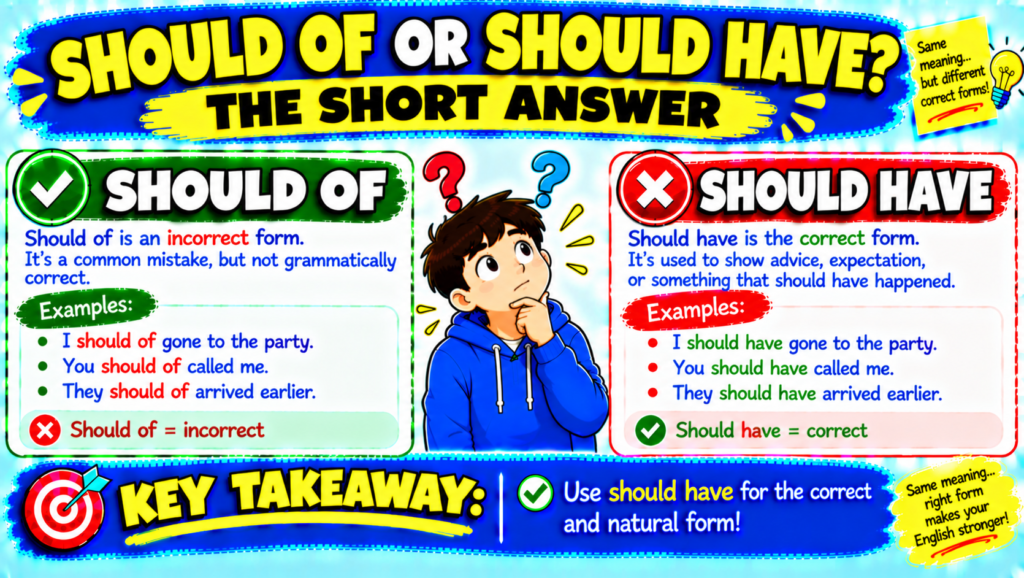
“Should have” is the correct phrase. ✅ It describes something that would have been a good idea in the past, but didn’t happen. ⏪ “Should of” is wrong whenever you mean “should have.” ❌
| Phrase | Correct? | Example |
|---|---|---|
| Should have | ✅ Yes | You should have called me first. ✅ |
| Should’ve | ✅ Yes (informal) | I should’ve left earlier. ✅ |
| Should of | ❌ No | You should of called me first. ❌ |
Why Do People Write Should Of Instead of Should Have?
The mistake comes down to sound. 👂 When we speak quickly, “should’ve” sounds almost identical to “should of.” 🗣️ So people write what they hear. ✍️
A few things keep the error alive:
- Sound-alike words: The “’ve” in should’ve is pronounced just like the word “of.” 🔊
- Spell-check blind spot: Both words are real, so basic spell checkers don’t flag “should of.” 🔍
- Texting habits: Fast typing and casual posts spread the mistake everywhere. 📲
- Missed lessons: Many people never learned that “’ve” is short for “have.” 📚
The same thing causes “would of” and “could of.” 🔁
Full Breakdown of Should Have
“Should” is a modal verb, and “have” works as a helping verb here. 🧩 Together, they point back to the past. ⏪
The formula is simple:
Subject + should have + past participle
For example, “I should have studied” and “She should have told us.” 📝 In both, the action didn’t happen, but it would have been the smarter choice. 💡
| Use | What it means | Example |
|---|---|---|
| Regret | You wish you had acted differently | I should have saved more money. 😔 |
| Criticism | Someone made a poor choice | You should have checked the oven. 🔥 |
| Expectation | Something was likely by now | The parcel should have arrived by now. 📦 |
| Hindsight advice | A better option existed | We should have booked earlier. 🗓️ |
Is Should Of or Should Have Formal or Informal?
“Should have” works in both formal and everyday writing. ✅ “Should’ve” is the informal version. 💬 “Should of” isn’t acceptable in either. 🚫
| Form | Tone | Best used in |
|---|---|---|
| Should have | Formal / neutral | Essays, reports, work emails |
| Should’ve | Informal | Texts, chats, blog posts |
| Shoulda | Very informal | Song lyrics, slang, dialogue |
| Should of | Incorrect | Nowhere |
How to Use Should Have Correctly
Follow these three steps:
- Start with the subject. Use I, you, they, or a name. 👤
- Add “should have” or “should’ve.” Pick the one that fits your tone. 🎚️
- Finish with the past participle. That’s the third form of the verb, like “gone,” “done,” or “seen.” ✔️
Negatives work the same way. ➖ Use “should not have” or “shouldn’t have,” as in “You shouldn’t have waited.” ⏳ For questions, flip the order: “Should I have called earlier?” ❓
Common Situations Where Should Have Is Used
- Personal regret: “I should have listened to my gut.” 😞
- Workplace feedback: “We should have tested the page before launch.” 💼
- Expectations: “The email should have reached you by now.” 📧
- Missed opportunities: “She should have applied for that job.” 🚪
- Safety and rules: “He should have worn a helmet.” 🚴
One small twist: sometimes “have” is the main verb. 🔄 In “You should have a spare key,” nothing is in the past, and you usually don’t contract it. 🔑
Can Should Of Ever Be Correct?
Almost never. 🙅 There is one rare case where the two words sit side by side by accident. 🤷 It happens when “of” belongs to the phrase that follows, like “of course.”
“Students should, of course, read the rules first.” 📖 Here, “should” and “of” aren’t a pair at all. 🔎
Some dictionaries do record “of” used in place of “have,” because people say it so often. 📘 But usage guides still tell writers to avoid it. ⚠️ In fiction, you might use it in dialogue to show how a character talks. 🎭 Even then, “shoulda” usually reads better. ✨
Should Have as a Contraction: Should’ve
“Should’ve” is just “should have” squeezed together. 🤏 The apostrophe replaces the letters “ha.” ✂️ It follows the same pattern as could’ve, would’ve, might’ve, and must’ve. 🔗
Keep these tips in mind:
- Always include the apostrophe, because “shouldve” looks like a typo. 🧐
- Use it in casual writing and speech. 💬
- Switch to “should have” in formal documents. 🎓
- Don’t add “of” after it, as in “should’ve of.” 🚫
Should Of or Should Have: Right vs Wrong
| ❌ Wrong | ✅ Correct |
|---|---|
| I should of gone home. ❌ | I should have gone home. ✅ |
| They should of known better. ❌ | They should have known better. ✅ |
| You should of seen it. ❌ | You should’ve seen it. ✅ |
| We should of called first. ❌ | We should have called first. ✅ |
| She shouldn’t of said that. ❌ | She shouldn’t have said that. ✅ |
| Should of I waited? ❌ | Should I have waited? ✅ |
Should Of vs Would Of vs Could Of
“Should of” has a few close cousins. 👯 They all come from the same sound-alike mix-up. 🔊
| Wrong | Correct | Contraction |
|---|---|---|
| Should of | Should have | Should’ve |
| Would of | Would have | Would’ve |
| Could of | Could have | Could’ve |
| Might of | Might have | Might’ve |
| Must of | Must have | Must’ve |
Here’s one rule that covers all of them. 📏 Never put “of” right after a modal verb. 🚫 Use “have” instead. ✅
Common Mistakes People Make with Should Of or Should Have
- Writing “should of.” This is the classic error. ❌
- Doubling up with “should’ve of.” The “’ve” already means “have.” 🔁
- Using the wrong verb form. Say “should have gone,” not “should have went.” 🚶
- Dropping the apostrophe. “Shouldve” isn’t standard spelling. ✏️
- Using “should of” in formal writing. Essays, cover letters, and reports lose credibility fast. 📉
- Mixing it up with “must have.” The two carry different meanings, as the FAQs below explain. ⬇️
Memory Trick: Never Write Should Of Again

Try one of these quick checks. ⚡
- The expand test: Say “should have” out loud. If the sentence still works, write “should have.” ✅
- The verb rule: “Of” is a preposition, and “have” is a verb. 🧠 After “should,” you need a verb, not a preposition. 🔑
- The apostrophe rule: If you hear “should-uv,” write “should’ve” with an apostrophe. 🔤
- The nonsense test: Ask yourself “should of what?” If the sentence makes no sense, you need “have.” 🤨
Should Of or Should Have in Formal vs Informal Writing
| Situation | Best choice | Example |
|---|---|---|
| Academic essay | Should have | The study should have included more participants. 🎓 |
| Business email | Should have | We should have confirmed the deadline. 💼 |
| Text message | Should’ve | I should’ve texted you earlier. 📱 |
| Blog or social post | Should’ve | You should’ve seen the crowd! 🎉 |
| Fiction dialogue | Should’ve / shoulda | “I shoulda stayed home,” he muttered. 🎭 |
Frequently asked questions About Should Of vs Should Have
Is should of ever correct?
Not as a replacement for “should have.” 🚫 It only shows up by accident, as in “should, of course, check.” 🔎
Why do people write should of instead of should have?
Because “should’ve” sounds like “should of” in fast speech. 👂 People spell what they hear. ✍️
What is the correct form should of or should have?
“Should have” is correct. ✅ “Should of” is always a mistake when you mean the past-tense phrase. ❌
Can I write should’ve instead of should have?
Yes, in casual writing. 💬 Use the full “should have” in formal documents. 🎓
Is would of also wrong?
Yes. ❌ The correct forms are “would have” and “would’ve.” ✅
Is could of correct?
No. 🚫 Write “could have” or “could’ve” instead. ✅
How do I remember should have vs should of?
Expand the phrase out loud. 🗣️ If “should have” fits, use it, because “of” never follows a modal verb. ✅
What type of error is should of?
It’s a sound-based spelling mistake caused by mishearing “should’ve.” 👂 It’s also a grammar error, since a modal verb needs a verb after it, not a preposition. 🧠
Can should of appear in fiction writing dialogue?
Rarely, and only to show a character’s casual speech. 🎭 “Shoulda” or “should’ve” usually looks cleaner, and your narration should stay correct. ✨
What is the difference between should have and must have?
“Should have” shows regret, advice, or a missed duty, as in “I should have called.” ⏪ “Must have” shows a strong guess, as in “He must have left already.” 🔮
Conclusion
The debate over should of vs should have has a clear winner. 🏆 “Should have” is correct, and “should’ve” is its relaxed, informal version. ✅ “Should of” only exists because of how the contraction sounds. 👂
