

English learners mix up become and became more often than almost any other verb pair. 🤔 The good news? The rule is simple once you see it clearly. This guide breaks down the meaning, grammar, and real-world usage of both words with examples you can actually remember.
Quick Answer: Become vs Became
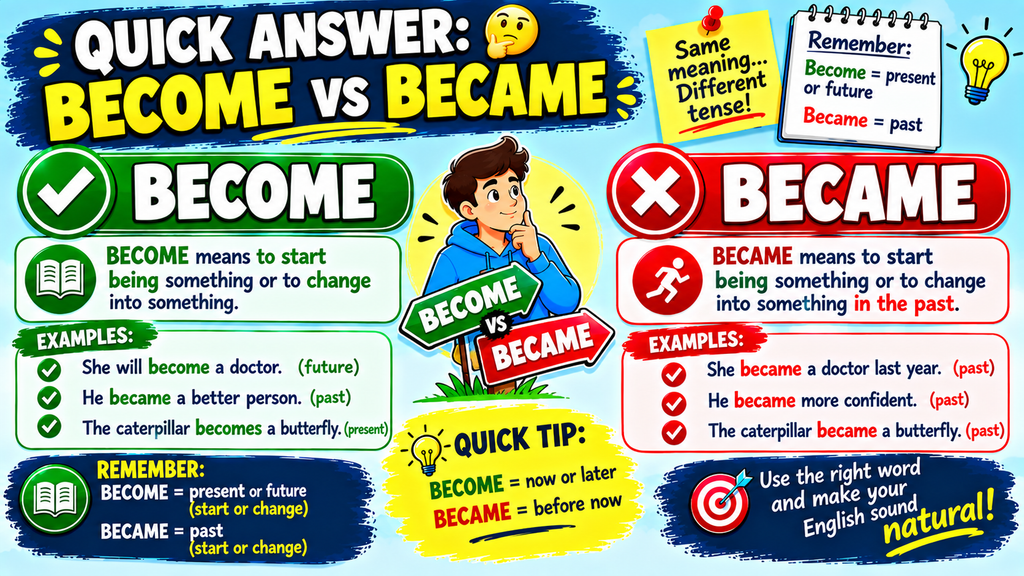
Become is the base (present tense) form, and became is its simple past tense. ✅
| Word | Tense | Example |
|---|---|---|
| Become | Present / base form | She will become a doctor. |
| Became | Simple past | She became a doctor last year. |
If the action already happened and is finished, use became. If it’s happening now, ongoing, or hasn’t happened yet, use become. 📌
Understanding the Basics: Become vs Became
Become is an irregular verb, meaning it doesn’t follow the standard “-ed” pattern for the past tense. Instead of “becomed,” English speakers use “became.” 😅
This verb describes a change of state going from one condition, role, or identity to another. Both become and became carry that same meaning; only the time changes.
Comparison Table
| Feature | Become | Became |
|---|---|---|
| Type | Base/present form | Simple past form |
| Tense | Present, future, present perfect (with have/has) | Past only |
| Used with | do/does/will/have/has | did (rarely), standalone |
| Example | They become friends easily. | They became friends in college. |
| Common with | Present perfect: “has become” | Simple past: “became” |
Correct Meanings & Uses
When to Use “Become” 🟢
Use become for present or future changes, habits, or general truths.
Examples:
- Children become more independent as they grow. 🧒
- I will become a certified trainer next month.
- She wants to become a nurse.
Sentence Breakdown: In “She wants to become a nurse,” become follows “wants to,” which requires the base form of the verb — not the past tense.
Test Tip: If you can swap in “will” or “wants to” naturally, become is correct. ✅
When to Use “Became” 🔵
Use became for a completed change that already happened in the past.
Examples:
- He became a father in 2023. 👶
- The weather became cold overnight.
- They became business partners after years of collaboration.
Sentence Breakdown: In “The weather became cold overnight,” the change is finished and tied to a specific past moment — signaled by “overnight.”
Test Tip: If the sentence already has a past-time clue (yesterday, last year, in 2020), became is your answer. 🕰️
Real-Life Case Study: Become vs Became in a Workplace Email
Grammar mistakes with this verb pair show up constantly in professional writing. Here’s a quick case study. 📧
Incorrect Email:
“I wanted to let you know that our client has became frustrated with the delay.”
Correct Email:
“I wanted to let you know that our client has become frustrated with the delay.”
Why?
“Has” is a present perfect helping verb, and present perfect always pairs with the past participle — which for this verb is “become,” not “became.” 🚫
Another Example:
- ❌ “The project had became too complex.”
- ✅ “The project had become too complex.”
Grammar Rules Explanation: Verb Forms of “Become”
Verb Forms of Become
| Form | Word |
|---|---|
| Base form | become |
| Present (3rd person singular) | becomes |
| Past simple | became |
| Past participle | become |
| Present participle | becoming |
Examples
- Present: I become anxious before exams.
- Past: I became anxious before my last exam.
- Present perfect: I have become more confident.
- Past perfect: I had become anxious before the results came in.
Why One Is Correct and the Other Is Incorrect
Became is a standalone past-tense verb — it never needs a helper like “has,” “have,” or “had.” The moment you add one of those helpers, the verb must switch back to “become” (its past participle form). This single rule solves 90% of the confusion. 💡
Common Mistakes with Become vs Became
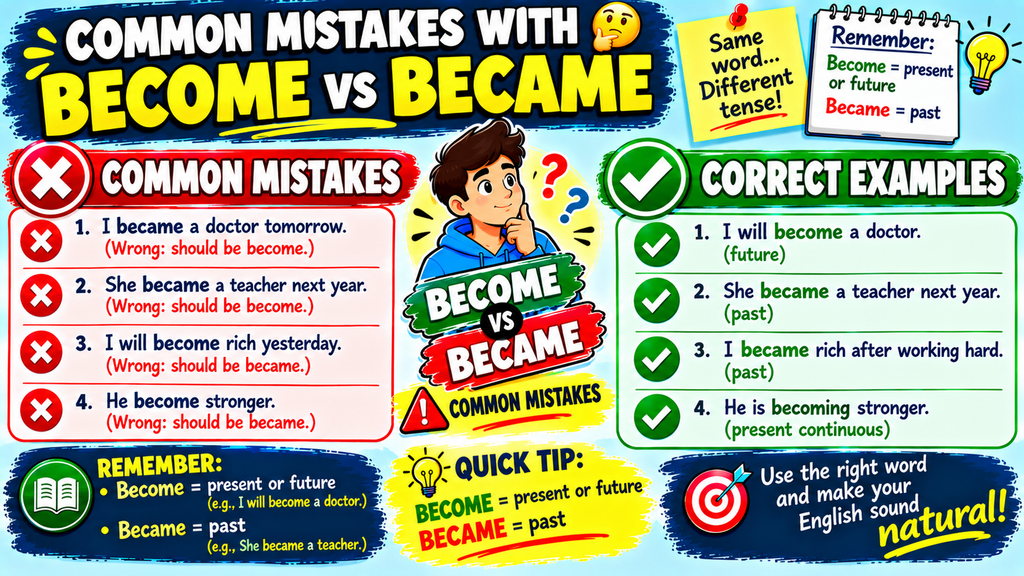
Common Errors
| Incorrect | Correct |
|---|---|
| She has became a manager. | She has become a manager. |
| He become sick yesterday. | He became sick yesterday. |
| They had became close friends. | They had become close friends. |
| I become tired after work today (referring to yesterday). | I became tired after work yesterday. |
Similar Grammar Confusions
This same pattern trips people up with other irregular verbs too:
- Go / Went / Gone — “He has gone,” not “he has went.” 🚶
- Come / Came / Come — “She has come,” not “she has came.”
- Do / Did / Done — “We have done it,” not “we have did it.”
Usage in Different Contexts
Everyday Conversation
People often use became casually to describe personal milestones: “I became a vegetarian last spring.” 🥗
Professional Writing
Formal writing leans on become with present perfect for ongoing business changes: “Our team has become more efficient this quarter.”
Creative Writing
Fiction often uses became to mark turning points in a character’s arc: “The quiet boy became a fearless leader.” 📖
Social Media / Texting
On social platforms, became frequently appears in captions announcing achievements: “Just became a homeowner! 🏡”
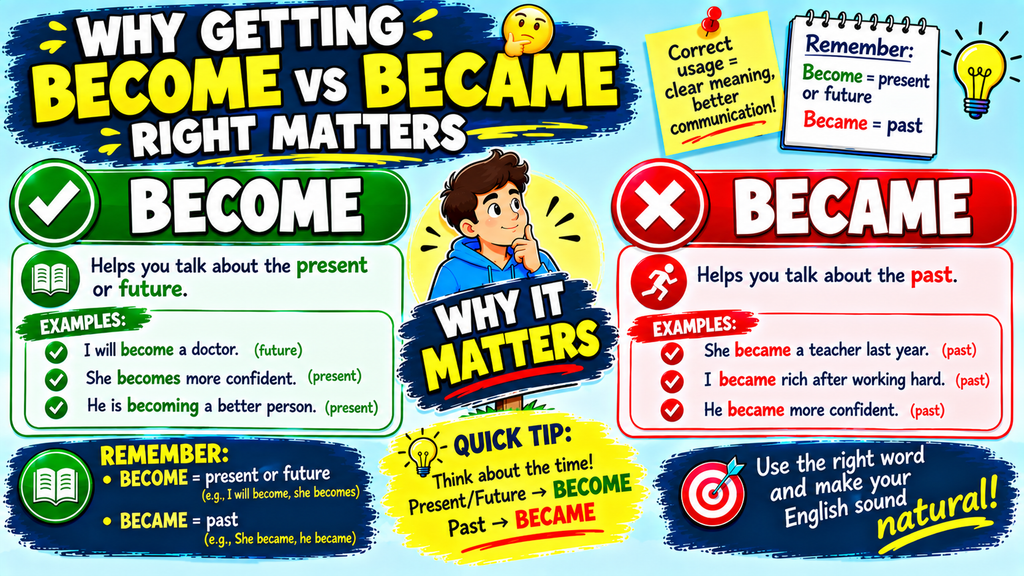
Why Getting Become vs Became Right Matters
Clarity in Communication
Choosing the wrong tense can confuse your timeline — readers may not know if something is finished or still happening. 🧩
Professionalism
In emails, resumes, and reports, a mistake like “has became” can undercut credibility, even if the message itself is strong.
Writing Accuracy in Digital Communication
Search engines and readers both reward clean, grammatically correct content — accuracy builds trust with your audience. 📈
“Grammar is the difference between knowing your stuff and knowing you’re stuff.” — a reminder that small verb slips can change meaning entirely. 😄
Special Exception: The Past Participle Alert ⚠️
The one rule to memorize: never use “became” after have, has, or had. The past participle of become is become — identical to the base form. This is unusual among irregular verbs and is the single biggest source of errors. 🚨
- ❌ I have became successful.
- ✅ I have become successful.
Quick Recap Checklist ✅
- Use become for present, future, or with helping verbs (has/have/had). ✔️
- Use became only for simple past tense, standing alone. ✔️
- Never write “has became,” “have became,” or “had became.” ✔️
- Past participle of become = become, not became. ✔️
- Test it: swap in “will” — if it fits, use become. If it doesn’t and there’s a past-time clue, use became. ✔️
Practice Examples
Try filling in the blanks with become or became:
- She ______ a teacher after graduating. (became)
- They have ______ good friends over the years. (become)
- He wants to ______ a pilot someday. (become)
- The city ______ crowded during the festival. (became)
- We had ______ tired by midnight. (become)
Frequently Asked Questions
Is it “has become” or “has became”?
“Has become” is correct — became never follows a helping verb like has, have, or had. ✅
What is the past participle of become?
The past participle of become is “become,” identical to its base form. 📌
Can “became” be used in present tense?
No, became is strictly past tense and cannot describe present or future actions.
What’s an easy trick to remember the difference?
If you can add “will” before the verb and it still makes sense, use become; if the action is already finished, use became. 💡
Is “become” a regular or irregular verb?
“Become” is irregular because its past tense doesn’t follow the standard “-ed” pattern. 🔤
Conclusion
Become and became both describe change, but the timing is what separates them. 🎯 Use become for the present, future, or alongside helping verbs like has/have/had — and reserve became for a completed action in the past, standing on its own. Once this rule clicks, you’ll never second-guess this verb pair again. ✨
