

“Dammit” and “damn it” show up everywhere texts, dialogue, social posts but which one is actually correct? 😅 The good news is that this isn’t a simple right-or-wrong situation like most spelling debates. Here’s exactly when to use each one, plus the mistake almost everyone accidentally makes.
Quick Answer: Dammit vs Damn It
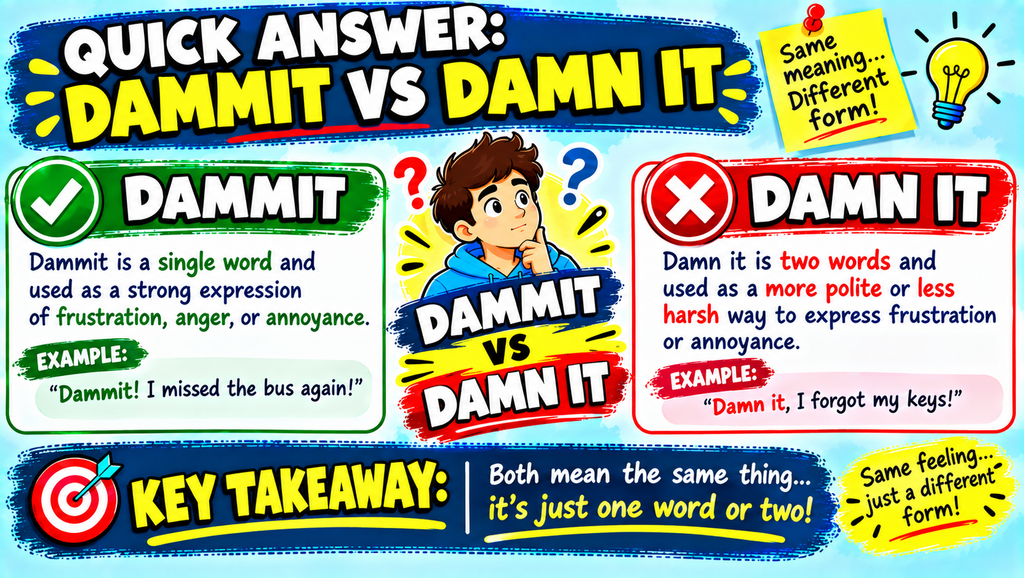
Both are correct, just in different contexts. ✅
- “Damn it” is the standard two-word phrase (verb + pronoun).
- “Dammit” is the widely accepted one-word, informal contraction.
- “Damnit” (one word, kept “n”) is the version to avoid it’s the actual mistake. ❌
Understanding the Basics of Dammit vs Damn It
“Damn it” is technically just the verb “damn” followed by the pronoun “it,” the same structure as “stop it” or “quit it.” 🧩 “Dammit” is what happens when people fuse that phrase together in casual speech, and dictionaries have since recognized it as a legitimate informal word.
Comparison Table
| Feature | Damn It ✅ | Dammit ✅ | Damnit ❌ |
|---|---|---|---|
| Word count | Two words | One word | One word |
| Grammar role | Verb + pronoun | Interjection | Not standard |
| Register | Neutral/standard | Casual, conversational | Common misspelling |
| Dictionary status | Standard phrase | Recognized (Collins, Dictionary.com) | Not recognized |
| Best used in | Formal or neutral writing | Dialogue, texting, social posts | Never |
Correct Meanings and Uses
What Does “Damn It” Mean?
It expresses frustration, anger, or disappointment, built from “damn” (to condemn) plus the object pronoun “it.” 😤
Examples:
- Damn it, I missed the bus again.
- She said, “Damn it,” under her breath.
Sentence Breakdown: “Damn” is the verb, “it” is the object grammatically identical to “cut it” or “drop it.”
Test Tip: If you can imagine a slight pause between the two words, “damn it” is the right choice. 🎯
What Does “Dammit” Mean?
It’s the same meaning, packed into one word for speed and emphasis. 🔥
Examples:
- Dammit, I forgot my keys.
- “Dammit!” he shouted at the screen.
Sentence Breakdown: The words are fused with no space, and the “m” doubles to preserve the short vowel sound.
Test Tip: If it sounds like a single, quick exclamation with no pause, use “dammit.” ⚡
Case Study Section
Workplace Email Example
A team lead once fired off a quick internal email after a server crash. 💻
Incorrect Professional Usage
“Dammit, the server crashed again and nobody told me.” too casual and slightly unprofessional for a workplace thread.
Better Professional Usage
“Unfortunately, the server crashed again without prior notice.” same frustration, professional tone. ✅
Key Lesson
Even correct spelling doesn’t guarantee appropriate usage. Context matters as much as grammar. 📌
Grammar Rules Explanation
Why “Damn It” Is Grammatically Standard
“Damn” functions as a verb, and “it” is simply its object, following a completely normal English sentence pattern.
Example: Just like “stop it” or “leave it,” “damn it” follows a verb-object structure. 🧠
Why “Dammit” Became Popular
In speech, the “n” in “damn” is already silent (like in “autumn” or “column”), so “damn it” naturally sounds like “dam-it.” Writers doubled the “m” when fusing it into one word to keep that short vowel sound intact, giving us “dammit” instead of the awkward “damit.” 🔤
Common Mistakes
The biggest error isn’t confusing “dammit” with “damn it” it’s writing “damnit” (one word, keeping the “n”), which matches neither form correctly. ⚠️
Why Do People Confuse Dammit vs Damn It?
- Fast Typing — dropping the space happens quickly in texts and comments.
- Pronunciation — the silent “n” makes people unsure how to spell it.
- Autocorrect — phone keyboards sometimes suggest the wrong version.
- Lack of Grammar Knowledge — many writers simply haven’t seen the “official” recognized spelling.
Similar Grammar Confusions Table
This isn’t the only phrase that gets fused informally. Here’s how it compares: 📊
| Standard Phrase | Informal Fused Form |
|---|---|
| Going to | Gonna |
| Want to | Wanna |
| Kind of | Kinda |
| Should have | Shoulda |
| Damn it | Dammit |
Usage in Different Contexts
Everyday Conversation
“Dammit” fits naturally into casual speech and texting. 💬
Examples: “Dammit, traffic again.” / “Ugh, dammit.”
Professional Writing
Avoid both forms in workplace or formal writing entirely.
Better Alternatives: “Unfortunately,” “This is frustrating,” or “That’s disappointing.” 💼
Creative Writing ✍️
Fiction and scripts often use “dammit” to mirror natural speech patterns.
Example: “Dammit!” she muttered, slamming the door.
Social Media and Texting
“Dammit” dominates casual online writing due to its quick, punchy feel. 📱
Examples: “dammit I missed the drop 😩” / “dammit, so close!”
Why It Matters
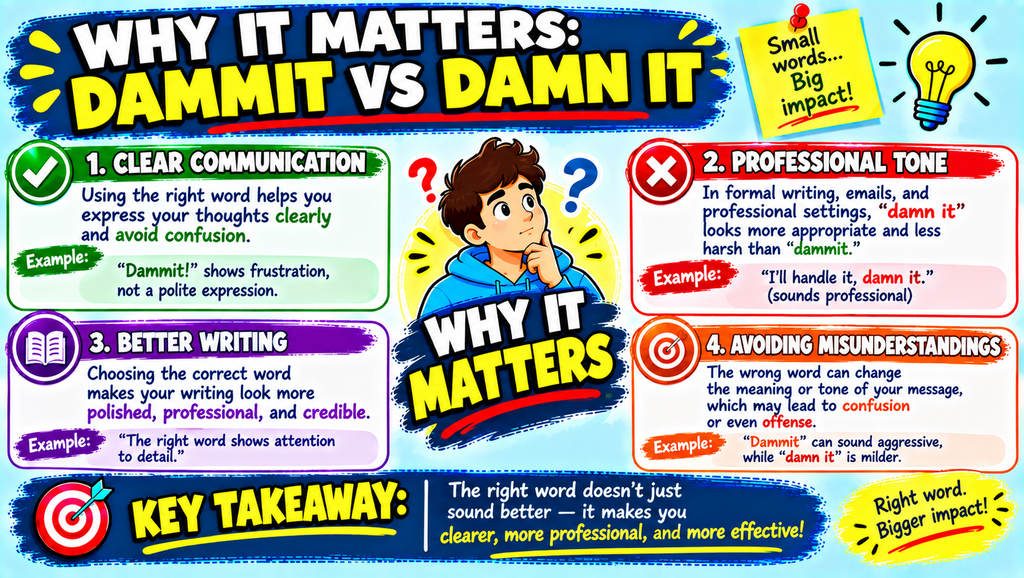
- Clarity in Communication choosing the right form signals tone instantly.
- Professionalism using either form in the wrong setting can look careless. 🚩
- Writing Accuracy knowing the difference avoids the actual error, “damnit.”
- Digital Communication consistent spelling builds credibility online.
Special Exception Section
When “Dammit” Is Intentionally Preferred
- Fiction and Screenwriting — dialogue feels more realistic as one punchy word.
- Branding and Entertainment — novelty products and song titles (like the 1997 hit “Dammit”) use the fused spelling for impact. 🎵
- Comedy and Internet Culture — memes and reaction posts almost always use “dammit” for comic timing.
Quick Recap Checklist
- ✅ Use “damn it” for standard, neutral writing.
- ✅ Use “dammit” for casual, conversational, or creative writing.
- ❌ Never use “damnit” — it’s not a recognized spelling.
- ⚠️ Avoid both in formal or workplace communication.
Practice Examples
Example 1: ______, I locked myself out again. → Dammit (casual tone)
Example 2: He whispered, “______,” after reading the email. → Damn it (neutral phrasing)
Example 3: She texted, “______ I’m running late!” → Dammit (informal texting)
Frequently asked questions: Dammit vs Damn It
Is “dammit” a real word?
Yes. It’s a recognized informal interjection meaning “damn it,” listed in dictionaries like Collins and Dictionary.com. 📖
Is “damnit” correct?
No. “Damnit” is a common misspelling use “dammit” or “damn it” instead.
Is “dammit” okay for professional writing?
No, it’s considered a mild expletive and should be avoided in formal or workplace communication.
Why does “dammit” have two Ms?
Doubling the “m” keeps the vowel sound short, following standard English spelling rules.
Is “damn it” a swear word?
Yes, though it’s widely considered one of the mildest expletives in English. 😌
Which should I use in writing?
Use “damn it” for standard or formal contexts, and “dammit” for casual, conversational writing.
Final Thoughts on Dammit vs Damn It
Both “dammit” and “damn it” are correct the real mistake to avoid is “damnit.” 🎉 Match the form to your tone: two words for standard writing, one word for casual speech and dialogue, and you’ll never second-guess it again.
