

If you’ve ever paused mid-sentence wondering whether to type “disfunction” or “dysfunction,” you’re not alone. 🤔 These two spellings look almost identical, sound almost identical, and trip up even confident writers. The good news? Once you understand where each spelling comes from, you’ll never second-guess yourself again.
This guide breaks down the meaning, origin, and correct usage of both words with real examples, a comparison table, and quick tips you can actually remember. ✅
Quick Answer: Disfunction vs Dysfunction
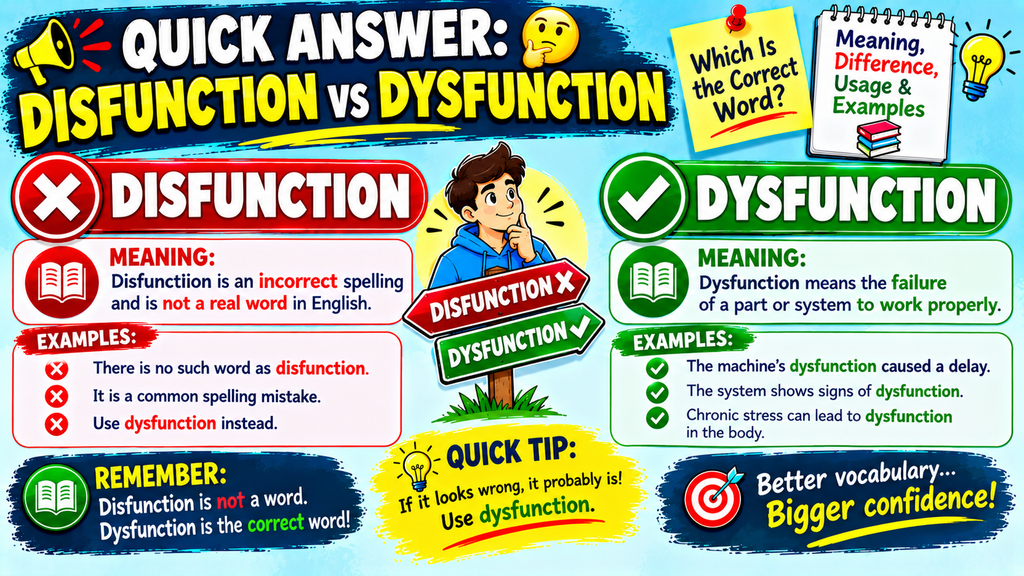
Dysfunction is the correct, standard spelling used in dictionaries, style guides, and professional writing. ✅
Disfunction is a rare variant spelling that a few dictionaries acknowledge but that modern style guides, editors, and medical journals avoid. 🚫
In short: when in doubt, write “dysfunction” — with a y, not an i. 📝
Understanding the Basics of Disfunction vs Dysfunction
Both spellings refer to something that isn’t working the way it should, whether that’s a body part, a machine, a family, or a team. The confusion comes from the fact that the two prefixes — dys- and dis- — sound similar in casual speech but come from different language roots. 🧠
A few quick facts to anchor the topic:
- “Dysfunction” comes from the Greek prefix dys-, meaning bad, abnormal, or difficult.
- “Disfunction” swaps in the Latin prefix dis-, meaning apart, not, or reversal.
- Major dictionaries treat “dysfunction” as the primary entry and “disfunction” as a secondary, less common form.
- Every major style guide (AP, Chicago, APA) uses “dysfunction” exclusively.
Comparison Table
Here’s a side-by-side breakdown to settle the debate at a glance. 📊
| Feature | Dysfunction ✅ | Disfunction ⚠️ |
|---|---|---|
| Prefix origin | Greek dys- (bad, abnormal) | Latin dis- (apart, not) |
| Dictionary status | Primary, standard entry | Listed only as a rare variant |
| Used in style guides (AP, Chicago) | Yes | No |
| Common in medical/academic writing | Yes | Almost never |
| Common in everyday writing | Yes | Occasionally, by mistake |
| Spell-check acceptance | Always accepted | Often flagged or autocorrected |
| Recommended for professional use | Yes | No |
Correct Meanings & Uses
What Does “Dysfunction” Mean?
“Dysfunction” is a noun that describes impaired, abnormal, or unhealthy functioning. It applies to two main situations: a body part or system not working properly (medical dysfunction), and unhealthy behavior within a group or relationship (social or family dysfunction). It’s also common in business writing to describe a team or organization that isn’t performing well. 💼
Common collocations include:
- Family dysfunction
- Organizational dysfunction
- Cognitive dysfunction
- Erectile dysfunction
- Team dysfunction
Example Sentences
- The report pointed to dysfunction in the supply chain as the main cause of delays.
- Years of poor communication led to serious dysfunction within the family.
- Doctors ran tests to check for thyroid dysfunction.
- The committee’s constant infighting was a clear sign of organizational dysfunction.
- His sleep dysfunction improved after he changed his evening routine.
Sentence Breakdown
Take this example: “The company suffered from years of managerial dysfunction.”
- The company suffered from years of — sets up the subject and timeframe.
- managerial — the adjective narrowing down what kind of dysfunction.
- dysfunction — the noun, built from dys- (abnormal) + function (how something operates).
Breaking a sentence down this way makes it easier to spot why the Greek-rooted spelling fits: the word is describing something abnormal, not something reversed or undone. 🔍
Why “Disfunction” Is Incorrect
Technically, a couple of dictionaries list “disfunction” as a recognized but uncommon variant of “dysfunction.” In practice, though, it’s treated as a spelling mistake almost everywhere that matters. 🚫
Here’s why:
- The Latin prefix dis- means “apart” or “not” (as in disconnect, disagree, dislike) — it doesn’t carry the “abnormal/bad” meaning that the word needs.
- No major style guide, newspaper, or academic journal uses “disfunction” as a standard spelling.
- Spell-checkers and editors will almost always flag it as an error.
For everyday and professional writing, treat “disfunction” as a spelling to avoid rather than an acceptable alternative. 👍
Test Tip
Here’s a simple memory trick: connect “dysfunction” to other Greek dys- words you already know, like dyslexia, dyspepsia, and dystopia. If you’d never write “distopia” or “dislexia,” you shouldn’t write “disfunction” either. 💡
Case Study Section
Workplace Email Example
Imagine a manager writing a short update to leadership after a rocky product launch:
Subject: Post-Launch Review
Hi team, our retrospective identified several points of dysfunction in the handoff process between engineering and support. We’re recommending a revised workflow to prevent the same breakdown next quarter.
Notice how naturally “dysfunction” fits into formal, professional language. Swapping in “disfunction” here would immediately look like a typo to any reader familiar with business writing. ✍️
Why It Matters
In professional settings, spelling errors like this can quietly undercut credibility, even when the rest of the message is well-written. Resumes, reports, and client emails all get judged partly on polish, and a misspelled word can distract from your actual point. 🎯
Grammar Rules Explanation
Why “Dis-” Doesn’t Work
Prefixes carry meaning, and dis- and dys- mean genuinely different things:
- Dis- (Latin) usually means “not,” “apart,” or “reversal of an action” — think disagree, disconnect, dislike, disappear.
- Dys- (Greek) means “bad,” “abnormal,” or “difficult” — think dysfunction, dyslexia, dyspepsia, dystrophy.
“Function” isn’t being reversed or undone in the word we’re discussing — it’s being described as abnormal or impaired. That’s a dys- job, not a dis- job. Once you separate the two prefixes by meaning instead of sound, the correct spelling becomes much easier to predict. 🧩
Common Mistakes Section
Why Do People Confuse Disfunction vs Dysfunction?
A few reasons explain why this mix-up is so common:
- Dis- is a far more frequent prefix in English, so it feels more “natural” to the ear.
- The two prefixes are pronounced almost identically in fast, casual speech.
- Autocorrect on some devices doesn’t always catch it, especially in informal messages.
- Many English learners haven’t been taught the distinction between Latin and Greek prefixes.
Similar Grammar Confusions
“Disfunction vs dysfunction” isn’t the only dys-/dis- mix-up out there. Watch for these lookalikes too:
- Dyslexia (correct) vs. dislexia (incorrect)
- Dystopia (correct) vs. distopia (incorrect)
- Dyspepsia (correct) vs. dispepsia (incorrect)
- Dysentery (correct) vs. disentery (incorrect)
Usage in Different Contexts
Everyday Conversation
In casual speech, “dysfunction” often shows up loosely, describing anything from a “dysfunctional relationship” to a “dysfunctional Wi-Fi router.” The tone is relaxed, but the spelling rule doesn’t change. 🗣️
Professional Writing
In reports, emails, and presentations, “dysfunction” signals precision and credibility, especially in HR, management, healthcare, and legal writing where the word appears often. 📑
Creative Writing
Novelists and screenwriters frequently use “dysfunction” to describe messy families, broken systems, or flawed characters, and it remains the only accepted spelling in published fiction and nonfiction. 🖋️
Social Media/Texting
Informal platforms are where “disfunction” most often slips through, since speed matters more than spelling in the moment. It’s still worth a quick proofread before posting, especially for brand or professional accounts. 📱
Why It Matters
Context changes tone, not spelling. Whether you’re texting a friend or drafting a formal report, “dysfunction” is the version that will always read as correct. 🎯
Special Exception Section
There’s one nuance worth knowing: a small number of dictionaries, including Merriam-Webster, do list “disfunction” as a documented but uncommon variant, tracing back to occasional use in early 20th-century texts. This means you may occasionally spot it in older documents, some legal writing, or informal online sources. Even so, this historical footnote doesn’t make it the recommended choice today — think of it the way you’d think of an outdated spelling that technically exists but has fallen out of practical use. 📜
Quick Recap Checklist
- ✅ “Dysfunction” is the correct, standard spelling.
- ✅ It comes from the Greek prefix dys-, meaning abnormal or bad.
- 🚫 “Disfunction” is a rare, nonstandard variant to avoid.
- 📚 Style guides, dictionaries, and editors all favor “dysfunction.”
- 🧠 Link it to dyslexia, dystopia, and dyspepsia to remember the spelling.
Practice Examples
Test yourself — pick the correct spelling for each sentence:
- The therapist specializes in treating family ___ (dysfunction / disfunction).
- A ___ (dysfunctional / disfunctional) printer held up the entire office.
- Researchers studied cognitive ___ (dysfunction / disfunction) in aging patients.
- The team’s ___ (dysfunction / disfunction) became obvious after the merger.
Answer key: 1. dysfunction 2. dysfunctional 3. dysfunction 4. dysfunction
Frequently Asked Questions
Is “disfunction” a real word?
It appears in a few dictionaries as a rare variant spelling, but it isn’t considered standard and should be avoided in formal writing.
Which spelling does spell-check accept?
Most spell-checkers accept “dysfunction” without flags, while “disfunction” is often underlined as a possible error.
What’s the difference between dysfunction and malfunction?
“Dysfunction” usually describes abnormal functioning in people, relationships, or systems, while “malfunction” typically refers to mechanical or technical failure.
Why is “dysfunction” spelled with a “y” instead of an “i”?
Because it comes from the Greek prefix dys-, not the Latin prefix dis-, and Greek-rooted words keep that “y” spelling.
Can I use “disfunction” in academic writing?
No — academic style guides and journals consistently use “dysfunction” as the correct spelling.
Is “erectile disfunction” ever correct?
No, the medical and everyday standard is “erectile dysfunction,” always spelled with a “y.”
What is the plural form of dysfunction?
The plural is “dysfunctions,” used the same way as any regular English noun.
Conclusion
The takeaway is simple: dysfunction is the correct spelling to use in every context, from casual texts to formal reports, while disfunction is a rare, outdated variant best left out of your writing. 📚 Remembering the Greek root dys- — the same one found in dyslexia, dystopia, and dyspepsia — makes the correct spelling easy to recall for good. The next time you’re describing a broken system, a messy family dynamic, or a malfunctioning gadget, you’ll know exactly which word to reach for. ✅
