

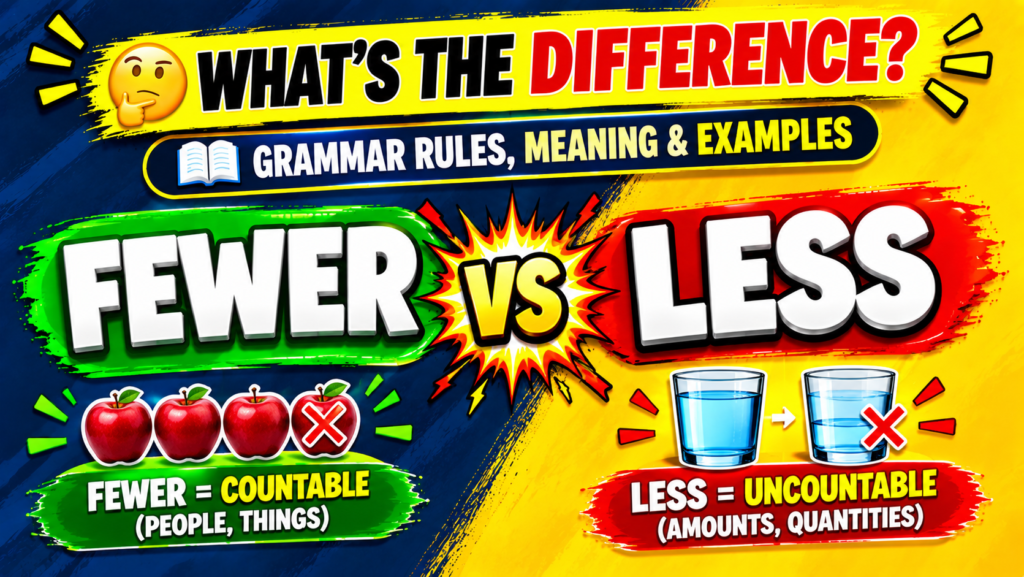
Have you ever typed “10 items or less” into a grocery list caption and paused, wondering if it should be “fewer”? 🛒 You’re not alone. Fewer vs less is one of the most commonly confused word pairs in the English language, and even professional writers slip up on it from time to time.
The good news? Once you understand one simple concept — countable nouns vs. uncountable nouns — you’ll never mix them up again. ✅
Quick Answer: Fewer vs Less
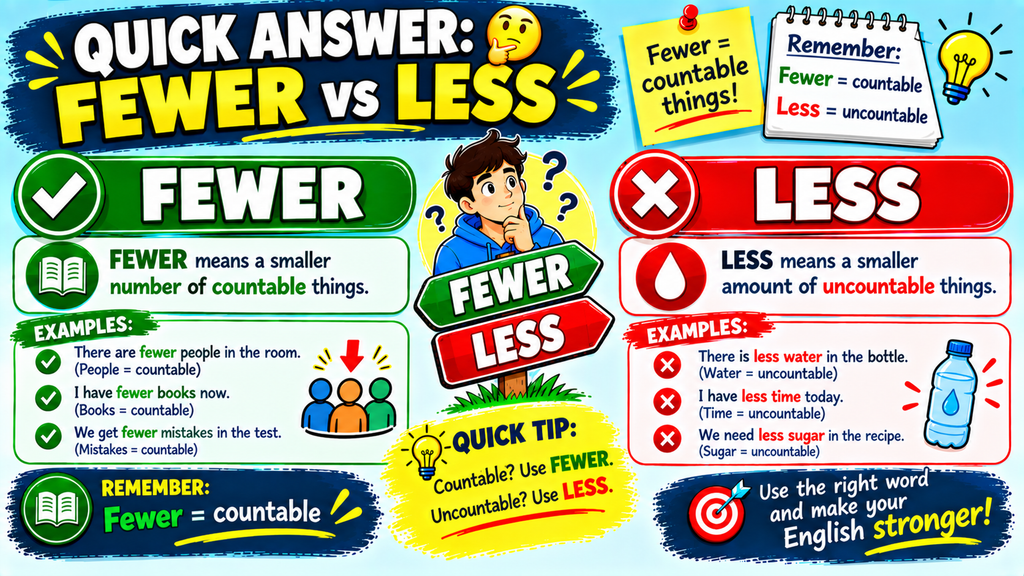
- Use fewer for things you can count individually (fewer apples, fewer cars, fewer people). 🍎
- Use less for things that are measured as a whole or bulk quantity (less water, less time, less money). 💧
- There’s one big exception: money, distance, weight, and time often pair with “less” even though they seem countable (less than $10, less than 5 miles). ⚠️
That’s the short version — now let’s break down exactly why this rule exists and how to apply it with confidence. 👇
Understanding the Basics of Fewer vs Less
The entire fewer/less debate comes down to noun type. English nouns fall into two broad categories, and knowing which bucket your noun belongs in tells you instantly which word to pick. 🧠
1. Countable Nouns (Use “Fewer”)
Countable nouns are things you can literally count one by one — 1 book, 2 books, 3 books. Because they have a plural form, they pair with fewer. 📚
Examples of countable nouns: books, cars, students, mistakes, emails, ideas.
2. Uncountable Nouns (Use “Less”)
Uncountable nouns (also called mass nouns) describe a substance, concept, or bulk quantity that doesn’t naturally break into separate units. These pair with less. 🌊
Examples of uncountable nouns: water, sugar, traffic, homework, information, patience.
Comparison Table: Fewer vs Less
| Feature | Fewer | Less |
|---|---|---|
| Noun type | Countable (plural) nouns | Uncountable (singular/mass) nouns |
| Meaning | Not as many | Not as much |
| Example noun | Books, cars, people | Water, money, time |
| Sample sentence | She has fewer books than I do. | She has less patience than I do. |
| Common exception | — | Money, time, distance, weight |
Correct Meanings & Uses
1. When to Use “Fewer”
“Fewer” is a comparative adjective that modifies plural, countable nouns. Think of it as answering the question “how many?” 🔢
Examples:
- There are fewer students in class today. 🎒
- I made fewer mistakes on this test than last time. ✏️
- We received fewer applications this year.
- Fewer than 20 people showed up to the meeting.
2. When to Use “Less”
“Less” modifies singular, uncountable nouns and answers the question “how much?” It’s about degree, bulk, or overall quantity rather than individual units. 📉
Examples:
- I have less energy today than yesterday. 😴
- There’s less traffic on Sundays. 🚗
- We need less stress in our lives.
- She spends less money on coffee now.
Important Modern Note:
Language evolves, and “less” is increasingly heard with countable nouns in casual speech (e.g., “less items”). Style guides and grammar purists still consider this incorrect in formal writing, so if you’re writing an email, resume, or report, stick to the traditional rule. 📌
Case Study: Real-Life Usage Example
Scenario: Office Email
Imagine a manager drafting a company-wide email about reducing meeting overload:
“This quarter, we’re aiming for less meetings and more focused work time.”
Explanation:
“Meetings” is a countable, plural noun — you can count 1 meeting, 2 meetings, 3 meetings. The correct version should read: “we’re aiming for fewer meetings…” 📧 This small fix instantly makes the email read as more polished and professional, which matters in workplace communication where credibility counts.
Grammar Rules Explanation
Core Rule:
Use fewer with plural countable nouns and less with singular uncountable (mass) nouns. That’s the entire foundation of the rule. 🎯
Why this rule exists:
English grammar draws a structural line between things that exist as separate, individual units (countable) and things that exist as an undivided whole (uncountable). “Fewer” logically applies to a reduced number of units, while “less” applies to a reduced amount or degree of a substance or concept.
Example:
- Countable: “I ate fewer cookies today.” (You can count cookies: 1, 2, 3.) 🍪
- Uncountable: “I ate less cake today.” (Cake as a substance isn’t counted in individual units unless you say “slices of cake.”)
Common Mistakes in Fewer vs Less
Why mistakes happen:
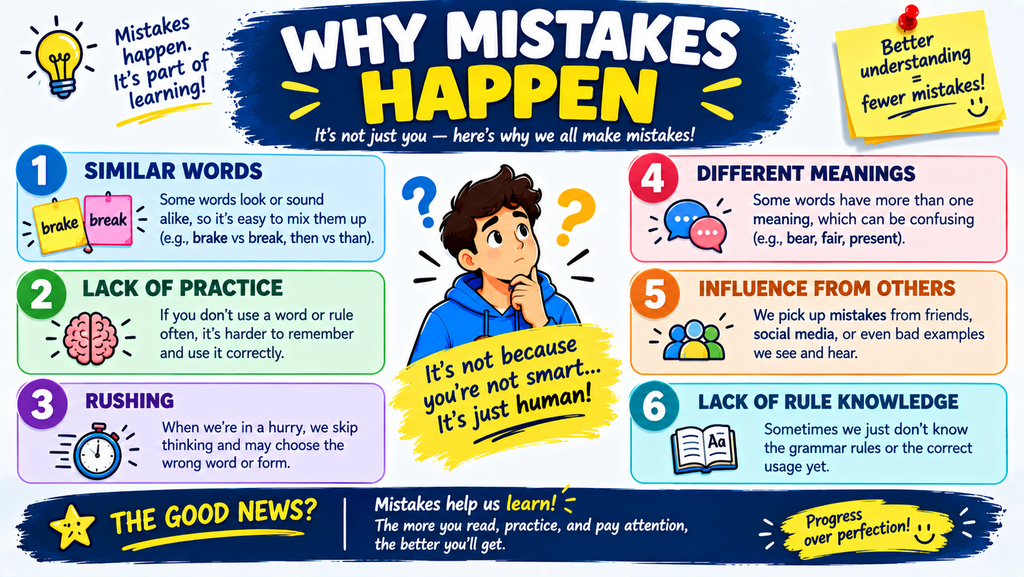
Many nouns feel countable in real life but grammatically function as uncountable (like “money” or “traffic”), which trips people up. Additionally, informal speech has normalized “less” in places where “fewer” is technically correct, so our ears get used to the wrong version. 👂
Common Confusion Table
| Incorrect ❌ | Correct ✅ | Why |
|---|---|---|
| I have less friends than you. | I have fewer friends than you. | “Friends” is countable |
| There are less calories in this snack. | There are fewer calories in this snack. | “Calories” is countable |
| She has fewer money than him. | She has less money than him. | “Money” is uncountable |
| We need fewer information. | We need less information. | “Information” is uncountable |
| 10 items or less | 10 items or fewer | “Items” is countable |
Additional Confusing Word Pairs:
- Amount vs. Number — use “amount” for uncountable nouns, “number” for countable nouns (same logic as less/fewer). 🔢
- Much vs. Many — “much” pairs with uncountable nouns, “many” pairs with countable nouns.
- Little vs. Few — “little” describes uncountable quantities, “few” describes countable quantities.
Usage in Different Contexts
1. Everyday Conversation
In casual speech, native speakers often say “less” for both countable and uncountable nouns, and it’s rarely corrected out loud. 🗣️ Example: “There were less people than I expected.”
2. Professional Writing
Reports, emails, resumes, and business documents should always follow the traditional fewer/less rule, since grammatical precision signals attention to detail. 💼
3. Creative Writing ✍️
Fiction and poetry sometimes bend the rule intentionally for rhythm, voice, or a character’s natural speech pattern — and that’s a valid stylistic choice, not an error.
4. Social Media/Texting
On platforms like Instagram or X, “less” is used loosely and casually, and audiences rarely notice or mind the swap. 📱
Why It Matters (Important)
Using fewer and less correctly isn’t just about sounding “proper” — it signals clarity, professionalism, and credibility, especially in resumes, business communication, academic writing, and published content. ✨ A small grammar slip can distract readers from your actual message.
Special Exception
Here’s where things get interesting: expressions involving money, time, distance, and weight often use “less” even though the nouns are technically countable, because we think of them as single bulk measurements rather than individual units. 💡
- Less than $50 (money) 💵
- Less than 10 minutes (time) ⏱️
- Less than 5 miles (distance) 🛣️
- Less than 150 pounds (weight) ⚖️
This is widely accepted in both formal and informal English, so you don’t need to force “fewer” into these phrases.
Quick Recap Checklist
- ✅ Countable noun (can be counted 1, 2, 3) → use fewer
- ✅ Uncountable/mass noun → use less
- ✅ Money, time, distance, weight → use less, even though technically countable
- ✅ Formal writing → always follow the traditional rule
- ✅ Casual speech → “less” is commonly heard, but not textbook-correct
Practice Examples:
- There are __________ (fewer/less) cars on the road today.
- I have __________ (fewer/less) confidence than before.
- She earns __________ (fewer/less) than $40,000 a year.
- We had __________ (fewer/less) problems this month.
- Please use __________ (fewer/less) plastic bags.
(Answers: 1. fewer, 2. less, 3. less, 4. fewer, 5. fewer)
Frequently Asked Questions: Fewer vs Less
Is it “10 items or less” or “10 items or fewer”?
Grammatically, it should be “10 items or fewer” since “items” is a countable noun, though many stores still use “less” informally. 🛒
Can “less” ever be correct with countable nouns?
Yes — with money, time, distance, and weight, “less” is standard even though the nouns are countable (e.g., “less than 3 miles”). 💡
What’s the easiest way to remember the rule?
Ask yourself “can I count it one by one?” If yes, use fewer; if no, use less. 🧠
Is using “less” instead of “fewer” a serious grammar mistake?
In casual conversation it’s barely noticed, but in formal or professional writing it’s considered incorrect and worth fixing. ✍️
Are “amount” and “number” governed by the same rule?
Yes — “number” pairs with countable nouns and “amount” pairs with uncountable nouns, just like fewer and less. 🔢
Why do so many native speakers get this wrong?
Because “less” has crept into everyday speech for both noun types, our ears have grown used to hearing it, even where “fewer” is technically correct. 👂
