

If you’ve ever paused mid-sentence wondering whether to write “the lake froze” or “the lake has frozen,” you’re not alone. 🤔 These two words come from the same irregular verb, but they play very different grammatical roles. Get them mixed up, and your writing can sound off even if the meaning is technically clear. This guide breaks down exactly when to use froze and when to use frozen, with simple rules, real examples, and a few common mistakes to avoid. ❄️
Quick Answer: Froze vs Frozen
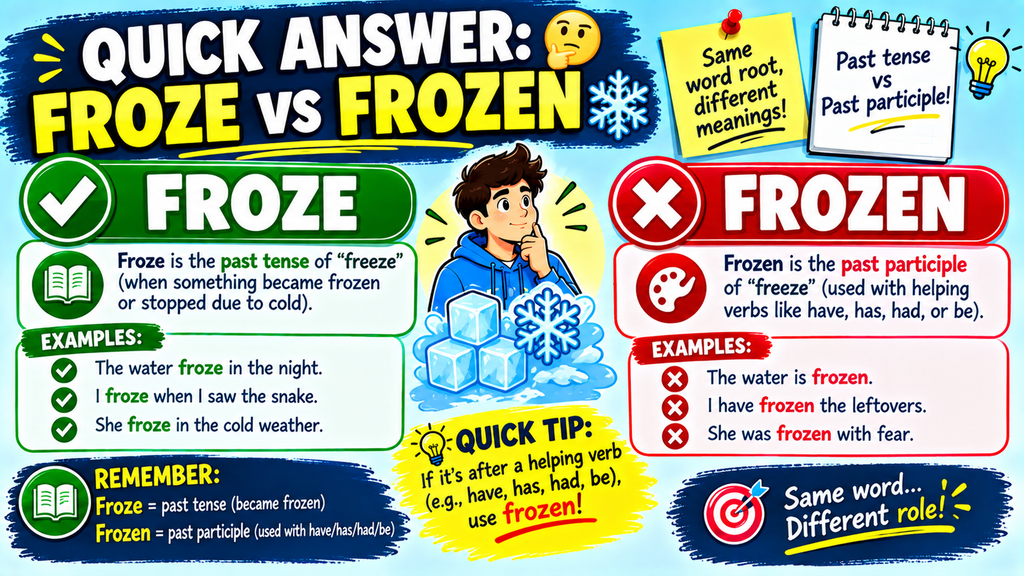
Here’s the short version before we go deeper. 👇
- Froze is the simple past tense of “freeze” — used alone to describe a completed action. ✅
- Frozen is the past participle — used with helping verbs like has, have, had, was, or is, and also as an adjective. ✅
Example: “The pipes froze last night, and now they’re frozen solid.” ❄️
Understanding the Basics of Froze vs Frozen
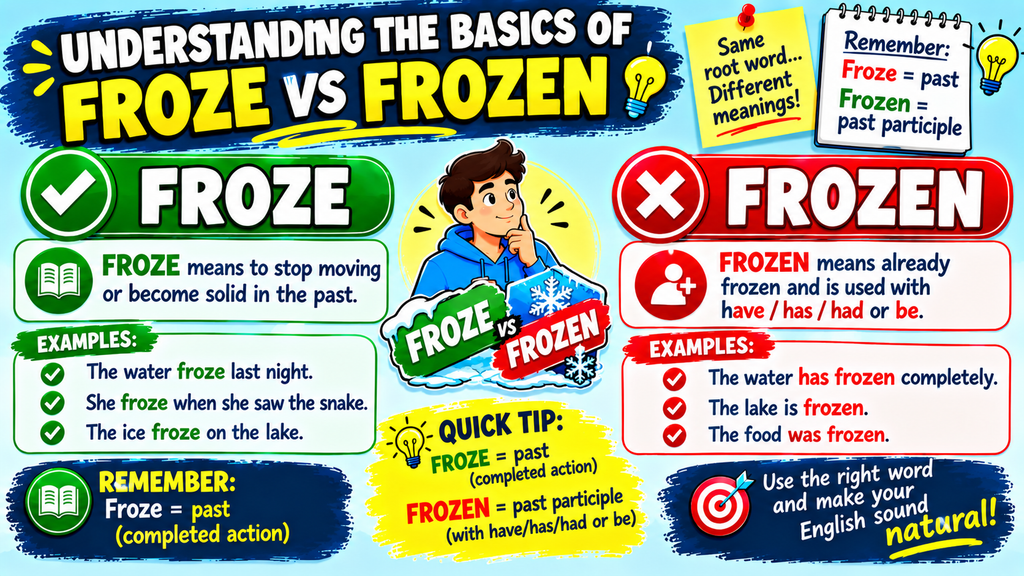
To really lock this in, it helps to see all three forms of the verb together. 📚
1. Freeze (Base Form)
This is the infinitive or present-tense form. It’s the version you’d find in a dictionary. 🧊
- Water will freeze at zero degrees Celsius.
- Please freeze the leftovers.
2. Froze (Past Simple)
This form stands alone and needs no helping verb. It describes a completed action in the past. ⏳
- She froze when she heard the noise.
- The lake froze overnight.
3. Frozen (Past Participle / Adjective)
This form always needs support — either a helping verb (has, have, had, is, was) or it functions as a descriptive adjective before a noun. 🧊
- The ground has frozen solid.
- I bought some frozen vegetables.
Comparison Table: Froze vs Frozen
| Feature | Froze | Frozen |
|---|---|---|
| Word type | Simple past verb | Past participle / adjective |
| Needs helper verb? | No ❌ | Yes (has/have/had/is/was) ✅ |
| Used in tense | Past simple | Present/past perfect, passive voice |
| Can act as adjective? | No | Yes ✅ |
| Example | He froze in fear. | He was frozen in fear. |
Correct Meanings & Uses
1. Using “Froze” (Simple Past)
Use froze when describing a single, completed past action with no auxiliary verb attached. 📝
- The company froze all new hiring last quarter.
- My laptop froze during the meeting.
2. Using “Frozen” (Past Participle / Adjective)
Use frozen whenever a helping verb comes before it, or when it’s describing a noun directly. 🧊
- All hiring has been frozen since March. (present perfect passive)
- We ordered a frozen pizza. (adjective)
Case Study: Real-Life Usage Example
Workplace Email Example
Imagine two coworkers writing about the same budget issue: 💼
- ❌ “Our budget has froze for this quarter.”
- ✅ “Our budget has frozen for this quarter.”
Why?
Because “has” is a helping verb, it demands the past participle — frozen — not the simple past form. 🎯 This tiny swap is one of the most common grammar slips in professional writing.
Grammar Rules Behind Froze vs Frozen
Rule 1: Froze = Simple Past Verb
Froze stands on its own in a sentence and never pairs with “has,” “have,” or “had.” 📌
Rule 2: Frozen = Past Participle
Frozen must follow a form of “have” (has/have/had) or “be” (is/was/were/been) to form perfect or passive tenses. 📌
Rule 3: Frozen = Adjective
Frozen can sit directly in front of a noun to describe it, just like any regular adjective. 📌
Common Mistakes with Froze vs Frozen
- ❌ I have froze the chicken. → ✅ I have frozen the chicken. 🚫
- ❌ The screen was froze. → ✅ The screen was frozen. 🚫
- ❌ Freezed is never a correct word — “freeze” is irregular. 🚫
Common Confusion Table
| Incorrect ❌ | Correct ✅ | Reason |
|---|---|---|
| I have froze | I have frozen | “have” needs past participle |
| It was froze | It was frozen | passive voice needs past participle |
| She freezed | She froze | “freeze” has no -ed form |
| I have frozen it yesterday | I froze it yesterday | simple past for specific past time |
Usage in Different Contexts
1. Everyday Conversation
Spoken English often leans on simple past for quick storytelling. 🗣️ “I froze when I saw him.”
2. Professional Writing
Formal documents frequently use perfect tenses, so frozen shows up more often here. 📄 “Accounts have been frozen pending review.”
3. Creative Writing ✍️
Writers use both forms to control pacing and tone. “Time froze. The world stood frozen around her.” 🎭
4. Social Media Texting
Casual, shorthand posts usually favor froze for quick updates. 📱 “omg my phone just froze lol.”
Why It Matters (Important Section)
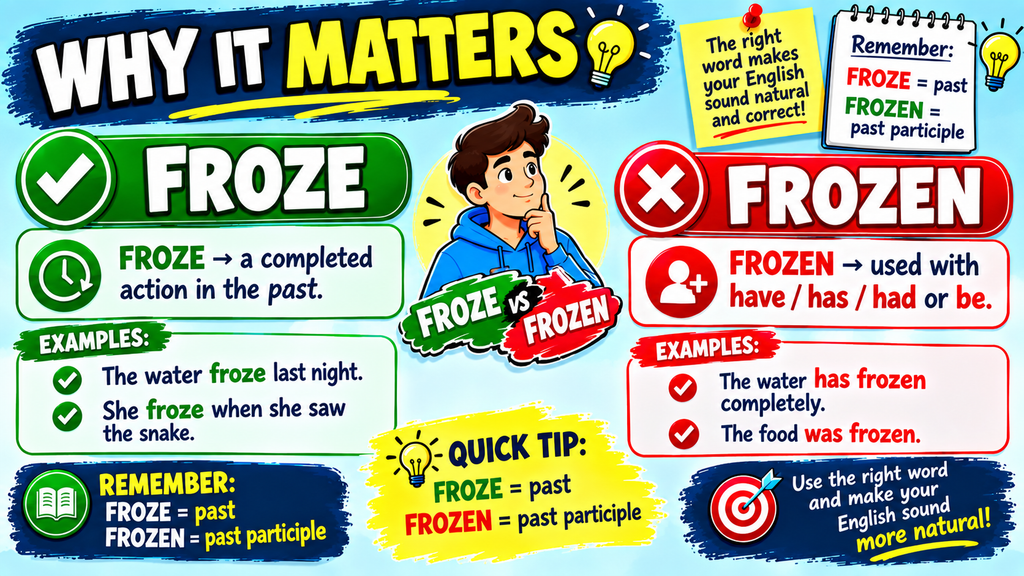
Getting froze and frozen right isn’t just about sounding “correct” — it affects clarity and credibility. ✨ In business emails, resumes, or reports, a misused verb form can make writing look careless, even when the ideas are strong. 💡
Special Exception Section
In some informal or regional dialects, “froze” is used colloquially as a past participle (e.g., “I was froze stiff”). 🌍 This is considered nonstandard in formal English, though it does appear historically and in casual speech. Stick to “frozen” in writing that needs to look polished. ✅
Quick Recap Checklist
- ✅ Use froze alone, with no helping verb.
- ✅ Use frozen after has/have/had/is/was/were.
- ✅ Use frozen as an adjective before a noun.
- ✅ Never write “freezed.”
- ✅ When in doubt, ask: “Is there a helper verb nearby?” If yes → frozen. 🎯
Practice Examples
Try filling in the blanks before checking the answers. 📝
- The river ___ completely by January. (froze)
- She has ___ all communication with them. (frozen)
- We found some ___ berries in the freezer. (frozen)
- He ___ in place when the alarm went off. (froze)
- The funds were ___ during the investigation. (frozen)
Frequently Asked Questions
Is “froze” or “frozen” correct after “have”?
Frozen is correct after “have,” as in “I have frozen the soup.” 📌
Can “frozen” be used without a helping verb?
Yes but only as an adjective, like “frozen lake,” not as a stand-alone past-tense verb. ❄️
Is “freezed” ever correct?
No, “freezed” is not a standard English word; “freeze” is irregular. 🚫
What tense uses “froze”?
Froze is used in the simple past tense to describe a completed action. ⏳
Why do people confuse froze and frozen?
Because both come from the same verb and sound similar, but they follow different grammatical rules for helper verbs. 🤔
Is “frozen” always an adjective?
No it can be an adjective (“frozen food”) or a past participle in perfect/passive tenses (“has frozen”). 📚
Conclusion
Froze and frozen may share the same root, but they serve very different jobs in a sentence. 🎯 Froze stands alone to mark a finished past action, while frozen always needs a partner — either a helping verb or a noun to describe. Once you remember that simple pairing rule, you’ll never second-guess this verb again. ❄️✅
