

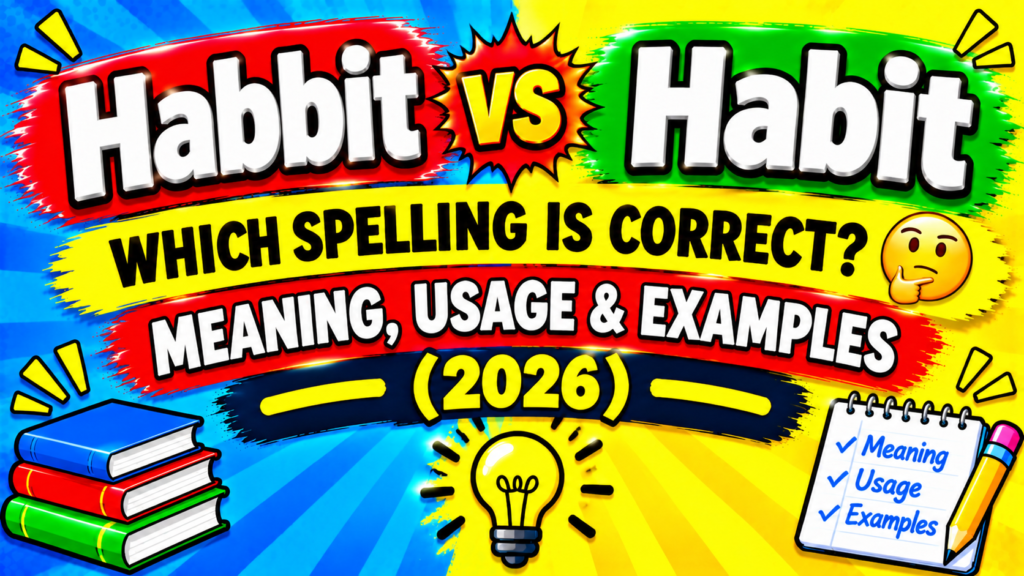
Habbit vs Habit: which one is right? 🤔 Many people get confused by habbit vs habit when they write fast. ⚡ The correct spelling is “habit” with one B. ✅ In this guide, you will learn the meaning, pronunciation, examples, idioms, and easy memory tricks. 📚
Habbit or Habit: Which One Is Correct?
“Habit” is the correct spelling. “Habbit” is a common misspelling and is never correct in standard English. ✅ The real word has five letters and just one B. ✍️ Major dictionaries such as Merriam-Webster and Oxford list only “habit.” 📚
| Feature | Habbit | Habit |
|---|---|---|
| Correct spelling? | ❌ No | ✅ Yes |
| Number of letters | 6 | 5 |
| Number of B’s | 2 | 1 |
| Found in dictionaries? | No | Yes |
| Example | He has a bad habbit. ❌ | He has a bad habit. ✅ |
What Does Habit Mean?

A habit is a behavior you repeat so often that you do it almost without thinking. 🔁 Dictionaries describe it as a settled tendency or a usual way of behaving. 📖 Brushing your teeth, checking your phone, and biting your nails are all habits. 🪥
Habit Meaning in Everyday English
In daily conversation, habit simply means “something you do again and again.” 💬 It can be good, bad, or totally neutral. ⚖️ Here are a few quick examples:
- She has a habit of drinking water first thing in the morning. 💧
- Skipping breakfast is a bad habit. 🍳
- He still checks the lock twice out of habit. 🔒
Why Is Habit the Correct Spelling?
The word comes from the Latin habitus, meaning condition, appearance, or dress. 🏛️ That Latin word comes from habēre, “to have” or “to hold.” 🤲 English borrowed it through Old French, and the modern spelling keeps just one B. 🇫🇷 Wikipedia even lists “habbit” among its common misspellings of “habit.” 📝
H A B I T
Spell it out slowly: H-A-B-I-T. ✍️ That’s five letters and two syllables: HAB-it. 🗣️ There’s only one B, so there’s nothing to double. ☝️
H A B B I T
Now try H-A-B-B-I-T. 🧐 That’s six letters, and it isn’t a real word. 🚫 The extra B likely sneaks in because “habit” rhymes with “rabbit,” and English has plenty of double-B words like “hobby.” 🐇
Pronunciation of Habit
Habit is pronounced HAB-it, with the stress on the first syllable. 🔊 In phonetic spelling, it’s written /ˈhæbɪt/. 🗣️ The first part rhymes with “cab.” 🚕
- Syllables: hab-it (2) 🔢
- Stress: first syllable 💡
- Rhymes with: rabbit 🐰
Part of Speech of Habit
Habit is mainly a noun. 📌 It can be countable (“a bad habit”) or uncountable (“by force of habit”). 🔢 The plural is habits. ➕ It also has a rare, literary use as a verb meaning “to clothe.” 👗
| Word | Part of Speech | Example |
|---|---|---|
| habit | noun | Reading daily is a great habit. 📖 |
| habits | plural noun | Her study habits are excellent. 🎓 |
| habitual | adjective | He is a habitual early riser. 🌅 |
| habitually | adverb | She habitually arrives ten minutes early. ⏰ |
| habituate | verb | It takes time to habituate yourself to change. 🔄 |
How to Use Habit in a Sentence
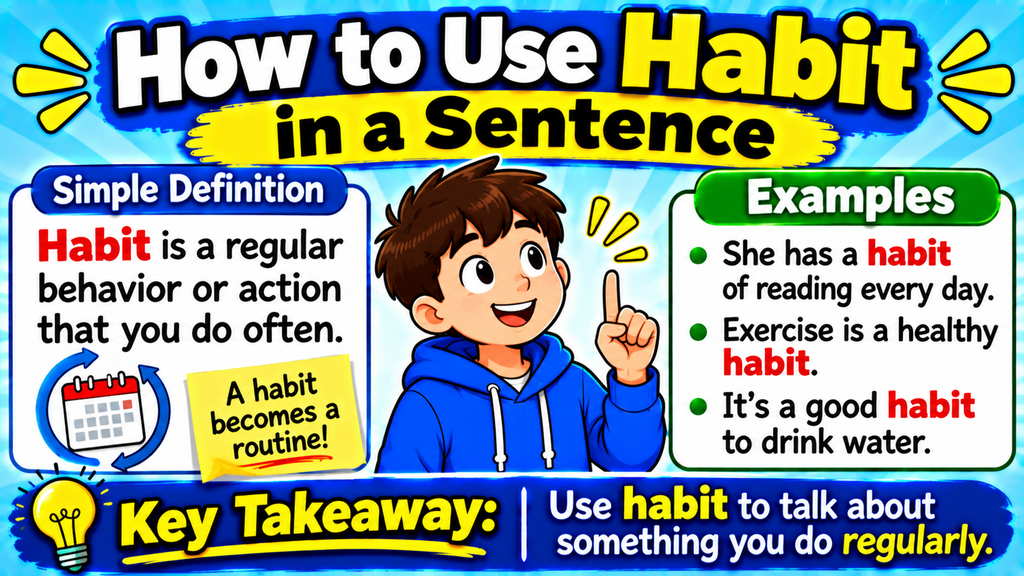
Habit shows up in a few fixed patterns. 🧩 Learn these four, and you’ll sound natural in no time. 🎯
Have a Habit of Doing Something
Use “have a habit of” plus a verb ending in -ing. ✅ It describes something a person does often, usually with a hint of judgment. 😏
- My brother has a habit of forgetting his keys. 🔑
- She has a habit of arriving early. ⏰
Get Into the Habit of Doing Something
This phrase means to start doing something regularly until it feels normal. 🌱 You’ll also hear “fall into the habit of” and “be in the habit of.” 🔄
- Get into the habit of reading before bed. 📖
- I’m in the habit of walking after dinner. 🚶
Break a Habit
To break a habit means to stop doing something you do regularly. ✂️ People also say “kick a habit” or “drop a habit.” 🦵
- It took him months to break the habit of snoozing his alarm. ⏰
- Cutting back on sugar is a tough habit to break. 🍬
Make a Habit of Something
This means to do something regularly on purpose. 💪 As a warning, “don’t make a habit of it” means “don’t do this too often.” ⚠️
- Make a habit of stretching every morning. 🧘
- You’re late again, so don’t make a habit of it. 😬
Different Types of Habits
Not all habits are equal, and the table below shows the main kinds. 📊
| Type | Meaning | Example |
|---|---|---|
| Good habits | Positive actions that help you | Drinking water daily 💧 |
| Bad habits | Behaviors that hurt your health, time, or relationships | Procrastinating 😴 |
| Daily habits | Small actions repeated every day | Making your bed 🛏️ |
| Personal habits | Individual quirks and hygiene | Humming while cooking 🎶 |
Good Habits
Good habits support your health, goals, or happiness. 🌟 Think regular exercise, early bedtimes, and saving money. 💰
Bad Habits
Bad habits work against you over time. 🚫 Nail-biting, mindless snacking, and putting things off are common examples. 🍿
Daily Habits
Daily habits are tiny actions you repeat every single day. 📅 They quietly shape your mood and productivity. ☀️
Personal Habits
Personal habits are the quirks that make you, well, you. 🙂 They range from hygiene to the way you drink your coffee. ☕
Common Expressions and Idioms With Habit
English loves habit idioms. 🗨️ Here are the three you’ll hear most.
Out of Habit
This means doing something automatically because you always do it. 🤖 Example: “I reached for my phone out of habit.” 📱
Force of Habit
This is similar, but it stresses the pull of long repetition. 🔁 Example: “I woke up at 6 a.m. by force of habit, even on vacation.” 🏖️
Creature of Habit
A creature of habit is someone who likes doing things the same way every time. 🐾 Example: “I’m a creature of habit, so I order the same latte daily.” ☕ One bonus saying is “old habits die hard,” which means some habits are tough to change. 💥
Habit in Different Contexts
The word changes flavor depending on where you use it. 🎭
Habit in Education
Teachers talk about study habits, reading habits, and homework habits. 🎓 Steady daily practice usually helps students more than last-minute cramming. 📝
Habit in Health and Fitness
Eating habits, sleep habits, and exercise habits are core wellness phrases. 🥗 Many people use a habit tracker to stay consistent. 📲
Habit in the Workplace
Work habits include time management, email checking, and meeting etiquette. 💼 Good ones build trust with your team. 🤝
Habit in Everyday Conversations
In casual talk, people say “It’s a habit of mine” or “Sorry, bad habit.” 😄 The tone is usually light and friendly. 🙌
Other Meanings of Habit
Habit isn’t only about behavior. 🔎 It can also mean clothing, addiction, and even the way a plant grows. 🌿
Habit as Clothing
Clothing is actually the oldest English meaning of habit. 👗 Today it survives in phrases like “a nun’s habit” and “a riding habit,” the outfit worn for horseback riding. 🐎
Habit as an Addiction
In informal English, habit can mean addiction, as in “a smoking habit.” 🚬 This sense goes back to the 19th century. 📜 Use it with care, because addiction is a serious matter. 💙
Synonyms and Related Words for Habit
These words are close to habit, but each has a slightly different feel. 🧠
| Word | Slight Difference |
|---|---|
| Routine | A planned sequence of actions 📋 |
| Custom | A practice shared by a group or society 🌍 |
| Practice | Done regularly, usually by choice 🎯 |
| Tendency | A leaning toward a behavior 🧭 |
| Pattern | A repeated way of acting 🔁 |
| Second nature | So natural it feels automatic 😎 |
| Wont | Formal, literary word for usual manner 🕰️ |
Related forms include habitual, habitually, and habit-forming. 🧩
Are There Antonyms for Habit?
Habit has no single perfect opposite. 🤷 Still, a few words capture the opposite idea: spontaneity, impulse, novelty, irregularity, and variation. 🔀 For example, “She skipped her usual coffee and acted on impulse.” ☕
Common Mistakes When Using Habit
Most errors are small, and all are easy to fix. 🛠️
Adding an Extra B
Write “habit,” never “habbit.” ✅ Also, don’t mix it up with “hobbit,” the fantasy creature, or “hobby,” a fun pastime. 🧙
Using the Wrong Article
The H is pronounced, so say “a habit,” not “an habit.” 🅰️ This one trips up many learners. 🌎
Forgetting the Plural Form
Add an -s when you mean more than one: “Her eating habits have improved.” 🥦 Skip the apostrophe, because “habit’s” shows possession, not a plural. ✍️
Confusing Habit With Routine
A habit is automatic, while a routine is planned. 🔁 Your morning routine may include yoga, but reaching for your phone is a habit. 📱
Using Habit Without a Clear Meaning
“I have a habit” sounds unfinished. 🤔 Say what it is: “I have a habit of checking email too often.” 📧 Also remember that a one-time action isn’t a habit. 1️⃣
How to Remember the Correct Spelling of Habit
Try these quick tricks until the spelling sticks. 🧲
- Think “bit.” A habit is built one little bit at a time, and the word ends in -bit. 🧩
- Count to five. H-A-B-I-T has five letters and only one B. ✋
- Link it to “have.” Both start with “ha,” and habit comes from the Latin word for “to have.” 🤲
- Don’t trust the rhyme. “Rabbit” has a double B, but “habit” doesn’t. 🐰
- Write it three times. Muscle memory is, fittingly, a habit. ✍️
Frequently Asked Questions
Is it habbit or habit?
The correct spelling is habit. ✅ “Habbit” is a common misspelling. ❌
Is “habbit” ever correct?
No, “habbit” is not a word in standard English. 🚫 Always use a single B. ☝️
What is the plural of habit?
The plural is habits. ➕ “Habbits” is also incorrect. ❌
What is the difference between habit and routine?
A habit is an automatic behavior, while a routine is a planned set of actions. 🔁 A routine can contain several habits. 📋
What does “creature of habit” mean?
It describes someone who prefers to do things the same way every time. 🐾 Think of a person who orders the same meal at the same café. ☕
Is habit a noun or a verb?
Habit is mostly a noun. 📌 It has a rare, literary verb use meaning “to clothe.” 👗
Why do people misspell habit as habbit?
It rhymes with “rabbit,” so the double B feels natural. 🐰 Many English words also double the B, which adds to the confusion. 🤯
What is a habit in a nun’s outfit?
It’s the long garment worn by nuns and monks. 🙏 This is the oldest meaning of the word in English. 👗
Conclusion
So, which is right: habbit or habit? 🤔 It’s always habit, with one B and five letters. ✅ Now you know what it means, how to say it, how to use it in sentences, and which idioms to try. 🎉 Keep the “bit” trick in mind, and you’ll never write “habbit” again. 💡 Bookmark this guide and share it with a friend who still doubts their spelling. 🔖
