

You are halfway through an email when you suddenly stop. 🤔 Is it “she has run the report” or “she has ran the report”? 📧 Many confident writers pause at this exact spot. 😅 The answer is short, and the reason behind it is easy to remember. 💡 This guide covers the rule, the meaning, common mistakes, and practice sentences you can try right now. ✍️
Quick Answer: Has Run vs Has Ran
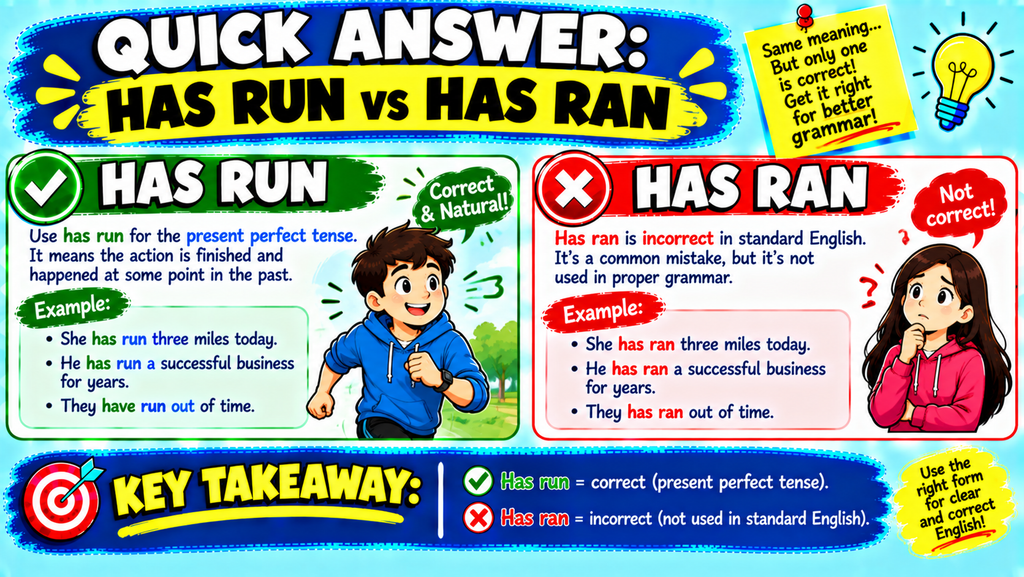
“Has run” is correct. “Has ran” is incorrect. ✅ “Run” is the past participle of the verb “run,” and the present perfect tense needs a past participle after “has” or “have.” 📌 “Ran” belongs only to the simple past, as in “She ran yesterday.” 🏃♀️
| Phrase | Correct? | Example |
|---|---|---|
| has run | ✅ Yes | She has run five miles. |
| has ran | ❌ No | She has ran five miles. |
| ran (alone) | ✅ Yes | She ran five miles yesterday. |
Understanding the Basics of Has Run vs Has Ran
“Run” is an irregular verb. 🧩 It does not add “-ed” to form the past, so you have to memorize its forms. 🧠 Here they are:
| Verb form | Word | Example |
|---|---|---|
| Base form | run | I run every morning. |
| Third person | runs | She runs every morning. |
| Present participle | running | He is running now. |
| Simple past | ran | They ran last week. |
| Past participle | run | We have run twice. |
Notice that the base form and the past participle look identical. 👀 That overlap is why “ran” feels tempting after a helping verb. 🤷
Simple Rule
- If there is a helping verb (has, have, or had), use run. ✅
- If there is no helping verb and the action finished in the past, use ran. ✅
The short version is has/have/had + run, never has/have/had + ran. 🔑
Correct Meanings and Uses
Using “Has Run” Correctly
“Has run” is the present perfect tense. ⏳ It links a past action to the present moment. 🔗 Use “has” with he, she, it, and singular nouns, and use “have” with I, you, we, and they. 👥 Reach for it when:
- The action started earlier and continues now: “He has run this shop for ten years.” 🏪
- The exact time is unknown or unimportant: “She has run a marathon.” 🏅
- The result still matters today: “The tap has run all night, so the floor is wet.” 💧
- You are describing life experience: “My brother has run in three countries.” 🌍
Examples
- She has run the same route every day this week. 🌅
- The software has run without errors since Monday. 💻
- The company has run a sale every spring. 🛍️
- Her nose has run all morning, so she stayed home. 🤧
Test Tip
Swap “run” with “gone.” 🔄 You would never say “has went,” so you should not say “has ran.” 🚫 It is the same pattern with the same fix. 🔧
Why “Has Ran” Is Incorrect
“Has ran” mixes two forms that do not belong together. 🧪 The word “has” asks for a past participle, but “ran” is the simple past form. ⚠️ Standard English treats “has went,” “has sang,” and “has began” as errors for the very same reason. ❌ The fix is always to switch to the participle. ✅
Test Tip
Look for a helping verb first. 👀 If you see “has,” “have,” or “had,” use run. ✅ If you can add a finished time like “yesterday” or “last year” and there is no helping verb, use ran. 📆
Case Study Section
Workplace Email Example
Here is an illustrative scenario. 📋 A project manager sends a quick update to the team. 📨
Before: “The team has ran the report three times, and the system has ran into errors again.” ❌
After: “The team has run the report three times, and the system has run into errors again.” ✅
The meaning survives either way. 👍 But the small slip makes a careful reader pause. 🧐 A grammar checker, or the simple rule above, would have caught it in seconds. ⚡
Why It Matters
In professional emails, tiny verb errors can quietly weaken trust. 🤝 Readers may not say anything, yet they notice. 👓 Clean grammar lets your message take center stage instead of your mistake. 🎯
Grammar Rules Explanation
The present perfect formula is subject + has/have + past participle. 🧮 For “run,” the past participle is always “run.” 🏃
| Tense | Structure | Example |
|---|---|---|
| Simple past | ran | She ran home. |
| Present perfect | has/have run | She has run home. |
| Past perfect | had run | She had run home before it rained. |
| Future perfect | will have run | She will have run home by six. |
| Passive voice | was/were run | The store was run by two sisters. |
The same participle appears in the passive voice, so “was ran” is wrong too. 🚫 After any form of “have” or “be,” the correct choice is “run.” 🔁
Common Mistakes
| Incorrect ❌ | Correct ✅ |
|---|---|
| She has ran a marathon. | She has run a marathon. |
| I had ran out of milk. | I had run out of milk. |
| They have ran the numbers. | They have run the numbers. |
| The test was ran twice. | The test was run twice. |
| He has run yesterday. | He ran yesterday. |
The last row is the reverse error. 🔄 The present perfect does not pair with a finished time like “yesterday.” 📅
Why Do People Make This Mistake?
1. Fast Typing
When you type quickly, you grab the first form that comes to mind. ⌨️ “Ran” is common, so it slips in easily. 💨
2. Autocorrect Issues
Autocorrect mostly fixes spelling, not verb tense. 📱 “Has ran” is spelled correctly, so many basic tools skip it. 🤖 A dedicated grammar checker is more likely to flag it. 🔍
3. Lack of Grammar Knowledge
Past participles are rarely taught in a way that sticks. 📚 Without the rule, many writers go by what “sounds right.” 👂
4. Regional Speech Habits
In some dialects and casual speech, people use the simple past where standard writing expects the participle. 🗣️ That is natural variation in spoken language, not a sign of poor intelligence. 💬 Still, formal and professional writing calls for “has run.” 📝
Similar Grammar Confusions
“Run” is not alone. 👥 Many irregular verbs use one form for the simple past and another for the past participle. 🔀
| Base verb | Simple past | Past participle | Correct example |
|---|---|---|---|
| begin | began | begun | She has begun. |
| sing | sang | sung | He has sung. |
| swim | swam | swum | They have swum. |
| go | went | gone | We have gone. |
| see | saw | seen | You have seen. |
| run | ran | run | She has run. |
Verbs like “come” and “become” follow the same pattern as “run,” so “has come” and “has become” are correct. 🧭
Usage in Different Contexts
Everyday Conversation
Spoken English is relaxed, and slips happen. 😊 Still, “has run” sounds natural and polished when you say it out loud. 🎙️
Professional Writing
Reports, emails, and résumés demand accuracy. 💼 Writing “has run campaigns” or “have run projects” keeps your achievements clear and credible. 📈
Creative Writing
Fiction gives you more freedom. 🎨 You may use “has ran” inside dialogue to show a character’s voice, but keep the narration standard. 📖
Social Media and Texting
Short posts feel casual, yet public posts are read by many people. 🌍 A quick proofread keeps your message sharp. ✨
Why It Matters
Clarity in Communication
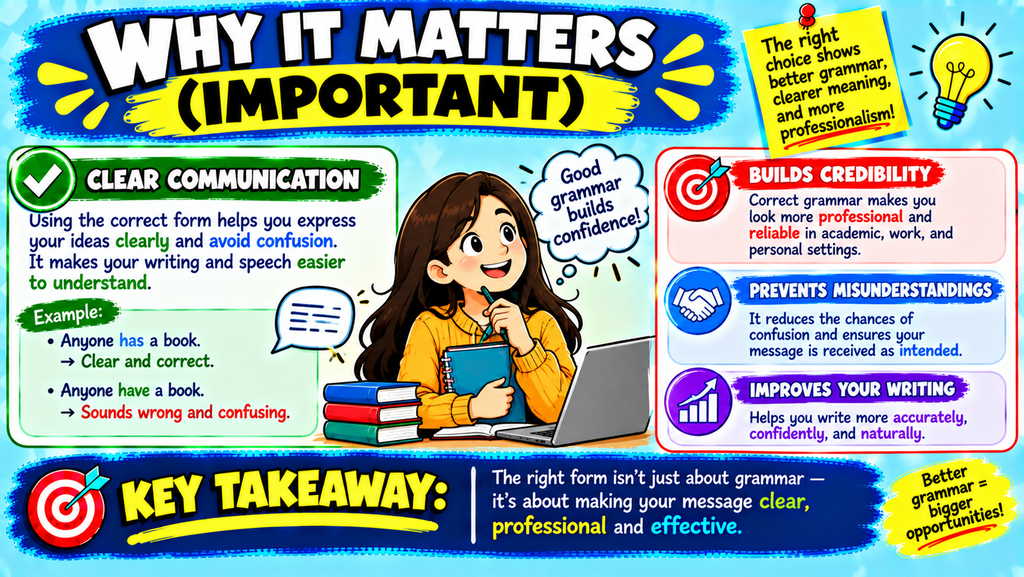
The right verb form tells the reader exactly how the past connects to now. 🕒 That keeps your meaning clean and easy to follow. 🧭
Professionalism
Accurate grammar signals care and attention to detail. 🧐 Clients, managers, and hiring teams often judge you by it. 💼
Writing Accuracy
One consistent rule is easier than guessing each time. 🎯 Once “has run” becomes automatic, your writing speeds up. 🚀
Better First Impressions
Your first email, post, or cover letter sets the tone. ✉️ A clean sentence helps readers trust you before they know you. 🤝
Quote
Good grammar will not make an idea brilliant, but it keeps a brilliant idea easy to hear. 🎤
Special Exception
Are There Any Exceptions?
In standard English, no. ❌ Dictionaries and grammar guides list “run” as the past participle and treat “has ran” as non-standard. 📖 You may still hear it in casual speech or see it in dialogue, where it shows a character’s voice rather than a grammar rule. 🎭
Quick Recap Checklist
- ✅ “Run” is the past participle, so write “has run,” “have run,” and “had run.”
- ✅ “Ran” is the simple past, so use it alone for finished past actions.
- ✅ Passive voice also needs “run,” as in “was run.”
- ✅ Never pair “has,” “have,” or “had” with “ran.”
- ✅ Do not pair “has run” with “yesterday” or other finished times.
Which One Should You Use?
| Situation | Use | Example |
|---|---|---|
| Helping verb present (has, have, had) | run | She has run the test. |
| Finished action with a past time word | ran | She ran the test yesterday. |
| Passive voice | run | The test was run twice. |
| Present tense | run / runs | She runs the test daily. |
Practice Examples
Example 1
Choose the correct word: “She has ___ the same route all week.” (run / ran) 🤓 Answer: run. ✅ The word “has” needs a past participle. 📌
Example 2
Choose the correct word: “Yesterday, he ___ to the station.” (run / ran) 🚉 Answer: ran. ✅ There is no helping verb, and the time is finished. ⏱️
Example 3
Choose the correct word: “By the time we arrived, the bus had already ___.” (run / ran) 🚌 Answer: run. ✅ The word “had” also needs the participle. 🔑
Frequently Asked Questions About Has Run vs Has Ran
Is it “has run” or “has ran”?
“Has run” is correct. ✅ “Has ran” is a common error. ❌
What is the past participle of run?
The past participle of “run” is “run.” 🏃 You use it after “has,” “have,” “had,” and forms of “be.” 🔁
Is “has ran” ever correct?
Not in standard English. 🚫 It may appear in dialogue to show how a character speaks. 🎭
What is the difference between “ran” and “has run”?
“Ran” is the simple past for a finished action at a past time. ⏱️ “Has run” is the present perfect and links the action to now. 🔗
Is “I have ran” correct?
No, the correct form is “I have run.” ✅ “Have” needs the past participle. 📌
Is “had ran” correct?
No, say “had run.” ✅ The past perfect also uses the past participle. 🔑
Is “was ran” correct in passive sentences?
No, use “was run,” as in “The event was run by volunteers.” ✅ The passive voice needs the past participle. 📌
Why does “has ran” sound right to some people?
Because “ran” is so common as the simple past. 👂 Familiarity can make the wrong form feel natural. 🤷
Conclusion
The rule is simple. ✅ Use “has run” whenever “has,” “have,” or “had” appears, and save “ran” for the simple past. 🏃 If you ever doubt yourself, try the “has went” test or add a time word to check. 🔍 A little practice will make the right form feel automatic. 🚀 Bookmark this guide, share it with a friend who keeps typing “has ran,” and write with confidence. 💪
