

“Here is the files” or “here are the files”? If you’ve typed this and then deleted it three times, you’re not alone. This tiny grammar rule trips up native speakers and learners alike. Let’s fix it for good, with simple rules and real examples. 📝
Quick Answer: Here Is or Here Are
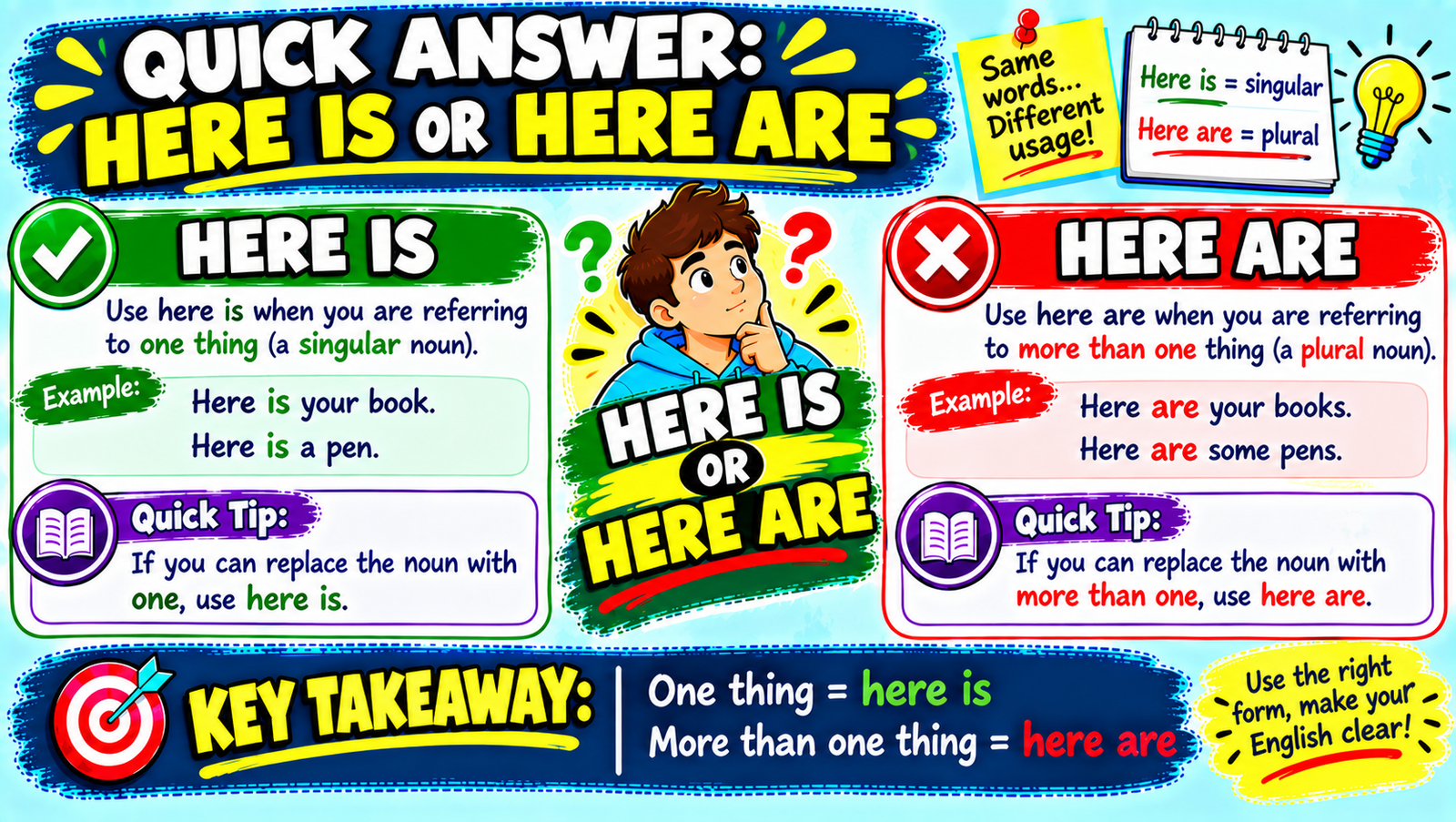
Both are correct it depends on whether the noun after it is singular or plural. ✅
Examples:
- Here is the book you asked for. (singular)
- Here are the books you asked for. (plural)
Understanding the Basics of Here Is or Here Are
“Here” doesn’t change the rule of subject-verb agreement it just flips the sentence order. The real subject comes after “is” or “are,” not before it. So the noun following the phrase decides which verb you use. 🎯
Comparison Table
| Phrase | Used With | Example |
|---|---|---|
| Here is | Singular noun / uncountable noun | Here is your coffee. |
| Here are | Plural noun | Here are your keys. |
| Here’s | Informal contraction of “here is” | Here’s your coffee. |
Correct Meanings and Uses
Using “Here Is” Correctly
Examples:
- Here is the report you requested.
- Here is my address.
Sentence Breakdown: “Here is” + singular noun (report, address). The verb “is” matches one item, not many.
Test Tip: Replace the noun with “it.” If “it” fits naturally, use “here is.” 💡
Using “Here Are” Correctly
Examples:
- Here are the documents you needed.
- Here are some snacks for the trip.
Sentence Breakdown: “Here are” + plural noun (documents, snacks). Multiple items need the plural verb “are.”
Test Tip: Replace the noun with “they.” If “they” fits, use “here are.” 💡
Why People Get Confused
Because “here” appears first, many people treat it as the subject and just add “is” out of habit — even when the real subject is plural. This habit gets worse in fast speech and texting. 😅
Case Study Section
Workplace Email Example
Incorrect Email:
“Hi team, here is the slides and the notes for tomorrow’s meeting.”
Correct Email:
“Hi team, here are the slides and the notes for tomorrow’s meeting.”
Real-Life Conversation Example
Incorrect:
“Here’s your tickets, sir.”
Correct:
“Here are your tickets, sir.”
Grammar Rules Explanation
Rule Formula
Singular: Here + is + singular/uncountable noun
Plural: Here + are + plural noun
Special Note About “Here’s”
“Here’s” is the contraction of “here is,” used only before singular nouns in formal writing.
- Correct: Here’s your ticket. (one ticket)
- Incorrect (formal writing): Here’s your tickets. (should be “here are”)
📌 In casual speech, people often say “here’s” before plural nouns too it’s common, but not grammatically correct in writing.
Common Mistakes
Common Errors People Make
- Here’s the results. ❌ → Here are the results. ✅
- Here is the reasons. ❌ → Here are the reasons. ✅
Why These Mistakes Happen
- Fast Typing — Writers type quickly and default to “is” without checking the noun. ⌨️
- Autocorrect — Some tools don’t flag article-verb mismatches.
- Informal Speech Habits — “Here’s” is used constantly in spoken English, even before plurals.
- Lack of Grammar Knowledge — Many learners assume “here” itself is the subject.
Similar Grammar Confusions
- There is vs. There are
- Where is vs. Where are
- It’s vs. Its
Usage in Different Contexts
Everyday Conversation
Examples:
- Here’s your change. (informal, singular)
- Here are your snacks! (plural)
Professional Writing
Correct Professional Examples:
- Here is the invoice for last month’s services.
- Here are the updated figures for Q3.
Creative Writing ✍️
Example: “Here is the silence you were looking for.” (singular, poetic)
Example: “Here are the ghosts of every choice you made.” (plural, dramatic)
Social Media and Texting
Informal: Here’s the pics from last night! 📸
Grammatically Correct: Here are the pics from last night!
Why It Matters
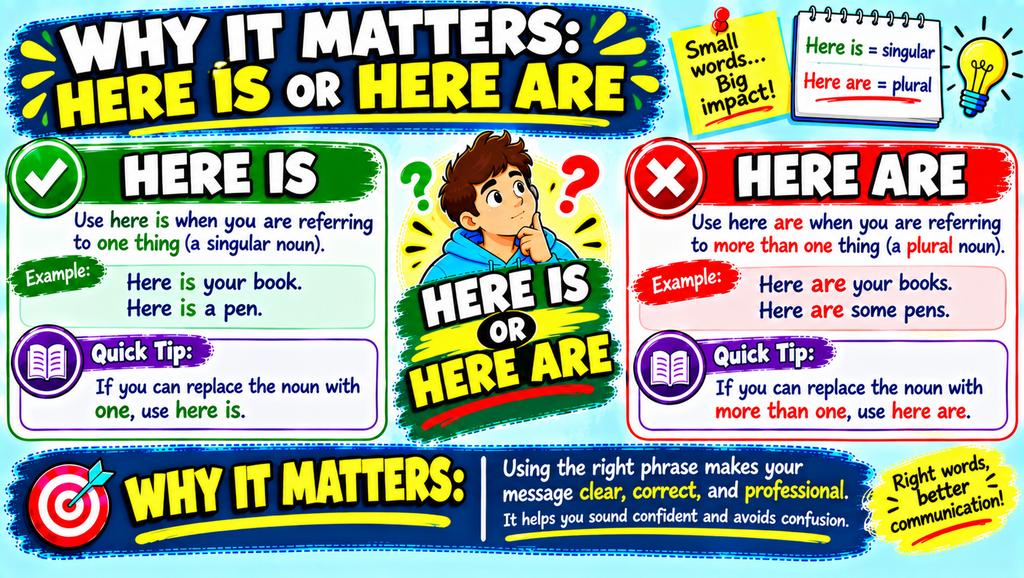
1. Clarity in Communication
Clear: Here are the three options.
Confusing: Here is the three options.
2. Professionalism
Correct grammar in emails and reports builds trust and credibility with readers. 💼
3. Better Digital Communication
Clean, correct writing gets read and trusted faster even in quick messages.
Inspirational Quote
“Grammar is the difference between knowing your stuff and knowing you’re stuff.” A small rule, but it changes everything. 🌟
Special Exceptions
Informal Spoken English
In casual talk, “here’s” is often used before plural nouns (“here’s your bags”) widely accepted in speech, though not correct in formal writing.
Uncountable Nouns
Uncountable nouns always take “here is,” even when they represent multiple things conceptually.
Examples:
- Here is the furniture you ordered.
- Here is the information you need.
Quick Recap Checklist
- ✅ Singular noun → Here is
- ✅ Plural noun → Here are
- ✅ Uncountable noun → Here is
- ❌ Don’t default to “here’s” before plural nouns in writing
Practice Examples
Choose the Correct Form
- Here ___ your order. (is)
- Here ___ the results of the test. (are)
- Here ___ some advice for you. (is — “advice” is uncountable)
Advanced Grammar Insight
Collective nouns (team, group, family) can take either form depending on meaning.
Example: Here is the team. (as one unit) vs. Here are the team members. (as individuals)
Here Is vs Here Are in Questions
The same agreement rule applies even in questions or tag questions the verb still matches the real subject.
Example: Here is your seat, isn’t it? (singular)
Example: Here are your seats, aren’t they? (plural)
Mini Memory Trick
Ask: “Is it one thing or many?” One → is. Many → are. That’s it. 🧠
Frequently asked questions About Here Is or Here Are
Is “here’s” grammatically correct before plural nouns?
No in formal writing, “here’s” should only be used before singular or uncountable nouns.
What decides “here is” vs “here are”?
The noun that comes right after it singular takes “is,” plural takes “are.”
Is “here is” used for uncountable nouns?
Yes, uncountable nouns like “information” or “furniture” always take “here is.”
Can I use “here’s” in casual conversation before plurals?
Yes, it’s common in speech, but it’s still technically incorrect grammar.
Does “here” count as the subject of the sentence?
No “here” is an adverb; the actual subject comes after “is” or “are.”
Conclusion
“Here is” and “here are” both follow one simple rule: match the verb to what comes after it, not to “here” itself. Singular or uncountable → “is.” Plural → “are.” Keep this rule in mind, and you’ll never second-guess this sentence starter again. ✅
