

If you’ve ever typed a quick greeting in Spanish and paused wondering whether it’s “Hola” or “Ola,” you’re definitely not alone 👋. This one tiny letter the silent “H” trips up learners, native speakers, and even fluent writers all the time. Let’s clear up the confusion for good.
Quick Answer: Hola or Ola
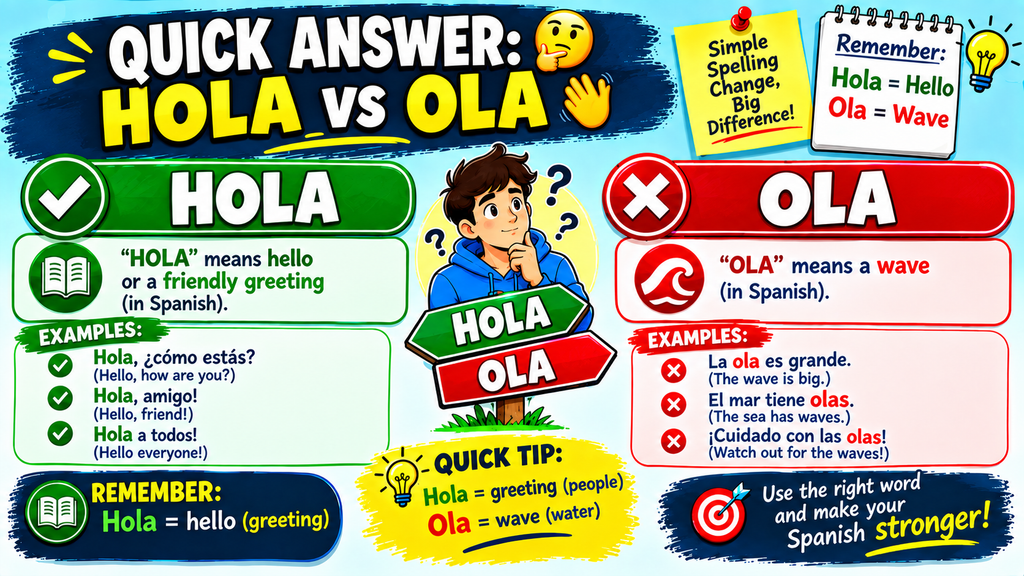
“Hola” is the correct spelling for the Spanish greeting “hello.” “Ola” is a completely different word that means “wave” (like an ocean wave) ✅. They sound identical when spoken, but they mean two very different things when written.
Understanding the Basics: Hola or Ola
Spanish has a quirky rule: the letter “H” is almost always silent 🤫. That’s exactly why “hola” and “ola” are pronounced the same way OH-lah even though only one of them means “hello.”
This is what linguists call a homophone pair: two words that sound alike but are spelled differently and carry different meanings.
Key Insight
Think of it like the English pair “there” and “their.” They sound the same, but writing the wrong one changes your meaning entirely. “Hola” and “ola” work the exact same way in Spanish 💡.
Correct Meanings & Uses
What Does “Hola” Mean?
“Hola” is an interjection used to greet someone. It translates directly to “hello” or “hi” in English, and it works in almost any casual or semi-formal situation 🙋.
Example:
¡Hola! ¿Cómo estás?
(Hello! How are you?)
Sentence Breakdown:
- Hola – greeting (hello)
- ¿Cómo estás? – follow-up question (how are you?)
More Examples:
- Hola, me llamo Ana. (Hi, my name is Ana.)
- Hola a todos, bienvenidos. (Hello everyone, welcome.)
- Solo quería decir hola. (I just wanted to say hi.)
What Does “Ola” Mean?
“Ola” is a noun that means “wave” most commonly an ocean wave, but it’s also used figuratively for a “wave” or “surge” of something, like weather or emotion 🌊.
Example:
La ola rompió cerca de la orilla.
(The wave broke near the shore.)
Sentence Breakdown:
- La ola – the wave (subject)
- rompió – broke (verb)
- cerca de la orilla – near the shore
More Examples:
- Una ola gigante sorprendió a los surfistas. (A giant wave surprised the surfers.)
- Hay una ola de calor esta semana. (There’s a heat wave this week.)
- La ola de entusiasmo fue contagiosa. (The wave of enthusiasm was contagious.)
Comparison Table: Hola vs Ola
| Feature | Hola | Ola |
|---|---|---|
| Meaning | Hello / Hi | Wave |
| Part of Speech | Interjection | Noun |
| Pronunciation | OH-lah | OH-lah |
| Silent Letter | H (silent) | None |
| Used For | Greetings | Ocean waves, surges, trends |
| Correct as a Greeting? | Yes ✅ | No ❌ |
Case Study Section
Scenario: Workplace Email
Imagine an employee writing to a new international client: “Ola Mr. Smith, thank you for reaching out.” It looks harmless, but a Spanish-speaking reader may pause, since “Ola” technically reads as “Wave Mr. Smith” 😅. It’s a small typo, but in professional writing, small typos shape big first impressions.
Takeaway
When professionalism matters, spelling accuracy matters too — even for a single silent letter 📩.
Grammar Rules Explanation
Why “Hola” Is Correct:
- It’s the standard, dictionary-recognized Spanish greeting.
- It follows the rule that Spanish interjections beginning with a silent “H” retain that “H” in spelling (like hoy, huevo, hola).
- It’s universally accepted across formal and informal Spanish.
Why “Ola” Is Incorrect (as greeting):
- “Ola” is a real word, but it means “wave,” not “hello.”
- Dropping the “H” changes the word’s identity entirely, not just its spelling.
- Native speakers will notice the swap immediately, even though pronunciation doesn’t change.
Common Mistakes Section
Why Do People Confuse Hola or Ola?
Mostly because of pronunciation. Since the “H” is silent, English speakers learning Spanish (or fast typists) often write exactly what they hear rather than what’s grammatically correct 🎧.
Similar Grammar Confusions
| Word Pair | Meaning 1 | Meaning 2 |
|---|---|---|
| Hola / Ola | Hello | Wave |
| Haber / A ver | To have (auxiliary) | Let’s see |
| Echo / Hecho | I throw / I miss | Made / Done (past participle) |
| Ay / Hay / Ahí | Ouch | There is / There |
Usage in Different Contexts
1. Everyday Conversation
“Hola” is your go-to casual greeting with friends, family, or strangers on the street 🗣️.
2. Professional Writing
Always double-check “Hola” in emails, presentations, or client-facing content — misspellings reduce credibility.
3. Creative Writing ✍️
Writers may intentionally use “ola” in poetry or storytelling to evoke imagery of the sea, tides, or emotional surges.
4. Social Media/Texting
Casual texting often stretches “Hola” into “Holaa” or “Holaaa” to add warmth or playfulness — but “Ola” should still be avoided unless you mean an actual wave 📱.
Why It Matters
Getting “Hola vs Ola” right isn’t just about grammar — it’s about clear communication. One letter separates a friendly greeting from a totally unrelated noun, and in written Spanish, that distinction can’t be heard, only read 👀.
Special Exception Section
There are a few legitimate cases where “Ola” (without an H) is completely correct:
- As a name: “Ola” is a common given name in Scandinavian countries (a short form of “Olaf”).
- As a brand: OLA is a well-known ride-hailing company, most popular in India.
- As an idiom: “Ola de calor” (heat wave) and “ola de crimen” (crime wave) are standard Spanish expressions.
So context always matters — “Ola” isn’t wrong, it’s just not a greeting 🔑.
Quick Recap Checklist
- ✅ Use “Hola” when greeting someone.
- ✅ Use “Ola” when referring to a wave (literal or figurative).
- ❌ Never swap the two in formal or professional writing.
- ✅ Remember: the silent “H” is the whole trick.
Practice Examples:
- _____, ¿qué tal tu día? (Hola/Ola)
- La _____ del mar era enorme. (hola/ola)
- _____ a todos, bienvenidos a la reunión. (Hola/Ola)
(Answers: 1. Hola, 2. ola, 3. Hola)
Frequently asked questions Section
Is “ola” a real Spanish word?
Yes, it means “wave,” referring to ocean waves or figurative surges like a heat wave.
Can “Ola” ever mean “hello”?
No, “Ola” never means hello in standard Spanish — that’s always “Hola.”
Why is the “H” silent in Spanish?
Historically, many Spanish words dropped their Latin “F” or “H” sound over time, but kept the letter in spelling.
Is “Hola” formal or informal?
“Hola” is mostly informal but is widely accepted in semi-formal settings too.
What does “ola de calor” mean?
It translates to “heat wave,” describing a period of unusually hot weather.
Is “Ola” used as a person’s name?
Yes, especially in Scandinavian countries, where it’s a short form of “Olaf.”
Conclusion
At the end of the day, “Hola vs Ola” comes down to one silent letter with a big impact 🎯. “Hola” is your friendly greeting, while “Ola” belongs to the ocean (or a heat wave, or a Scandinavian name). Keep that single “H” in mind, and you’ll never mix up a hello with a wave again 🌊.

jrkkhkptoretytomkdmiesdksiemeq