

If you’ve ever paused mid-sentence wondering whether to ask “how long” or “how much time,” you’re not alone. 😅 These two phrases look like twins, sound almost identical, and both circle around the same idea — duration. But native speakers don’t actually use them the same way, and mixing them up is one of the most common small mistakes English learners make. 🎯
This guide breaks the difference down in plain language, with real examples, a comparison table, common mistakes, and a quick recap you can bookmark for later. ✅
Quick Answer: How Long vs How Much Time
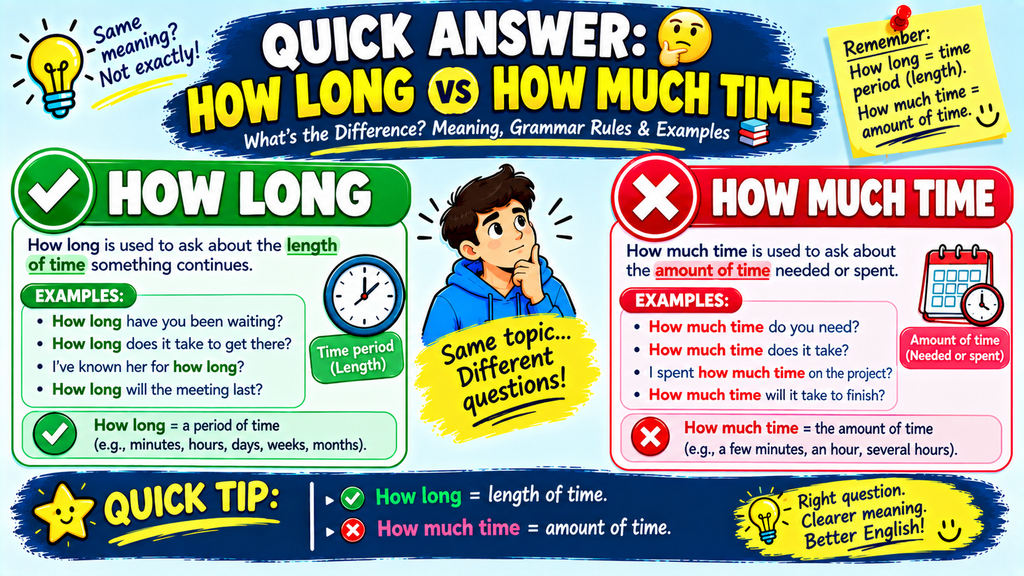
“How long” asks about the duration of something — how many minutes, days, or years a situation, action, or object lasts or extends. 🕐 “How much time” asks about a quantity of time available, needed, or remaining for a specific task. ⏳
In short: “how long” leans toward length, and “how much time” leans toward amount. They overlap often enough that either one works in casual speech, but each has a “home turf” where it sounds more natural. 🏡
Understanding the Basics: How Long vs How Much Time
Both phrases are question starters used to talk about time, and both can appear at the start of a sentence. 📝 The real difference sits in tone, tense, and function.
“How long” is the more flexible, more frequently used phrase in everyday English. 🗣️ It works with present perfect tense to ask about ongoing situations (“How long have you lived here?”), and it also works with simple duration questions (“How long is the flight?”). It’s even used for physical length, not just time — “How long is this rope?” is a perfectly normal question. 📏
“How much time,” on the other hand, is stricter. It only ever refers to time — never distance, size, or length. ⌛ It tends to sound more precise and slightly more formal, and it’s commonly used when someone is asking how much time is left, needed, or allotted for a task. 💼
Comparison Table
| Feature | How Long | How Much Time |
|---|---|---|
| Main use | Duration of an action, state, or object | Quantity/amount of time needed or left |
| Can refer to distance/length? | Yes (e.g., “How long is the road?”) | No — time only |
| Formality | Neutral to casual | Slightly more formal/precise |
| Common tense pairing | Present perfect (“have you been”) | Present simple/future (“do you need,” “will it take”) |
| Typical context | Everyday conversation, general questions | Task planning, deadlines, instructions |
| Example | How long is the meeting? | How much time do we have before the meeting? |
Correct Meanings & Uses
1. “How Long” — Asking About Duration 🕰️
“How long” is used to ask about the span or length of something — how much time it takes from start to finish, or how far something stretches. ✨
Examples:
- How long have you been learning English? 📖
- How long does the movie run? 🎬
- How long is the bridge? 🌉
- How long will you be staying in Tbilisi? ✈️
Sentence Breakdown: In “How long have you been learning English?”, the phrase pairs with present perfect continuous to show an action that started in the past and continues now. The focus is on the span of the action, not a fixed number. 🔍
Test Tip: If you can naturally answer with “for two years” or “since 2020,” “how long” is almost always the safer, more natural choice. ✅
2. “How Much Time” — Asking About Quantity ⏱️
“How much time” asks specifically for an amount — usually because that amount matters for planning, scheduling, or completing something. 📊
Examples:
- How much time do I have to finish this exam? 📝
- How much time is left before the store closes? 🏪
- How much time do you need to pack? 🧳
- How much time does it take to boil an egg? 🥚
Sentence Breakdown: In “How much time do I have to finish this exam?”, the question isn’t about a general duration — it’s about a countable quantity relevant right now, often tied to a deadline or limit. ⌚
Test Tip: If the answer works better as “twenty minutes” or “not much,” rather than “since Monday,” “how much time” usually fits better. 🎯
Case Study Section
Workplace Email Example 💻
Imagine two coworkers writing about the same project deadline. One writes: “How long will the report take to finish?” The other writes: “How much time do you need to finish the report?”
Why? 🤷
The first version sounds like a general estimate question — almost casual, focused on the overall process. The second sounds like a scheduling question, aimed at a specific number the sender can plan around. 📆 Both are grammatically correct, but they carry a slightly different intent, and professional writers often pick “how much time” when precision matters, like in meeting invites or project timelines.
Another Example: 📌
A manager asking a new hire “How long have you worked in this industry?” is asking about career duration. If instead they ask “How much time do you have for onboarding today?”, they’re asking about a scheduling quantity for that specific day. Same topic — time — but a different kind of question entirely. 🧩
Grammar Rules Explanation
Key Rule: 🔑
“How long” typically pairs with present perfect tense when asking about something ongoing (“How long have you known her?”), and with simple present or future when asking about a fixed duration (“How long is the class?” / “How long will it take?”). “How much time,” by contrast, almost always pairs with simple present or future, never present perfect, because it’s asking for a countable amount rather than an ongoing span. 📐
Important Note: ⚠️
You should never say “how long time” — that construction doesn’t exist in standard English, even though it’s a very common learner mistake, especially among speakers whose native language translates “how long” and “time” as separate words that combine naturally. The correct forms are either “how long” alone or “how much time.” 🚫
Common Mistakes Section
Why Do People Get Confused? 🤔
The confusion usually comes from direct translation. In many languages, the equivalent of “how long” literally translates word-for-word to “how much time,” so learners assume the English phrases are always interchangeable — and while they’re close, they’re not identical twins. 🌍
Frequent Mistakes: ❌
- “How long time will it take?” ❌
- “How much time have you lived here?” ❌
- “How much time is this river?” (referring to length) ❌
Correct Forms: ✔️
- “How long will it take?” ✅
- “How long have you lived here?” ✅
- “How long is this river?” ✅
Similar Grammar Confusions 🔄
This isn’t the only time-related pair that trips people up. “When” vs. “How Long” is another common mix-up — “when” asks for a specific point (“When did you move here?”), while “how long” asks for a span (“How long have you lived here?”). Similarly, “for” vs. “since” causes confusion: “for” marks a duration (“for five years”), while “since” marks a starting point (“since 2019”). 🗂️
Usage in Different Contexts
1. Everyday Conversation 💬
“How long” dominates casual speech because it feels natural and quick — “How long till we get there?” is far more common than the “how much time” equivalent.
2. Professional Writing 📧
“How much time” appears more often in emails, project plans, and scheduling requests, where precision and clarity matter most.
3. Creative Writing ✍️
Writers often use “how long” for rhetorical or reflective effect — “How long can a heart wait?” — because it sounds more natural and poetic than “how much time.”
4. Social Media & Texting 📱
Both phrases get shortened or dropped in texting (“how long?” or “how much time left?”), but “how long” remains the quicker, more casual default.
Why It Matters 💡
Choosing the right phrase doesn’t just affect grammar accuracy — it shapes how formal, precise, or natural your sentence sounds to a native speaker. 🎓
Special Exception Section
There’s one unusual exception worth knowing: the phrase “how long a time” does exist, though it’s rare and slightly old-fashioned. You might hear it in formal or literary contexts, such as “How long a time will we have to wait?” This differs from the incorrect “how long time” because “a” turns it into a proper noun phrase. 🎭
Quick Recap Checklist ✅
- Use “how long” for duration, ongoing situations, and even physical length. 📏
- Use “how much time” for specific quantities, deadlines, and scheduling. ⏰
- Never say “how long time” — it’s incorrect. 🚫
- “How much time” never refers to distance or size — only time. ⌛
- “How long a time” is a rare but valid formal exception. 📖
Practice Examples: 🧠
- _____ have you been studying French? (how long)
- _____ do we have before the train leaves? (how much time)
- _____ is the Nile River? (how long)
- _____ do you need to finish your homework? (how much time)
Conclusion
“How long” and “how much time” both ask about time, but they’re not perfect substitutes for each other. 🎯 “How long” is the flexible, everyday choice for duration and even length, while “how much time” is the more precise pick for quantities tied to tasks, deadlines, and schedules. Once you internalize the pattern — duration versus quantity — the choice becomes almost automatic. 🌟
Frequently Asked Questions
Is “how long” more common than “how much time”?
Yes, “how long” is used far more frequently in everyday spoken English because it sounds natural and flexible. 🗣️
Can “how much time” be used for distance?
No, “how much time” only refers to time — for distance or length, “how long” is the correct choice. 📏
Is “how long time” ever correct?
No, “how long time” is grammatically incorrect in standard English and should be avoided. 🚫
What tense goes best with “how long”?
“How long” commonly pairs with present perfect tense for ongoing situations, like “How long have you lived here?” ⏳
Is “how much time” more formal than “how long”?
Generally yes, “how much time” tends to sound slightly more precise and formal, especially in professional or scheduling contexts. 💼
Can I use both phrases interchangeably?
In many casual sentences, yes, but “how long” fits ongoing duration better while “how much time” fits countable quantities better. 🔄
