

If you’ve ever paused mid-sentence wondering whether to write “install the app on your phone” or “install the app in your phone,” you’re not alone. This tiny preposition choice trips up native speakers and English learners alike. The good news? Once you understand the logic behind it, you’ll never second-guess it again. 🎯
Quick Answer: Install In vs Install On
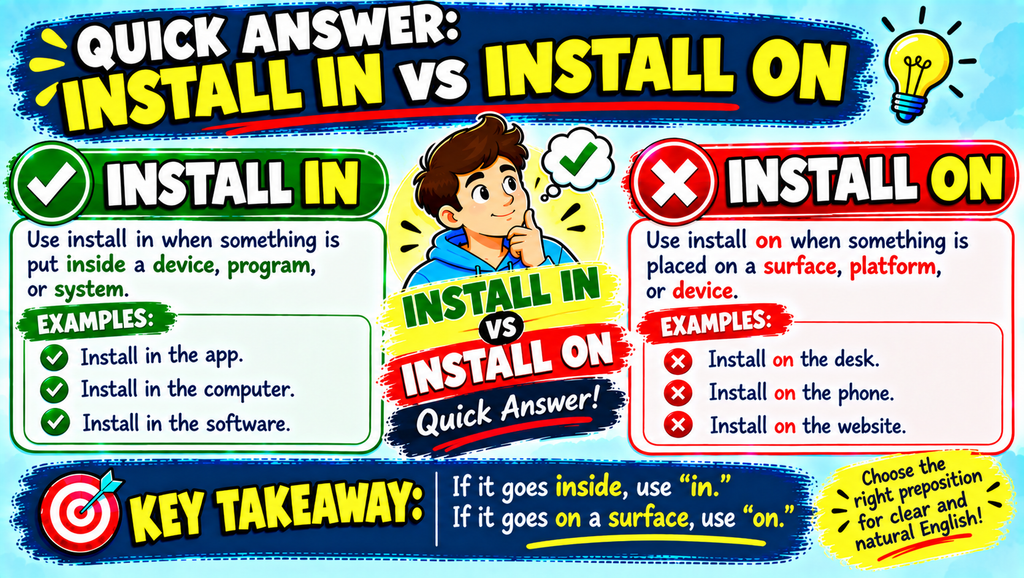
“Install on” is used when something is placed onto a surface, device, or platform think software, apps, or panels. “Install in” is used when something goes inside an enclosed space, room, or system think wiring, engines, or fixtures. Both phrases are grammatically correct; the right one simply depends on where the object physically or conceptually ends up.
Understanding the Basics of Install In vs Install On
English prepositions follow spatial logic, and “install” is no exception. The verb itself doesn’t change meaning — only the relationship between the object and its location shifts.
Key Idea 🔑
Think of “on” as describing a surface (a flat, top-level layer) and “in” as describing an interior (a bounded, enclosed space). Once you picture the physical relationship, choosing the right preposition becomes almost automatic.
Comparison Table: Install In vs Install On
| Aspect | Install On | Install In |
|---|---|---|
| Core meaning | Placed onto a surface or platform | Placed inside an enclosed space |
| Typical objects | Apps, software, updates, panels, tiles | Engines, wiring, cabinets, sensors, plumbing |
| Common field | Tech, IT, digital products | Construction, automotive, manufacturing |
| Example sentence | “Install the update on your laptop.” | “Install the heater in the basement.” |
| Substitution test | Works with “onto” | Works with “inside” |
Correct Meanings & Uses
1. Install “In” – When to Use It
Use “install in” when the object is being fitted inside a room, vehicle, container, or physical system.
Examples:
- The electrician will install new wiring in the extension.
- We’re installing a water heater in the basement.
- The mechanic installed a new battery in the car.
- The team plans to install sensors in the greenhouse.
Sentence Breakdown: The pattern is subject + install + object + in + enclosed location. The location noun is always a space you could conceptually step into or that fully surrounds the object.
Test Tip: Swap “in” for “inside.” If the sentence still reads naturally “install the heater inside the basement” then “in” is the correct choice. ✅
2. Install “On” – When to Use It
Use “install on” when the object rests on top of a surface, device, or platform this is the far more common usage in everyday and tech writing.
Examples:
- Please install the update on your laptop.
- The crew installed solar panels on the roof.
- You can install this app on any Android device.
- They installed new tiles on the kitchen floor.
Sentence Breakdown: The pattern is subject + install + object + on + surface/device/platform. “On” implies the object sits atop something rather than being enclosed by it.
Test Tip: Swap “on” for “onto.” If it still sounds natural — “install the panels onto the roof” then “on” is correct.
Case Study: Real-Life Usage Example
Scenario: Workplace Email
“Hi team, IT will install the new software on all company laptops this weekend.”
Why?
Software isn’t physically inside the laptop’s casing it sits on top of the operating system layer, which is why “on” is the natural, technically accurate choice here.
Scenario: IT Instruction Manual
“Insert the card into the slot, then install the drivers in the system folder.”
Here, “in” appears because a folder is treated as an interior digital space a small exception where “in” fits even in a tech context, since folders act like containers rather than surfaces.
Grammar Rules Explanation
Why “Install On” is More Common
Most modern usage centers on technology, and software, apps, and updates are conceptually layered “on top of” a device’s operating system. Because of this, tech style guides and everyday speech overwhelmingly default to “on.”
Why “Install In” Still Matters
Physical trades construction, automotive repair, electrical work, plumbing describe objects fitted inside defined spaces. Swapping “in” for “on” in these contexts can sound imprecise or even confusing to a technician reading instructions.
Common Mistakes in Install In vs Install On
Frequent Errors
- Saying “install the app in your phone” instead of “on your phone.”
- Overusing “install onto” when plain “on” would sound more natural.
- Confusing “install in” with “install into,” which implies motion rather than a static location.
- Mixing up “install to” (a destination, like a drive path) with “install in” (a physical space).
Similar Grammar Confusions Table
| Confusion Pair | Correct Distinction |
|---|---|
| In vs Into | “In” = static location; “Into” = movement toward the interior |
| On vs Onto | “On” = static surface; “Onto” = movement toward the surface |
| Install to vs Install in | “To” = destination or file path; “In” = physical/spatial interior |
| Installed on vs Installed at | “At” marks a general point; “On” marks a specific surface |
Why These Mistakes Happen
Non-native speakers often translate prepositions directly from their first language, where one word may cover several English equivalents. Native speakers, meanwhile, sometimes rely on instinct rather than the underlying surface-versus-interior logic, leading to inconsistent usage. 🧩
Usage in Different Contexts
1. Everyday Conversation
Casual speech leans heavily on “on” for gadgets and apps “just install it on your phone” is the default phrasing most people use without thinking twice.
2. Professional Writing
Technical manuals and contracts favor “in” for equipment inside enclosures or systems, since precision matters when someone is physically assembling something.
3. Creative Writing
Writers sometimes bend the rule for figurative effect, as in “she installed doubt in his mind” a metaphorical, non-physical use of “in.”
4. Social Media / Texting
Short, casual posts about apps, updates, and devices almost always use “on,” reflecting the dominance of tech-related language online.
Why It Matters

Getting this preposition right isn’t just a grammar nitpick it affects how clearly and professionally your message lands.
Benefits of Correct Usage
- Clarity: Readers instantly understand where something is being placed.
- Professionalism: Technical documents and emails read as precise and credible.
- Better search visibility: Matches how people actually phrase install-related queries.
- Fewer misunderstandings: Especially important in instruction manuals and workplace communication.
Special Exception Section
Idiomatic and figurative expressions almost always take “in,” never “on” for example, “install confidence in a team” describes an internal, mental state rather than a physical surface. Similarly, formal appointments use “install as” (e.g., “installed as president”), a completely separate grammatical pattern from spatial “in” or “on.” 🎓
Quick Recap Checklist
- Use on for surfaces, devices, platforms, and software.
- Use in for interiors, rooms, vehicles, and enclosed systems.
- Use into for movement toward an interior.
- Use onto for movement toward a surface.
- Use as for roles, titles, or positions.
- Test your sentence with “inside” or “onto” to confirm the right fit.
Practice Examples
- Please install the printer driver ___ your desktop. (on)
- The plumber will install new pipes ___ the wall. (in)
- We need to install this software ___ every laptop. (on)
- They will install a new engine ___ the truck. (in)
Frequently asked questions: Install In vs Install On
Is it “install in” or “install on” a computer?
“On” a computer software sits on the operating system layer, not literally inside the physical hardware.
Can I say “install onto”?
Yes, “onto” is grammatically correct and emphasizes movement toward a surface, though plain “on” is more common in everyday use.
Is “install into” correct?
Yes, use “install into” when describing something being fitted or embedded within an interior space, like “install into the wall cavity.”
Which is correct for apps “in” or “on” my phone?
“On” your phone is correct, since apps are installed onto the device’s system rather than inside its physical shell.
Do professional style guides prefer one form?
Most major tech style guides standardize on “install on” for software and devices, reserving “in” for physical, enclosed installations.
Conclusion
The choice between “install in” and “install on” comes down to a simple spatial test: is the object sitting on a surface, or is it going inside an enclosed space? Master that distinction, apply the substitution tricks above, and you’ll use both phrases with confidence in any context — from casual texts to professional manuals. 🚀
