

Lay vs lie is one of the trickiest pairs in English grammar. 😅 Even native speakers mix them up in emails, songs, and everyday chat. 🎵 The good news is that the rule is simple once you see it. ✅
In this guide, you’ll learn what each word means, how the past tense works, and how to choose the right one every time. 📘 You’ll also get clear examples, memory tricks, and a short practice test. 📝
Understanding Lay or Lie in Simple English
Both verbs describe something being in a flat, horizontal position. 🛏️ The real difference is who or what is doing the action. 🔍
- You lay something down. 📦
- You lie down yourself. 😴
Quick answer: lay needs an object, and lie never takes one. ✅
Lay or Lie: Simple Definition
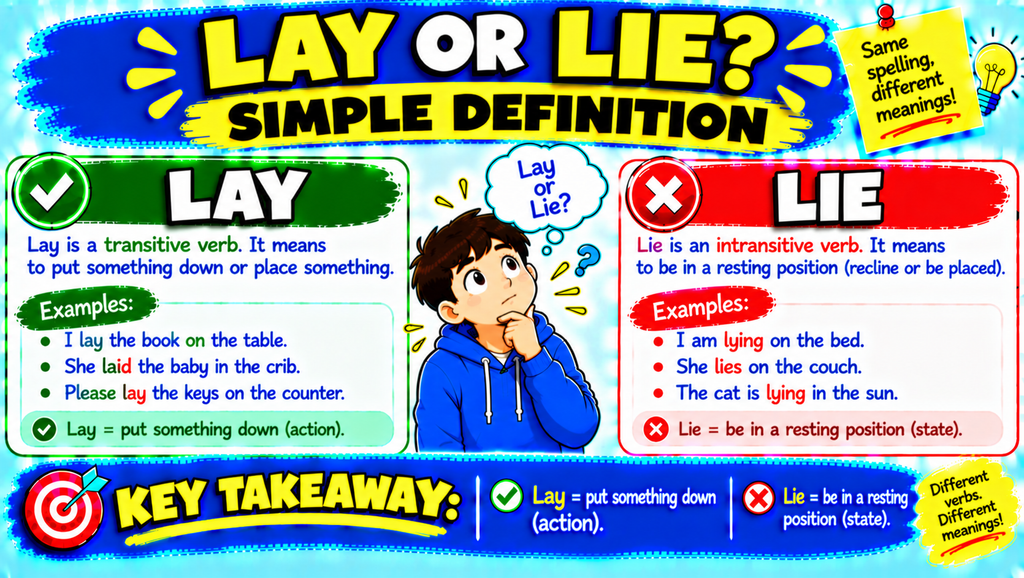
Lay means to put or place something down. 📦 Lie means to rest or recline in a flat position. 😴
What Does Lay Mean?
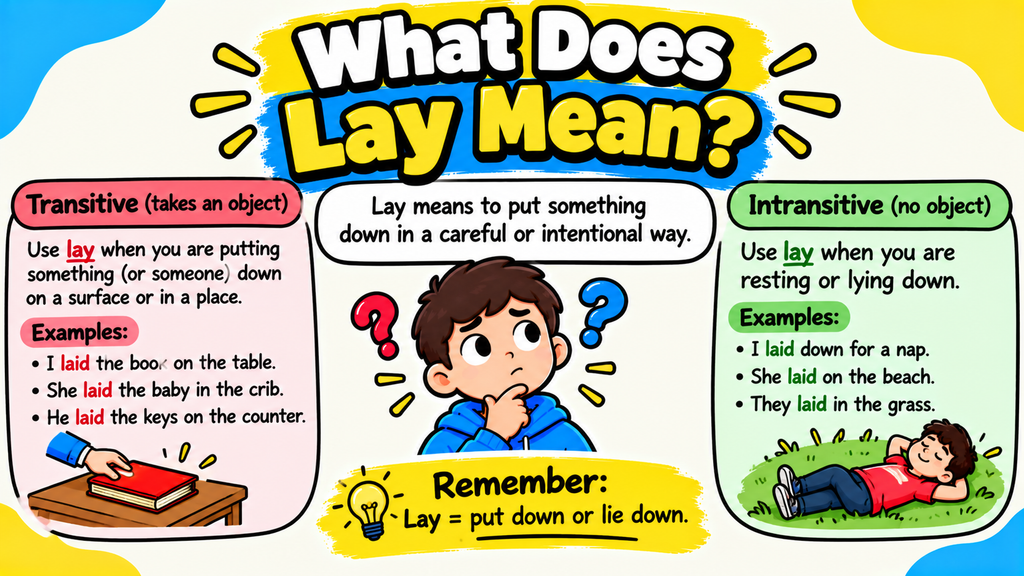
Lay is a transitive verb, so it needs a direct object. 📌 Think of it as a synonym for “place,” “put,” or “set down.” 🧩
- Please lay the baby in the crib. 👶
- She lays her phone on the desk every night. 📱
- Hens lay eggs. 🥚
What Does Lie Mean?
Lie is an intransitive verb, so it takes no direct object. 📌 Think of it as “recline,” “rest,” or “be flat.” 🛋️
- I need to lie down for a minute. 😴
- The dog loves to lie in the sun. ☀️
There’s also a separate verb lie that means to tell an untruth. 🤥 Its forms are lie, lied, lied, and lying. 📚
Lay or Lie: Core Difference
| Feature | Lay | Lie (to recline) |
|---|---|---|
| Meaning | Place or put something down | Rest or recline |
| Needs an object? | Yes ✅ | No ❌ |
| Past tense | laid | lay |
| Past participle | laid | lain |
| -ing form | laying | lying |
| Example | I lay the book on the shelf. 📚 | I lie on the sofa. 🛋️ |
| Memory hook | LAy = pLAce | LIe = recLIne |
Here are the three verbs side by side, because the forms are where most mistakes happen. 👀
| Verb | Present | Past | Past participle | -ing |
|---|---|---|---|---|
| lay (to place) | lay | laid | laid | laying |
| lie (to recline) | lie | lay | lain | lying |
| lie (to fib) | lie | lied | lied | lying |
Notice the trap: the past tense of lie is lay. ⚠️ That’s why the two verbs keep colliding. 💥
Is Lay or Lie Formal or Informal?
Neither word is formal or informal on its own. 📖 What matters is how you use it. 🗣️ In casual speech, many people say “lay down” when they mean “lie down.” 😴 You’ll even spot the slip in famous song titles. 🎶 Still, essays, reports, and business emails expect the standard forms. 🎓 Dictionaries note that people have mixed these verbs up for centuries, so you’re in good company. 😉
How to Use Lay Correctly
Ask one question: what is being placed? 🧐 If there’s a thing, use lay. ✅
- Find the verb in your sentence. 🔎
- Ask “lay what?” 📦
- If you can answer, choose lay, laid, or laying. ✅
Here’s how lay looks across tenses:
- Present: I lay the cards on the table. 🃏
- Past: Yesterday, she laid the cards on the table. 📅
- Perfect: They have laid the foundation. 🏗️
- -ing: He is laying new tiles. 🧱
How to Use Lie Correctly
If the subject itself is resting, use lie. 😌
- Present: I lie on the couch after work. 🛋️
- Past: Last night, I lay awake for hours. 🌙
- Perfect: She has lain in bed all morning. ⏰
- -ing: The cat is lying by the window. 🐈
Spelling warning: it’s “lying,” never “lieing.” ✍️ And “layed” isn’t a word at all. 🚫
Lie + To + Verb Structure
The word “to” shows up in a few common patterns, and they don’t all mean the same thing. 🧩
| Pattern | Meaning | Example |
|---|---|---|
| to lie down | to recline | You should lie down to rest. 😴 |
| lie to someone | to tell an untruth | Please don’t lie to me. 🤥 |
| to lay something down | to place it | I forgot to lay out my clothes. 👕 |
Lie vs Very Tired: Important Difference
When you’re exhausted, your brain takes shortcuts. 😵 That’s why people say, “I’m so tired, I’m going to lay down.” ❌ The correct version is, “I’m so tired, I’m going to lie down.” ✅ Quick check: swap in “place.” 🔁 “I’m going to place down” makes no sense, so lie is the right choice. 💤
Lie in Questions
Questions follow the same rules. ❓ After “did,” use the base form, which is lie (not lay) for reclining. 📌
- Did he lie down after lunch? 😴
- Where did you lay the keys? 🔑
- Has the dog lain there all day? 🐕
- Why did she lie to me? 🤥
Common Situations Where Lay or Lie Is Used
Use lay when you’re placing something:
- Setting a table or laying a blanket on the grass. 🧺
- Hens laying eggs. 🥚
- Laying bricks, tiles, or a foundation. 🧱
Use lie when someone or something is resting:
- Taking a nap or resting in bed. 😴
- Relaxing on the beach. 🏖️
- Lying around the house. 🏠
Advanced Usage of Lie
Lie with Nouns
Lie works as a noun too. 📖 Think of “a white lie” or “a big lie.” 🤥 In golf, a ball’s “lie” is where it rests. ⛳ British speakers also say “the lie of the land,” while Americans say “the lay of the land.” 🌍
Lie with Time Expressions
Time words give you a clue about which form to use. ⏰
| Time clue | Form | Example |
|---|---|---|
| Every day / usually | lie | I lie down after lunch every day. 😴 |
| Right now | lying | She is lying on the grass. 🌿 |
| Yesterday / last night | lay | Last night, I lay awake. 🌙 |
| Since / for hours | lain | He has lain in bed since noon. 🛏️ |
British English also uses “lie in” for sleeping late on weekends. 🇬🇧
Lie in Formal Writing
In formal writing, stick to the standard forms: lie, lay, and lain. 🎓 If “lain” feels stiff, rewrite the sentence with another verb, such as “rested” or “sat.” ✍️ Consistency matters more than fancy wording. ✅
Synonyms of Lie
| Sense | Synonyms |
|---|---|
| To recline | rest, recline, lounge, sprawl, stretch out 🛋️ |
| To tell an untruth | fib, deceive, mislead, fabricate 🤥 |
Opposite of Lie
- Reclining: the opposite is to stand up, sit up, or get up. 🧍
- Untruth: the opposite is to tell the truth or be honest. 😇
Lay or Lie Right vs Wrong
| ❌ Wrong | ✅ Right | Why |
|---|---|---|
| I’m going to lay down. ❌ | I’m going to lie down. ✅ | No object, so use lie. 👉 |
| She laid in bed all day. ❌ | She lay in bed all day. ✅ | Past tense of lie is lay. 🕰️ |
| He has laid there for hours. ❌ | He has lain there for hours. ✅ | Past participle of lie is lain. 📚 |
| I layed the book down. ❌ | I laid the book down. ✅ | “Layed” isn’t a word. 🚫 |
| The cat is laying on the sofa. ❌ | The cat is lying on the sofa. ✅ | No object, so use lying. 🐈 |
| Lie the towel on the sand. ❌ | Lay the towel on the sand. ✅ | The towel is the object. 📦 |
Common Mistakes People Make
- Using lay when there’s no object. 🚫
- Forgetting that the past tense of lie is lay. 🔄
- Writing “layed” or “lieing.” ✍️
- Saying “laid” when you mean “lain.” ⚠️
- Mixing up lie (recline) with lie (fib). 🤥
Memory Trick: Never Confuse Lay or Lie Again
- LAy = pLAce. 📍 LIe = recLIne. 🛋️
- The place test: swap in “place,” and if it fits, use lay. 🔁
- The “me” bonus: “Now I lay me down to sleep” is correct, because “me” is the object. 🌙
Quick Practice Section
Choose the correct word. ✏️
- I’m exhausted, so I’m going to ___ down. (lie / lay) 😴
- Please ___ the keys on the counter. (lie / lay) 🔑
- Yesterday, the cat ___ in the sun for hours. (lay / laid) 🐈
- She ___ the baby in the crib an hour ago. (lay / laid) 👶
- He has ___ in bed all morning. (lain / laid) ⏰
- Please don’t ___ to me. (lie / lay) 🤥
Answers
- lie. You’re resting yourself, with no object. 😴
- lay. The keys are the object. 🔑
- lay. It’s the past tense of lie. 🐈
- laid. It’s the past tense of lay, and “the baby” is the object. 👶
- lain. It’s the past participle of lie. ⏰
- lie. Here it means to tell an untruth. 🤥
Lay or Lie in Formal vs Informal Writing
| Situation | Informal speech | Formal writing |
|---|---|---|
| Resting now | I’m gonna lay down. 😴 | I’m going to lie down. ✅ |
| Resting earlier | I laid there for an hour. ⏱️ | I lay there for an hour. ✅ |
| Resting over time | I’ve laid here all day. 🕰️ | I’ve lain here all day. ✅ |
Use the right column for essays, reports, and professional emails. 💼 Save the left column for texts with friends. 😄
Lay or Lie with Specific Phrases
| Phrase | Meaning | Example |
|---|---|---|
| lie down | to recline | I’ll lie down for a bit. 😴 |
| lay down | to put something down | Lay down your pen. ✒️ |
| lie low | to stay out of sight | He decided to lie low for a while. 🕵️ |
| lay off | to dismiss from a job | The company laid off fifty workers. 💼 |
| lay out | to arrange or explain | She laid out her plan clearly. 🗺️ |
| lie in wait | to hide and wait | The cat lay in wait. 🐈 |
Frequently Asked Questions
What is the difference between lay and lie?
Lay means to put something down and needs an object. 📦 Lie means to recline and takes no object. 😴
Is it lay down or lie down?
Say “lie down” when you rest yourself. 😴 Say “lay down” only when you place something, like “lay down your phone.” 📱
When should I use lay?
Use lay when someone places or puts something somewhere. 📍 For example, “lay the book on the desk.” 📚
When should I use lie?
Use lie when someone or something rests or reclines, with no object. 🛋️ It also covers telling an untruth, which is a separate verb. 🤥
Why is lay or lie confusing?
The past tense of lie is lay, so the two verbs overlap. 🔄 Their meanings are also close. 🤝
Is “lay down” ever correct?
Yes, when it has an object, as in “lay down your weapons.” ✅ It’s also common in casual speech, though formal writing prefers “lie down.” 🎓
What is the past tense of lie?
For reclining, it’s “lay,” and the past participle is “lain.” 🛏️ For telling an untruth, it’s “lied.” 🤥
What is the past tense of lay?
It’s “laid,” and the past participle is also “laid.” 📦
Do native speakers confuse lay and lie?
Yes, all the time, even in songs and headlines. 🎵 You’re in good company. 😊
How can I remember lay or lie easily?
Think LAy = pLAce and LIe = recLIne. 🧠 If you can swap in “place,” use lay. ✅
Conclusion
Lay vs lie doesn’t have to be a headache. 😌 Lay needs an object, while lie never takes one. ✅ Remember the forms: lay, laid, laid, laying and lie, lay, lain, lying. 📚 Use the “place” test whenever you’re unsure. 🔁 Practice a few sentences, and the right word will start to feel natural. 🚀 Now go write with confidence. ✍️
