

If you’ve ever paused mid-sentence wondering whether to type “lier” or “liar,” you’re not alone. These two words look almost identical, sound the same in casual speech, and both trace back to the verb “lie” — which is exactly why they trip up so many writers.
The short version: almost every time you mean “a person who doesn’t tell the truth,” the word you want is liar. “Lier” is a real word too, but it’s rare, and it means something completely different. Below, we’ll break down the meaning, spelling, grammar rules, and real-world examples so you never second-guess yourself again.
Quick Answer: Lier or Liar
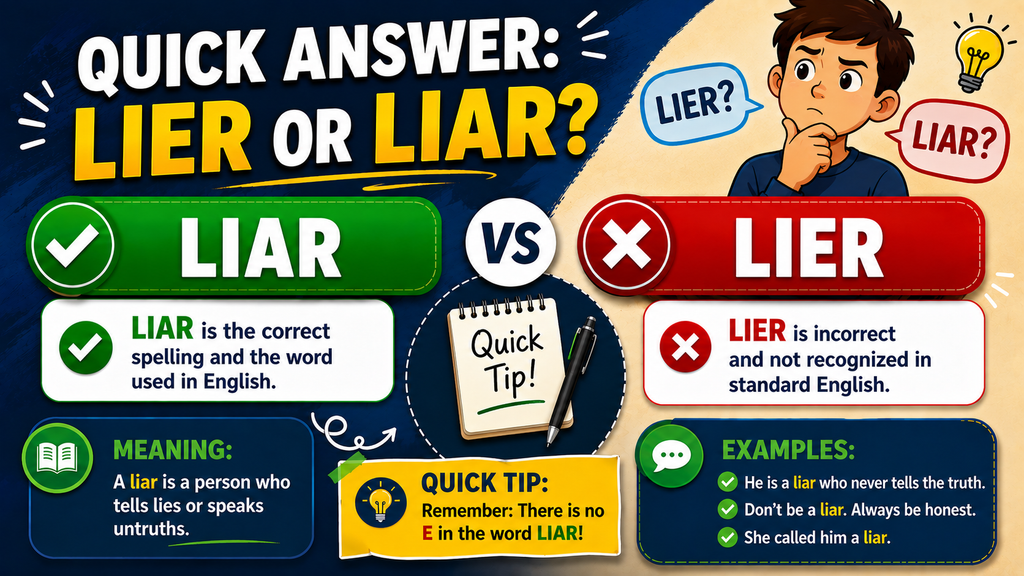
Liar is the correct word for someone who tells lies. It’s the standard, dictionary-preferred spelling used in everyday writing, journalism, and professional communication.
Lier is a technically valid but rarely used word meaning “one who lies down” or “one who lies in wait.” Unless you’re writing about someone reclining or hiding, you almost certainly want “liar.”
Understanding the Basics: Lier or Liar
The confusion starts with the verb “lie,” which has two unrelated meanings in English:
- To say something untrue (lie → lied → lied)
- To recline or rest in a horizontal position (lie → lay → lain)
Both meanings can theoretically take the agent suffix “-er,” which is what turns a verb into “a person who does this.” But English spelling didn’t play fair here — the two resulting nouns are spelled differently, and only one of them shows up in everyday conversation.
Key Difference
| Feature | Liar | Lier |
|---|---|---|
| Meaning | A person who tells lies | A person or thing that lies down / lies in wait |
| Root verb | Lie (to say something false) | Lie (to recline) |
| Frequency of use | Very common | Extremely rare |
| Found in dictionaries | Yes, standard entry | Yes, but marked as rare/dated |
| Typical context | Everyday speech, writing, journalism | Legal or archaic/literary texts |
| Pronunciation | LY-er | LY-er (same sound) |
Correct Meanings and Uses
What Does “Liar” Mean?
A liar is someone who says things they know are false, usually to deceive or mislead another person. It’s a noun formed from “lie” (to tell an untruth) plus the agent suffix “-ar.”
Examples
- He’s known as the office liar because his excuses never add up.
- Don’t trust her — she’s a compulsive liar.
- The witness was exposed as a liar during cross-examination.
- Calling someone a liar in public can damage their reputation.
Sentence Breakdown
In the sentence “She is a liar,” the word “liar” functions as a predicate noun describing the subject’s character. It answers the question “what kind of person is she?” — the same grammatical role played by words like “teacher” or “singer.”
Test Tip 💡
If you can substitute the phrase “a dishonest person” into your sentence and it still makes sense, you need liar.
What Does “Lier” Mean?
A lier is someone (or something) that lies down or lies in wait. It comes from the “recline” sense of “lie,” not the “deceive” sense. This word appears in dictionaries, but it’s so uncommon that most native speakers have never seen it used outside a crossword puzzle or an old legal document.
Examples
- The hunter, a patient lier in wait, watched the trail for hours.
- As a lier-in, she stayed in bed long after sunrise.
- The lier beneath the tree remained still until the danger passed.
Test Tip 💡
If your sentence is really about someone resting, hiding, or waiting motionless, and never about dishonesty, “lier” could technically apply — but most style guides recommend rephrasing with “one who lies” or “someone in hiding” instead, since “lier” reads as a typo to most readers.
Why Most People Mean “Liar”
In practice, almost nobody sets out to write “lier.” The word shows up by accident — usually because a writer applied a spelling pattern from words like “flier” or “supplier” to “lie,” not realizing that “liar” broke from that pattern centuries ago. When in doubt, default to liar.
Case Study Section
Workplace Email Example
Incorrect Version “I understand your concerns, but I want to be clear that I am not a lier. Every report I submitted was accurate.”
Correct Version “I understand your concerns, but I want to be clear that I am not a liar. Every report I submitted was accurate.”
Lesson
A single misspelled word in a serious workplace message can undercut the point you’re making. If you’re defending your honesty, the last thing you want is a typo that makes the email look rushed or careless. Spell-check tools don’t always catch this error because “lier” is a real word — so proofreading matters more than autocorrect here.
Grammar Rules Explanation
Rule 1: Liar Comes From “Lie” Meaning “Tell an Untruth”
The noun “liar” is formed from the deceptive sense of “lie” (present: lie, past: lied, past participle: lied). Add the agent suffix “-ar,” and you get “liar” — someone who performs that action habitually or in a specific instance.
Rule 2: Lier Comes From “Lie” Meaning “Recline”
“Lier” is built from the positional sense of “lie” (present: lie, past: lay, past participle: lain). Add the regular agent suffix “-er,” and you get “lier” — someone who lies down. This follows the normal pattern seen in words like “flier” and “crier,” but it’s rarely applied to “lie” in modern usage.
Rule 3: Standard Dictionaries Favor “Liar”
Major dictionaries list “liar” as the common, standard spelling for a dishonest person, while “lier” is typically flagged as rare, dated, or restricted to legal and literary contexts. If you’re writing for a general audience, style guides consistently point to “liar.”
Common Mistakes
- Writing “lier” when you mean a dishonest person
- Typing “lieing” instead of “lying” for the present participle
- Confusing “lie” (to recline) with “lay” (to put something down)
- Using “liar” as a verb (it’s a noun only — the verb is “to lie”)
Why These Mistakes Happen
Fast Typing
When typing quickly, it’s easy for your fingers to default to the “-er” pattern used in far more common words, producing “lier” instead of “liar.”
Autocorrect Issues
Because “lier” is a legitimate dictionary word, many spell-checkers won’t flag it, letting the mistake slip through unnoticed.
Lack of Knowledge
Many writers simply haven’t been taught that “lie” has two separate word families, so they don’t realize the spellings diverge at all.
Similar Grammar Confusions
| Pair | Confusion | Correct Usage |
|---|---|---|
| Lie vs. Lay | Both relate to reclining or placing something | “Lie” has no object (“I lie down”); “lay” needs one (“I lay the book down”) |
| Lying vs. Lieing | “Lieing” looks logical but is not a word | Use “lying” for both senses of “lie” |
| Liar vs. Lier | Sound identical, meanings unrelated | “Liar” = dishonest person; “lier” = one who reclines |
| Flier vs. Liar | Same “-er/-ar” ending pattern, different roots | “Flier” keeps “-er”; “liar” uniquely takes “-ar” |
Usage in Different Contexts
Everyday Conversation
In casual speech, “liar” is the go-to word whenever someone is called out for dishonesty — from playful teasing among friends to more serious accusations.
Professional Writing
In workplace emails, reports, and official statements, precision matters. Using “liar” correctly (and sparingly, given its strong tone) keeps writing clear and credible.
Creative Writing
Fiction writers use “liar” constantly to build tension between characters, while “lier” occasionally appears in period pieces or poetry aiming for an older, formal register.
Social Media and Texting
On social platforms, “liar” is a common sometimes overused word in arguments and callouts. Because informal writing skips proofreading, this is exactly where “lier” typos are most likely to appear.
Why It Matters
Clarity in Communication
Choosing the right word ensures your reader instantly understands your meaning, without pausing to decode a typo.
Professionalism
Correct spelling in resumes, emails, and reports signals attention to detail — something that matters more in formal or high-stakes writing.
Writing Accuracy
Getting homophone-style pairs right protects the credibility of your writing, especially in published or shared content.
Digital Communication
Search engines, spell-checkers, and readers alike register “liar” as the standard form, so consistent use also helps your content read as polished and trustworthy.
A single letter can change what a sentence says about someone — which is exactly why “liar” and “lier” are worth getting right.
Special Exception
Rare Usage of “Lier”
“Lier” survives mainly in older legal phrasing — such as describing someone as “a lier in wait” — and in specialized or archaic literary contexts. Outside of these narrow situations, treat “lier” as a word to avoid rather than a stylistic choice.
Quick Recap Checklist
- Use liar for a person who tells lies — this covers 99% of real-world writing situations.
- Reserve lier only for describing someone reclining or lying in wait, and even then, consider rephrasing for clarity.
- Remember: “lie” (untruth) → liar; “lie” (recline) → lier.
- Double-check workplace and formal writing, since spell-checkers often miss this mistake.
- When unsure, say “dishonest person” instead — if that fits, you need “liar.”
Practice Examples
Example 1
He denied everything, but the evidence proved he was a ______ (liar/lier). Answer: liar
Example 2
The old poem describes a ______ (liar/lier) resting quietly beneath the willow tree. Answer: lier
Example 3
Nobody likes being called a ______ (liar/lier) in front of their coworkers. Answer: liar
FAQs: Lier or Liar
Is “lier” a real word?
Yes, but it’s rare. It means someone who lies down or lies in wait, not someone who is dishonest.
What is the correct spelling for someone who tells lies?
The correct spelling is “liar,” formed from “lie” (untruth) plus “-ar.”
Why do people confuse “liar” and “lier”?
They sound identical and both come from forms of “lie,” so writers often apply the wrong spelling pattern by mistake.
Can “lier” ever mean a dishonest person?
No. “Lier” only relates to reclining or lying in wait; it never means someone who tells falsehoods.
Does spell-check catch “lier” as an error?
Not always, since “lier” is a legitimate dictionary word — proofreading by eye is still necessary.
Is “liar” a noun or a verb?
“Liar” is a noun only. The related verb is “to lie” (lie, lied, lied).
Conclusion
The rule is simpler than it feels: if you’re talking about dishonesty, write liar. If you’re describing someone lying down or lying in wait — a situation you’ll rarely need to write about — “lier” is technically correct but best avoided in favor of clearer phrasing. Keep the two “lie” word families straight, lean on the quick tests above when you’re unsure, and you’ll never let a one-letter typo undercut your writing again.
